Advertisements
Advertisements
Question
Which of the following can be the sides of a right triangle?
1.5 cm, 2 cm, 2.5 cm
In the case of right-angled triangles, identify the right angles.
Advertisements
Solution
1.5 cm, 2 cm, 2.5 cm
(1.5)2 = 2.25
(2)2 = 4
(2.5)2 = 6.25
Here,
2.25 + 4 = 6.25
(1.5)2 + (2)2 = (2.5)2
The square of the length of one side is the sum of the squares of the lengths of the remaining two sides. Hence, these are the sides of a right-angled triangle.
Right angle will be in front of the side of measure 2.5 cm.
RELATED QUESTIONS
In a ∆ABC, AD ⊥ BC and AD2 = BC × CD. Prove ∆ABC is a right triangle
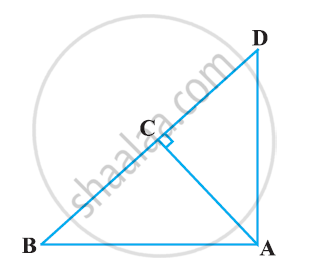
In Figure ABD is a triangle right angled at A and AC ⊥ BD. Show that AC2 = BC × DC
Identify, with reason, if the following is a Pythagorean triplet.
(5, 12, 13)
Find the side and perimeter of a square whose diagonal is 10 cm.
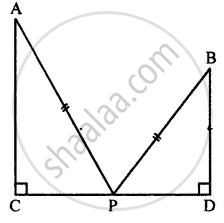
In the given figure, angle ACP = ∠BDP = 90°, AC = 12 m, BD = 9 m and PA= PB = 15 m. Find:
(i) CP
(ii) PD
(iii) CD
In the right-angled ∆LMN, ∠M = 90°. If l(LM) = 12 cm and l(LN) = 20 cm, find the length of seg MN.
Find the length of the perpendicular of a triangle whose base is 5cm and the hypotenuse is 13cm. Also, find its area.
In a triangle ABC, AC > AB, D is the midpoint BC, and AE ⊥ BC. Prove that: AB2 + AC2 = 2(AD2 + CD2)
∆ABC is right-angled at C. If AC = 5 cm and BC = 12 cm. find the length of AB.
In the figure, find AR