Advertisements
Advertisements
Question
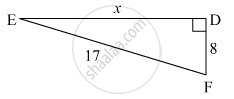
In the figure below, find the value of 'x'.
Advertisements
Solution
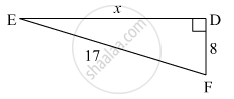
In the right-angled triangle EDF,
∠D = 90°.
Hence, side EF is the hypotenuse.
According to Pythagoras' theorem,
l(EF)2 = l(ED)2 + l(DF)2
⇒ (17)2 = (x)2 + (8)2
⇒ 289 = x2 + 64
⇒ x2 = 289 − 64
⇒ x2 = 225
⇒ `root 225`
⇒ x = 15
∴ The value of x is 15.
RELATED QUESTIONS
If the sides of a triangle are 6 cm, 8 cm and 10 cm, respectively, then determine whether the triangle is a right angle triangle or not.
If ABC is an equilateral triangle of side a, prove that its altitude = ` \frac { \sqrt { 3 } }{ 2 } a`
ABC is an isosceles triangle with AC = BC. If AB2 = 2AC2, prove that ABC is a right triangle.
Pranali and Prasad started walking to the East and to the North respectively, from the same point and at the same speed. After 2 hours distance between them was \[15\sqrt{2}\]
km. Find their speed per hour.
A ladder 13 m long rests against a vertical wall. If the foot of the ladder is 5 m from the foot of the wall, find the distance of the other end of the ladder from the ground.
In ∆ ABC, AD ⊥ BC.
Prove that AC2 = AB2 +BC2 − 2BC x BD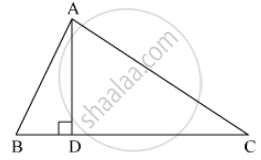
Find the length of the hypotenuse of a triangle whose other two sides are 24cm and 7cm.
A ladder 15m long reaches a window which is 9m above the ground on one side of a street. Keeping its foot at the same point, the ladder is turned to other side of the street to reach a window 12m high. Find the width of the street.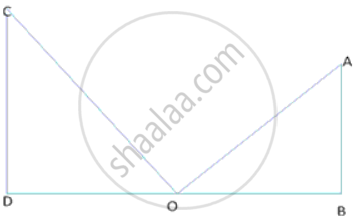
A point OI in the interior of a rectangle ABCD is joined with each of the vertices A, B, C and D. Prove that OB2 + OD2 = OC2 + OA2
If ΔABC ~ ΔPQR, `("ar" triangle "ABC")/("ar" triangle "PQR") = 9/4` and AB = 18 cm, then the length of PQ is ______.
