Advertisements
Advertisements
Question
Two poles of heights 6 m and 11 m stand vertically on a plane ground. If the distance between their feet is 12 m;
find the distance between their tips.
Advertisements
Solution
The diagram of the given problem is given below,
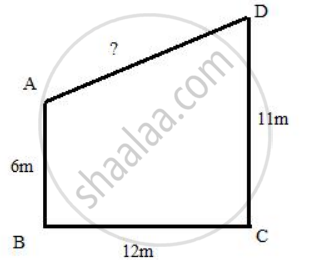
We have Pythagoras theorem which states that in a right-angled triangle, the square on the hypotenuse is equal to the sum of the squares on the remaining two sides.
Here, 11 - 6 = 5m ...( Since DC is perpendicular to BC )
base = 12 cm
Applying Pythagoras theorem we get,
hypotenuse2 = 52 + 122
h2 = 25 + 144
h2 = 169
h = 13
Therefore, the distance between the tips will be 13m.
APPEARS IN
RELATED QUESTIONS
In the given figure, ∆ABC is an obtuse triangle, obtuse-angled at B. If AD ⊥ CB (produced) prove that AC2 = AB2 + BC2 + 2BC · BD.

ABC is a right triangle right-angled at C. Let BC = a, CA = b, AB = c and let p be the length of perpendicular from C on AB, prove that
(i) cp = ab
`(ii) 1/p^2=1/a^2+1/b^2`
In the given figure, AD is a median of a triangle ABC and AM ⊥ BC. Prove that:

`"AC"^2 = "AD"^2 + "BC"."DM" + (("BC")/2)^2`
Find the side and perimeter of a square whose diagonal is 10 cm.
In ∆PQR, point S is the midpoint of side QR. If PQ = 11, PR = 17, PS = 13, find QR.
AD is drawn perpendicular to base BC of an equilateral triangle ABC. Given BC = 10 cm, find the length of AD, correct to 1 place of decimal.
In triangle ABC, AB = AC = x, BC = 10 cm and the area of the triangle is 60 cm2.
Find x.
In the following Figure ∠ACB= 90° and CD ⊥ AB, prove that CD2 = BD × AD

Triangle XYZ is right-angled at vertex Z. Calculate the length of YZ, if XY = 13 cm and XZ = 12 cm.
Show that the triangle ABC is a right-angled triangle; if: AB = 9 cm, BC = 40 cm and AC = 41 cm
Find the Pythagorean triplet from among the following set of numbers.
2, 4, 5
The sides of the triangle are given below. Find out which one is the right-angled triangle?
1.5, 1.6, 1.7
A point OI in the interior of a rectangle ABCD is joined with each of the vertices A, B, C and D. Prove that OB2 + OD2 = OC2 + OA2
In the given figure. PQ = PS, P =R = 90°. RS = 20 cm and QR = 21 cm. Find the length of PQ correct to two decimal places.
PQR is an isosceles triangle with PQ = PR = 10 cm and QR = 12 cm. Find the length of the perpendicular from P to QR.
A man goes 18 m due east and then 24 m due north. Find the distance of his current position from the starting point?
From given figure, In ∆ABC, If AC = 12 cm, then AB = ?

Activity: From given figure, In ∆ABC, ∠ABC = 90°, ∠ACB = 30°
∴ ∠BAC = `square`
∴ ∆ABC is 30° – 60° – 90° triangle.
∴ In ∆ABC by property of 30° – 60° – 90° triangle.
∴ AB = `1/2` AC and `square` = `sqrt(3)/2` AC
∴ `square` = `1/2 xx 12` and BC = `sqrt(3)/2 xx 12`
∴ `square` = 6 and BC = `6sqrt(3)`
Sides AB and BE of a right triangle, right-angled at B are of lengths 16 cm and 8 cm respectively. The length of the side of largest square FDGB that can be inscribed in the triangle ABE is ______.

Two squares having same perimeter are congruent.
Jiya walks 6 km due east and then 8 km due north. How far is she from her starting place?
