Advertisements
Advertisements
Question
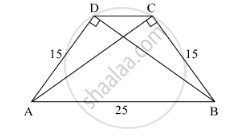
In a trapezium ABCD, seg AB || seg DC seg BD ⊥ seg AD, seg AC ⊥ seg BC, If AD = 15, BC = 15 and AB = 25. Find A(▢ABCD)
Advertisements
Solution

According to Pythagoras theorem,
In ∆ADB
\[{AB}^2 = {AD}^2 + {DB}^2 \]
\[ \Rightarrow \left( 25 \right)^2 = \left( 15 \right)^2 + {BD}^2 \]
\[ \Rightarrow 625 = 225 + {BD}^2 \]
\[ \Rightarrow {BD}^2 = 625 - 225\]
\[ \Rightarrow {BD}^2 = 400\]
\[ \Rightarrow BD = 20\]
Now,
Also,
\[\text{Area of the triangle} = \frac{1}{2} \times \text{base} \times \text{height}\]
\[ \Rightarrow 150 = \frac{1}{2} \times 25 \times DP\]
\[ \Rightarrow DP = \frac{300}{25}\]
\[ \Rightarrow DP = 12\]
According to Pythagoras theorem,
In ∆ADP
\[ \Rightarrow \left( 15 \right)^2 = \left( 12 \right)^2 + {AP}^2 \]
\[ \Rightarrow 225 = 144 + {AP}^2 \]
\[ \Rightarrow {AP}^2 = 225 - 144\]
\[ \Rightarrow {AP}^2 = 81\]
\[ \Rightarrow AP = 9\]
\[ = \frac{1}{2} \times \left( 25 + 7 \right) \times 12\]
\[ = \frac{1}{2} \times 32 \times 12\]
\[ = 32 \times 6\]
= 192 sq . units
Hence, A(▢ABCD) = 192 sq. units.
RELATED QUESTIONS
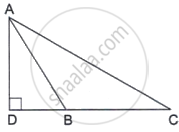
In the given figure, ∆ABC is an obtuse triangle, obtuse-angled at B. If AD ⊥ CB (produced) prove that AC2 = AB2 + BC2 + 2BC · BD.
If ABC is an equilateral triangle of side a, prove that its altitude = ` \frac { \sqrt { 3 } }{ 2 } a`
ABCD is a rhombus. Prove that AB2 + BC2 + CD2 + DA2= AC2 + BD2
ABC is an equilateral triangle of side 2a. Find each of its altitudes.
A ladder 10 m long reaches a window 8 m above the ground. Find the distance of the foot of the ladder from base of the wall.
Find the side and perimeter of a square whose diagonal is 10 cm.
In ∆PQR, point S is the midpoint of side QR. If PQ = 11, PR = 17, PS = 13, find QR.
ABC is a triangle, right-angled at B. M is a point on BC.
Prove that: AM2 + BC2 = AC2 + BM2
Diagonals of rhombus ABCD intersect each other at point O.
Prove that: OA2 + OC2 = 2AD2 - `"BD"^2/2`
In a rectangle ABCD,
prove that: AC2 + BD2 = AB2 + BC2 + CD2 + DA2.
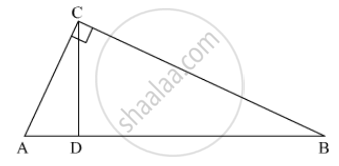
In Fig. 3, ∠ACB = 90° and CD ⊥ AB, prove that CD2 = BD x AD.
Find the Pythagorean triplet from among the following set of numbers.
4, 5, 6
AD is perpendicular to the side BC of an equilateral ΔABC. Prove that 4AD2 = 3AB2.
In a triangle ABC right angled at C, P and Q are points of sides CA and CB respectively, which divide these sides the ratio 2 : 1.
Prove that: 9BP2 = 9BC2 + 4AC2
PQR is an isosceles triangle with PQ = PR = 10 cm and QR = 12 cm. Find the length of the perpendicular from P to QR.
The perpendicular PS on the base QR of a ∆PQR intersects QR at S, such that QS = 3 SR. Prove that 2PQ2 = 2PR2 + QR2
The perimeters of two similar triangles ABC and PQR are 60 cm and 36 cm respectively. If PQ = 9 cm, then AB equals ______.
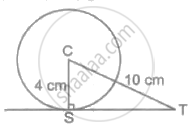
In the adjoining figure, a tangent is drawn to a circle of radius 4 cm and centre C, at the point S. Find the length of the tangent ST, if CT = 10 cm.
The top of a broken tree touches the ground at a distance of 12 m from its base. If the tree is broken at a height of 5 m from the ground then the actual height of the tree is ______.
Jiya walks 6 km due east and then 8 km due north. How far is she from her starting place?
