Advertisements
Advertisements
Question
In a square PQRS of side 5 cm, A, B, C and D are points on sides PQ, QR, RS and SP respectively such as PA = PD = RB = RC = 2 cm. Prove that ABCD is a rectangle. Also, find the area and perimeter of the rectangle.
Advertisements
Solution
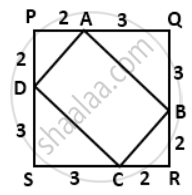
In ΔAPD, ∠P = 90°
∴ AD2 = AP2 + PD2
= 22 + 22
= 4 + 4
= 8
⇒ AD = `2sqrt(2)"cm"`
Similarly, we can prove that in ΔBRC,
BC = `2sqrt(2)"cm"`
∴ AD = BC ....(i)
In ΔAQB, ∠Q = 90°
∴ AB2 = AQ2 + BQ2
= 32 + 32
= 9 + 9
= 18
⇒ AB = `3sqrt(2)"cm"`
Similarly, we can prove that in ΔCSD,
CD = `3sqrt(2)"cm"`
∴ AB = CD ....(ii)
|Again, in ΔAPD,
AP = PD
⇒ ∠PAD = ∠PDA = 45°
Also, in ΔAQB,
AQ = BQ
⇒ ∠QAB = ∠QBA = 45°
Now, ∠PAD + ∠DAB + ∠QAB = 180°
⇒ 45° + ∠DAB + 45° = 180°
⇒ ∠DAB = 90°
Similarly, we can prove that ∠ABC, ∠BCD and ∠ADC are 90° each.
Thus, ABCD is a rectangle as opposite as opposite sides are equal and each angle is 90°.
Now,
Area of a rectangle ABCD
= AD x AB
= `2sqrt(2) xx 3sqrt(2)`
= 12cm2
Perimeter of a rectangle ABCD
= AB + BC + CD + AD
= `2sqrt(2) + 3sqrt(2) + 2sqrt(2) + 3sqrt(2)`
= `10sqrt(2)"cm"`.
APPEARS IN
RELATED QUESTIONS
In figure, ∠B of ∆ABC is an acute angle and AD ⊥ BC, prove that AC2 = AB2 + BC2 – 2BC × BD
ABCD is a rhombus. Prove that AB2 + BC2 + CD2 + DA2= AC2 + BD2
From a point O in the interior of a ∆ABC, perpendicular OD, OE and OF are drawn to the sides BC, CA and AB respectively. Prove
that :
`(i) AF^2 + BD^2 + CE^2 = OA^2 + OB^2 + OC^2 – OD^2 – OE^2 – OF^2`
`(ii) AF^2 + BD^2 + CE^2 = AE^2 + CD^2 + BF^2`
Sides of triangle are given below. Determine it is a right triangle or not? In case of a right triangle, write the length of its hypotenuse. 50 cm, 80 cm, 100 cm
ABC is an isosceles triangle with AC = BC. If AB2 = 2AC2, prove that ABC is a right triangle.
The perpendicular from A on side BC of a Δ ABC intersects BC at D such that DB = 3CD . Prove that 2AB2 = 2AC2 + BC2.

Prove that the points A(0, −1), B(−2, 3), C(6, 7) and D(8, 3) are the vertices of a rectangle ABCD?
In the figure: ∠PSQ = 90o, PQ = 10 cm, QS = 6 cm and RQ = 9 cm. Calculate the length of PR.
In triangle ABC, given below, AB = 8 cm, BC = 6 cm and AC = 3 cm. Calculate the length of OC.

In Fig. 3, ∠ACB = 90° and CD ⊥ AB, prove that CD2 = BD x AD.

In the right-angled ∆LMN, ∠M = 90°. If l(LM) = 12 cm and l(LN) = 20 cm, find the length of seg MN.
The top of a ladder of length 15 m reaches a window 9 m above the ground. What is the distance between the base of the wall and that of the ladder?
The sides of the triangle are given below. Find out which one is the right-angled triangle?
11, 60, 61
A right triangle has hypotenuse p cm and one side q cm. If p - q = 1, find the length of third side of the triangle.
The foot of a ladder is 6m away from a wall and its top reaches a window 8m above the ground. If the ladder is shifted in such a way that its foot is 8m away from the wall to what height does its tip reach?
In a triangle ABC, AC > AB, D is the midpoint BC, and AE ⊥ BC. Prove that: AB2 + AC2 = 2AD2 + `(1)/(2)"BC"^2`
From the given figure, in ∆ABQ, if AQ = 8 cm, then AB =?

Sides AB and BE of a right triangle, right-angled at B are of lengths 16 cm and 8 cm respectively. The length of the side of largest square FDGB that can be inscribed in the triangle ABE is ______.

Two angles are said to be ______, if they have equal measures.
If the hypotenuse of one right triangle is equal to the hypotenuse of another right triangle, then the triangles are congruent.
