Advertisements
Advertisements
प्रश्न
In a square PQRS of side 5 cm, A, B, C and D are points on sides PQ, QR, RS and SP respectively such as PA = PD = RB = RC = 2 cm. Prove that ABCD is a rectangle. Also, find the area and perimeter of the rectangle.
Advertisements
उत्तर
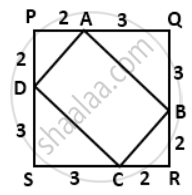
In ΔAPD, ∠P = 90°
∴ AD2 = AP2 + PD2
= 22 + 22
= 4 + 4
= 8
⇒ AD = `2sqrt(2)"cm"`
Similarly, we can prove that in ΔBRC,
BC = `2sqrt(2)"cm"`
∴ AD = BC ....(i)
In ΔAQB, ∠Q = 90°
∴ AB2 = AQ2 + BQ2
= 32 + 32
= 9 + 9
= 18
⇒ AB = `3sqrt(2)"cm"`
Similarly, we can prove that in ΔCSD,
CD = `3sqrt(2)"cm"`
∴ AB = CD ....(ii)
|Again, in ΔAPD,
AP = PD
⇒ ∠PAD = ∠PDA = 45°
Also, in ΔAQB,
AQ = BQ
⇒ ∠QAB = ∠QBA = 45°
Now, ∠PAD + ∠DAB + ∠QAB = 180°
⇒ 45° + ∠DAB + 45° = 180°
⇒ ∠DAB = 90°
Similarly, we can prove that ∠ABC, ∠BCD and ∠ADC are 90° each.
Thus, ABCD is a rectangle as opposite as opposite sides are equal and each angle is 90°.
Now,
Area of a rectangle ABCD
= AD x AB
= `2sqrt(2) xx 3sqrt(2)`
= 12cm2
Perimeter of a rectangle ABCD
= AB + BC + CD + AD
= `2sqrt(2) + 3sqrt(2) + 2sqrt(2) + 3sqrt(2)`
= `10sqrt(2)"cm"`.
APPEARS IN
संबंधित प्रश्न
ABCD is a rectangle whose three vertices are B (4, 0), C(4, 3) and D(0,3). The length of one of its diagonals is
(A) 5
(B) 4
(C) 3
(D) 25
In the given figure, ∆ABC is an obtuse triangle, obtuse-angled at B. If AD ⊥ CB (produced) prove that AC2 = AB2 + BC2 + 2BC · BD.

If ABC is an equilateral triangle of side a, prove that its altitude = ` \frac { \sqrt { 3 } }{ 2 } a`
In a right triangle ABC right-angled at C, P and Q are the points on the sides CA and CB respectively, which divide these sides in the ratio 2 : 1. Prove that
`(i) 9 AQ^2 = 9 AC^2 + 4 BC^2`
`(ii) 9 BP^2 = 9 BC^2 + 4 AC^2`
`(iii) 9 (AQ^2 + BP^2 ) = 13 AB^2`
In Figure, ABD is a triangle right angled at A and AC ⊥ BD. Show that AD2 = BD × CD

Prove that the points A(0, −1), B(−2, 3), C(6, 7) and D(8, 3) are the vertices of a rectangle ABCD?
Identify, with reason, if the following is a Pythagorean triplet.
(10, 24, 27)
In the following figure, AD is perpendicular to BC and D divides BC in the ratio 1: 3.
Prove that : 2AC2 = 2AB2 + BC2
In the figure, given below, AD ⊥ BC.
Prove that: c2 = a2 + b2 - 2ax.
In a rectangle ABCD,
prove that: AC2 + BD2 = AB2 + BC2 + CD2 + DA2.
Prove that `(sin θ + cosec θ)^2 + (cos θ + sec θ)^2 = 7 + tan^2 θ + cot^2 θ`.
In the given figure, BL and CM are medians of a ∆ABC right-angled at A. Prove that 4 (BL2 + CM2) = 5 BC2.
In the given figure, AD = 13 cm, BC = 12 cm, AB = 3 cm and angle ACD = angle ABC = 90°. Find the length of DC.

In the right-angled ∆PQR, ∠ P = 90°. If l(PQ) = 24 cm and l(PR) = 10 cm, find the length of seg QR.
In a right-angled triangle PQR, right-angled at Q, S and T are points on PQ and QR respectively such as PT = SR = 13 cm, QT = 5 cm and PS = TR. Find the length of PQ and PS.
If in a ΔPQR, PR2 = PQ2 + QR2, then the right angle of ∆PQR is at the vertex ________
In a right angled triangle, the hypotenuse is the greatest side
The perimeters of two similar triangles ABC and PQR are 60 cm and 36 cm respectively. If PQ = 9 cm, then AB equals ______.
Sides AB and BE of a right triangle, right-angled at B are of lengths 16 cm and 8 cm respectively. The length of the side of largest square FDGB that can be inscribed in the triangle ABE is ______.

If S is a point on side PQ of a ΔPQR such that PS = QS = RS, then ______.
