Advertisements
Advertisements
प्रश्न
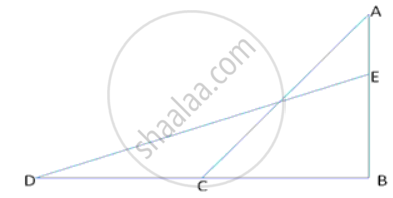
The foot of a ladder is 6m away from a wall and its top reaches a window 8m above the ground. If the ladder is shifted in such a way that its foot is 8m away from the wall to what height does its tip reach?
Advertisements
उत्तर
Let AC be the ladder and A be the position of the window which is 8m above the ground.
Now, the ladder is shifted such that its foot is at point D which is 8m away from the wall.
∴ BD = 8m
At this instance, the position of the ladder is DE.
∴ AC = DE
Using Pythagoras theorem in ΔABC,
AC2 = AB2 + BC2
= (8m)2 + (6m)2
= 64m2 + 36m2
= 100m2
= (10m)2
∴ AC = DE = 10m
Using Pythagoras theorem in ΔDBE,
BE2 = DE2 - BD2
⇒ BE2 = (10m)2 - (8m)2
= 100m2 - 64m2
= 36m2
= (6m)2
⇒ BE = 6m
Thus, the required height up to which the ladder reaches is 6m above the ground.
APPEARS IN
संबंधित प्रश्न
From a point O in the interior of a ∆ABC, perpendicular OD, OE and OF are drawn to the sides BC, CA and AB respectively. Prove
that :
`(i) AF^2 + BD^2 + CE^2 = OA^2 + OB^2 + OC^2 – OD^2 – OE^2 – OF^2`
`(ii) AF^2 + BD^2 + CE^2 = AE^2 + CD^2 + BF^2`
Sides of triangles are given below. Determine it is a right triangles? In case of a right triangle, write the length of its hypotenuse. 3 cm, 8 cm, 6 cm
An aeroplane leaves an airport and flies due north at a speed of 1,000 km per hour. At the same time, another aeroplane leaves the same airport and flies due west at a speed of 1,200 km per hour. How far apart will be the two planes after `1 1/2` hours?
A 15 m long ladder reached a window 12 m high from the ground on placing it against a wall at a distance a. Find the distance of the foot of the ladder from the wall.

Which of the following can be the sides of a right triangle?
2 cm, 2 cm, 5 cm
In the case of right-angled triangles, identify the right angles.
In ∆ABC, ∠BAC = 90°, seg BL and seg CM are medians of ∆ABC. Then prove that:
4(BL2 + CM2) = 5 BC2

The given figure shows a quadrilateral ABCD in which AD = 13 cm, DC = 12 cm, BC = 3 cm and ∠ABD = ∠BCD = 90o. Calculate the length of AB.
In equilateral Δ ABC, AD ⊥ BC and BC = x cm. Find, in terms of x, the length of AD.
Find the side of the square whose diagonal is `16sqrt(2)` cm.
The sides of the triangle are given below. Find out which one is the right-angled triangle?
40, 20, 30
The length of the diagonals of rhombus are 24cm and 10cm. Find each side of the rhombus.
In a triangle ABC, AC > AB, D is the midpoint BC, and AE ⊥ BC. Prove that: AC2 - AB2 = 2BC x ED
A point OI in the interior of a rectangle ABCD is joined with each of the vertices A, B, C and D. Prove that OB2 + OD2 = OC2 + OA2
AD is perpendicular to the side BC of an equilateral ΔABC. Prove that 4AD2 = 3AB2.
PQR is an isosceles triangle with PQ = PR = 10 cm and QR = 12 cm. Find the length of the perpendicular from P to QR.
∆ABC is right-angled at C. If AC = 5 cm and BC = 12 cm. find the length of AB.
A man goes 18 m due east and then 24 m due north. Find the distance of his current position from the starting point?
In the given figure, AD is a median of a triangle ABC and AM ⊥ BC. Prove that:

(i) `"AC"^2 = "AD"^2 + "BC"."DM" + (("BC")/2)^2`
(ii) `"AB"^2 = "AD"^2 - "BC"."DM" + (("BC")/2)^2`
(iii) `"AC"^2 + "AB"^2 = 2"AD"^2 + 1/2"BC"^2`
In the adjoining figure, a tangent is drawn to a circle of radius 4 cm and centre C, at the point S. Find the length of the tangent ST, if CT = 10 cm.

Two squares are congruent, if they have same ______.
