Advertisements
Advertisements
Question
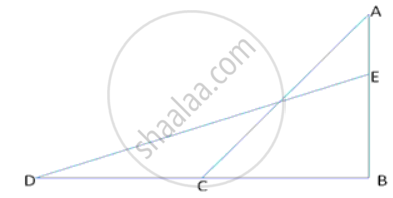
The foot of a ladder is 6m away from a wall and its top reaches a window 8m above the ground. If the ladder is shifted in such a way that its foot is 8m away from the wall to what height does its tip reach?
Advertisements
Solution
Let AC be the ladder and A be the position of the window which is 8m above the ground.
Now, the ladder is shifted such that its foot is at point D which is 8m away from the wall.
∴ BD = 8m
At this instance, the position of the ladder is DE.
∴ AC = DE
Using Pythagoras theorem in ΔABC,
AC2 = AB2 + BC2
= (8m)2 + (6m)2
= 64m2 + 36m2
= 100m2
= (10m)2
∴ AC = DE = 10m
Using Pythagoras theorem in ΔDBE,
BE2 = DE2 - BD2
⇒ BE2 = (10m)2 - (8m)2
= 100m2 - 64m2
= 36m2
= (6m)2
⇒ BE = 6m
Thus, the required height up to which the ladder reaches is 6m above the ground.
APPEARS IN
RELATED QUESTIONS
ABC is an isosceles triangle right angled at C. Prove that AB2 = 2AC2
PQR is a triangle right angled at P. If PQ = 10 cm and PR = 24 cm, find QR.
The diagonals of a rhombus measure 16 cm and 30 cm. Find its perimeter.
Identify, with reason, if the following is a Pythagorean triplet.
(10, 24, 27)
A ladder 13 m long rests against a vertical wall. If the foot of the ladder is 5 m from the foot of the wall, find the distance of the other end of the ladder from the ground.
In ΔABC, Find the sides of the triangle, if:
- AB = ( x - 3 ) cm, BC = ( x + 4 ) cm and AC = ( x + 6 ) cm
- AB = x cm, BC = ( 4x + 4 ) cm and AC = ( 4x + 5) cm
In the figure, given below, AD ⊥ BC.
Prove that: c2 = a2 + b2 - 2ax.
Find the side of the square whose diagonal is `16sqrt(2)` cm.
Prove that (1 + cot A - cosec A ) (1 + tan A + sec A) = 2
A boy first goes 5 m due north and then 12 m due east. Find the distance between the initial and the final position of the boy.
Find the Pythagorean triplet from among the following set of numbers.
4, 5, 6
A man goes 10 m due east and then 24 m due north. Find the distance from the straight point.
Two poles of height 9m and 14m stand on a plane ground. If the distance between their 12m, find the distance between their tops.
The perpendicular PS on the base QR of a ∆PQR intersects QR at S, such that QS = 3 SR. Prove that 2PQ2 = 2PR2 + QR2
In a right angled triangle, the hypotenuse is the greatest side
In triangle ABC, line I, is a perpendicular bisector of BC.
If BC = 12 cm, SM = 8 cm, find CS
The hypotenuse of a right angled triangle of sides 12 cm and 16 cm is __________
In a right angled triangle, if length of hypotenuse is 25 cm and height is 7 cm, then what is the length of its base?
In ∆PQR, PD ⊥ QR such that D lies on QR. If PQ = a, PR = b, QD = c and DR = d, prove that (a + b)(a – b) = (c + d)(c – d).
Two trees 7 m and 4 m high stand upright on a ground. If their bases (roots) are 4 m apart, then the distance between their tops is ______.
