Advertisements
Advertisements
Question
AD is drawn perpendicular to base BC of an equilateral triangle ABC. Given BC = 10 cm, find the length of AD, correct to 1 place of decimal.
Advertisements
Solution
Since ABC is an equilateral triangle therefore, all the sides of the triangle are of the same measure and the perpendicular AD will divide BC into two equal parts.
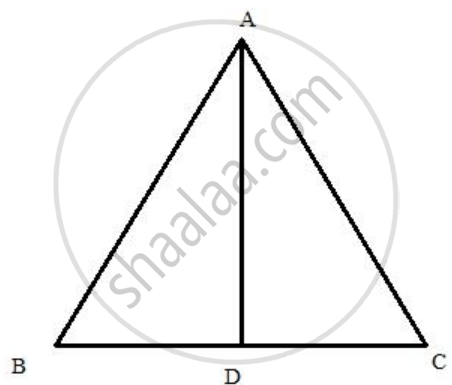
Pythagoras theorem states that in a right-angled triangle, the square on the hypotenuse is equal to the sum of the squares on the remaining two sides.
Here, we consider the ΔABD and applying Pythagoras theorem we get,
AB2 = AD2 + BD2
AD2 = 102 - 52 ......[ Given, BC = 10 cm = AB, BD = `1/2` BC ]
AD2 = 100 - 25
AD2 = 75
AD = 8.7
Therefore, the length of AD is 8.7 cm
APPEARS IN
RELATED QUESTIONS
In a ∆ABC, AD ⊥ BC and AD2 = BC × CD. Prove ∆ABC is a right triangle
The perpendicular AD on the base BC of a ∆ABC intersects BC at D so that DB = 3 CD. Prove that `2"AB"^2 = 2"AC"^2 + "BC"^2`
In an equilateral triangle, prove that three times the square of one side is equal to four times the square of one of its altitudes.
PQR is a triangle right angled at P. If PQ = 10 cm and PR = 24 cm, find QR.
Prove that the points A(0, −1), B(−2, 3), C(6, 7) and D(8, 3) are the vertices of a rectangle ABCD?
Identify, with reason, if the following is a Pythagorean triplet.
(11, 60, 61)

In ΔMNP, ∠MNP = 90˚, seg NQ ⊥ seg MP, MQ = 9, QP = 4, find NQ.
Two poles of heights 6 m and 11 m stand vertically on a plane ground. If the distance between their feet is 12 m;
find the distance between their tips.
Prove that in a right angle triangle, the square of the hypotenuse is equal to the sum of squares of the other two sides.
Triangle PQR is right-angled at vertex R. Calculate the length of PR, if: PQ = 34 cm and QR = 33.6 cm.
A man goes 10 m due east and then 24 m due north. Find the distance from the straight point.
The foot of a ladder is 6m away from a wall and its top reaches a window 8m above the ground. If the ladder is shifted in such a way that its foot is 8m away from the wall to what height does its tip reach?
In a triangle ABC, AC > AB, D is the midpoint BC, and AE ⊥ BC. Prove that: AB2 + AC2 = 2AD2 + `(1)/(2)"BC"^2`
The perpendicular PS on the base QR of a ∆PQR intersects QR at S, such that QS = 3 SR. Prove that 2PQ2 = 2PR2 + QR2
Find the unknown side in the following triangles
Find the distance between the helicopter and the ship
From given figure, In ∆ABC, If AC = 12 cm. then AB =?

Activity: From given figure, In ∆ABC, ∠ABC = 90°, ∠ACB = 30°
∴ ∠BAC = `square`
∴ ∆ABC is 30° – 60° – 90° triangle
∴ In ∆ABC by property of 30° – 60° – 90° triangle.
∴ AB = `1/2` AC and `square` = `sqrt(3)/2` AC
∴ `square` = `1/2 xx 12` and BC = `sqrt(3)/2 xx 12`
∴ `square` = 6 and BC = `6sqrt(3)`
A right-angled triangle may have all sides equal.
Two circles having same circumference are congruent.
