English

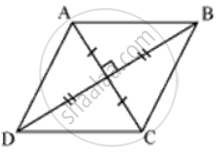
ABCD is a rhombus. Prove that AB2 + BC2 + CD2 + DA2= AC2 + BD2 - Mathematics

Advertisements
Advertisements

Question

ABCD is a rhombus. Prove that AB2 + BC2 + CD2 + DA2= AC2 + BD2

Sum
Advertisements

Solution 1

Let the diagonals AC and BD of rhombus ABCD intersect at O.

Since the diagonals of a rhombus bisect each other at right angles.

∴ ∠AOB = ∠BOC = ∠COD = ∠DOA = 90º and AO = CO, BO = OD.

Since ∆AOB is a right triangle right-angle at O.
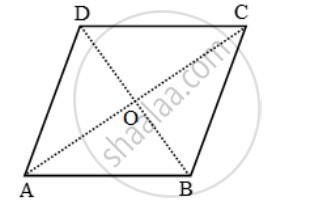
∴ AB2 = OA2 + OB2

`AB^2=(1/2AC)^2 +(1/2BD)^2 `

⇒ 4AB2 = AC2 + BD2 ….(i)

Similarly, we have

`4BC^2 = AC^2 + BD^2 ….(ii)`

`4CD^2 = AC^2 + BD^2 ….(iii)`

and,

`4AD^2 = AC^2 + BD^2 ….(iv)`

Adding all these results, we get

`4(AB^2 + BC^2 + AD^2 ) = 4(AC^2 + BD^2 )`

`⇒ AB^2 + BC^2 + AD^2 + DA^2 = AC^2 + BD^2`

shaalaa.com

Solution 2


In ΔAOB, ΔBOC, ΔCOD, ΔAOD

Applying Pythagoras theorem

AB2 = AO2 + OB2

BC2 = BO2 + OC2

CD2 = CO2 + OD2

AD2 = AO2 + OD2

Adding all these equations,

AB2 + BC2 + CD2 + AD2

= 2(AO2 + OB2 + OC2 + OD2)

= `2{("AC"/2)^2 + ("BD"/2)^2 + ("AC"/2)^2 + ("BD"/2)^2}`  ...(diagonals bisect each other)

= `2(("AC")^2/2 + ("BD")^2/2)`

= (AC)2 + (BD)2

shaalaa.com
  Is there an error in this question or solution?
Chapter 17: Pythagoras Theorem - Exercise 17.1

APPEARS IN

Frank Mathematics [English] Class 9 ICSE
Chapter 17 Pythagoras Theorem
Exercise 17.1 | Q 17

RELATED QUESTIONS

The points A(4, 7), B(p, 3) and C(7, 3) are the vertices of a  right traingle ,right-angled at B. Find the values of p.


In a right triangle ABC, right-angled at B, BC = 12 cm and AB = 5 cm. The radius of the circle inscribed in the triangle (in cm) is
(A) 4
(B) 3
(C) 2
(D) 1


A man goes 10 m due east and then 24 m due north. Find the distance from the starting point


In figure, ∠B of ∆ABC is an acute angle and AD ⊥ BC, prove that AC2 = AB2 + BC2 – 2BC × BD


Sides of triangle are given below. Determine it is a right triangle or not? In case of a right triangle, write the length of its hypotenuse. 50 cm, 80 cm, 100 cm


ABC is an equilateral triangle of side 2a. Find each of its altitudes.


Prove that the sum of the squares of the diagonals of parallelogram is equal to the sum of the squares of its sides.


Which of the following can be the sides of a right triangle?

2.5 cm, 6.5 cm, 6 cm

In the case of right-angled triangles, identify the right angles.


Identify, with reason, if the following is a Pythagorean triplet.
(11, 60, 61)


Find the length diagonal of a rectangle whose length is 35 cm and breadth is 12 cm.


In ∆ABC, AB = 10, AC = 7, BC = 9, then find the length of the median drawn from point C to side AB.


In ΔMNP, ∠MNP = 90˚, seg NQ ⊥ seg MP, MQ = 9, QP = 4, find NQ.


Triangle PQR is right-angled at vertex R. Calculate the length of PR, if: PQ = 34 cm and QR = 33.6 cm.


Is the triangle with sides 25 cm, 5 cm and 24 cm a right triangle? Give reasons for your answer.


A flag pole 18 m high casts a shadow 9.6 m long. Find the distance of the top of the pole from the far end of the shadow.


In the adjoining figure, a tangent is drawn to a circle of radius 4 cm and centre C, at the point S. Find the length of the tangent ST, if CT = 10 cm.


In an equilateral triangle PQR, prove that PS2 = 3(QS)2.


The perimeter of the rectangle whose length is 60 cm and a diagonal is 61 cm is ______.


Points A and B are on the opposite edges of a pond as shown in the following figure. To find the distance between the two points, the surveyor makes a right-angled triangle as shown. Find the distance AB.


The foot of a ladder is 6 m away from its wall and its top reaches a window 8 m above the ground. If the ladder is shifted in such a way that its foot is 8 m away from the wall, to what height does its top reach?


Share
Notifications

Englishहिंदीमराठी


      Forgot password?
Use app×