Advertisements
Advertisements
Question
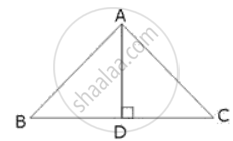
AD is perpendicular to the side BC of an equilateral ΔABC. Prove that 4AD2 = 3AB2.
Advertisements
Solution

In equilateral triangle AD ⊥ BC.
⇒ BD = DC = `"BC"/(2)` ...(In equilateral triangle altitude bisects the opposite side)
In right triangle ABD,
AB2 = AD2 + BD2
= `"AD"^2 + ("BC"/2)^2`
= `(4"AD"^2 + "BC"^2)/(4)`
= `(4"AD"^2 + "BC"^2)/(4)` ...(Since AB = BC)
⇒ 4AB2 = 4AD2 + AB2
⇒ 3AB2 = 4AD2
Hence proved..
APPEARS IN
RELATED QUESTIONS
In figure, ∠B of ∆ABC is an acute angle and AD ⊥ BC, prove that AC2 = AB2 + BC2 – 2BC × BD
ABCD is a rhombus. Prove that AB2 + BC2 + CD2 + DA2= AC2 + BD2
Sides of triangles are given below. Determine it is a right triangles? In case of a right triangle, write the length of its hypotenuse. 3 cm, 8 cm, 6 cm
PQR is a triangle right angled at P and M is a point on QR such that PM ⊥ QR. Show that PM2 = QM . MR
Which of the following can be the sides of a right triangle?
1.5 cm, 2 cm, 2.5 cm
In the case of right-angled triangles, identify the right angles.
Prove that, in a right-angled triangle, the square of the hypotenuse is equal to the sum of the square of remaining two sides.
In the given figure, point T is in the interior of rectangle PQRS, Prove that, TS2 + TQ2 = TP2 + TR2 (As shown in the figure, draw seg AB || side SR and A-T-B)

In triangle ABC, AB = AC and BD is perpendicular to AC.
Prove that: BD2 − CD2 = 2CD × AD
Diagonals of rhombus ABCD intersect each other at point O.
Prove that: OA2 + OC2 = 2AD2 - `"BD"^2/2`
Choose the correct alternative:
In right-angled triangle PQR, if hypotenuse PR = 12 and PQ = 6, then what is the measure of ∠P?
In the given figure, angle BAC = 90°, AC = 400 m, and AB = 300 m. Find the length of BC.

In the given figure, angle ACP = ∠BDP = 90°, AC = 12 m, BD = 9 m and PA= PB = 15 m. Find:
(i) CP
(ii) PD
(iii) CD

In triangle PQR, angle Q = 90°, find: PR, if PQ = 8 cm and QR = 6 cm
In the given figure, AD = 13 cm, BC = 12 cm, AB = 3 cm and angle ACD = angle ABC = 90°. Find the length of DC.

A boy first goes 5 m due north and then 12 m due east. Find the distance between the initial and the final position of the boy.
Find the Pythagorean triplet from among the following set of numbers.
3, 4, 5
PQR is an isosceles triangle with PQ = PR = 10 cm and QR = 12 cm. Find the length of the perpendicular from P to QR.
In ΔABC, if DE || BC, AD = x, DB = x – 2, AE = x + 2 and EC = x – 1, then value of x is ______.
In ∆PQR, PD ⊥ QR such that D lies on QR. If PQ = a, PR = b, QD = c and DR = d, prove that (a + b)(a – b) = (c + d)(c – d).