Advertisements
Advertisements
Question
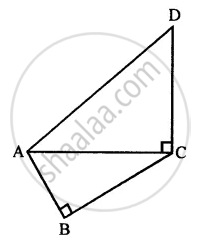
In the given figure, AD = 13 cm, BC = 12 cm, AB = 3 cm and angle ACD = angle ABC = 90°. Find the length of DC.
Advertisements
Solution
Given :
∆ ACD = ∠ABC = 90°
and AD = 13 cm, BC = 12 cm, AB = 3 cm
To find : Length of DC.

(i) In right angled ∆ ABC
AB = 3 cm, BC = 12 cm
According to Pythagoras Theorem,
(AC)2 = (AB)2 + (BC)2
(AC)2 = (3)2 + (12)2
(AC) =`sqrt(9+144)=sqrt153` cm
(ii) In right angled ∆ ACD
AD = 13 cm, AC =`sqrt153`
According to Pythagoras Theorem,
DC2 = AB2 − AC2
DC2= 169 − 153
DC = `sqrt16` = 4 cm
∴ Length of DC is 4 cm
APPEARS IN
RELATED QUESTIONS
Sides of triangle are given below. Determine it is a right triangle or not? In case of a right triangle, write the length of its hypotenuse. 7 cm, 24 cm, 25 cm
In an equilateral triangle ABC, D is a point on side BC such that BD = `1/3BC` . Prove that 9 AD2 = 7 AB2
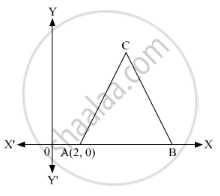
In the given figure, ∆ABC is an equilateral triangle of side 3 units. Find the coordinates of the other two vertices ?
AD is drawn perpendicular to base BC of an equilateral triangle ABC. Given BC = 10 cm, find the length of AD, correct to 1 place of decimal.
In equilateral Δ ABC, AD ⊥ BC and BC = x cm. Find, in terms of x, the length of AD.
Prove that in a right angle triangle, the square of the hypotenuse is equal to the sum of squares of the other two sides.
Find the unknown side in the following triangles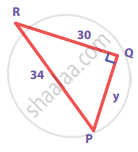
From given figure, In ∆ABC, If AC = 12 cm, then AB = ?
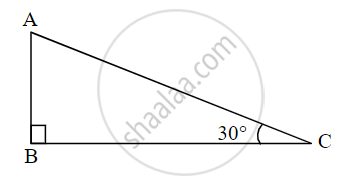
Activity: From given figure, In ∆ABC, ∠ABC = 90°, ∠ACB = 30°
∴ ∠BAC = `square`
∴ ∆ABC is 30° – 60° – 90° triangle.
∴ In ∆ABC by property of 30° – 60° – 90° triangle.
∴ AB = `1/2` AC and `square` = `sqrt(3)/2` AC
∴ `square` = `1/2 xx 12` and BC = `sqrt(3)/2 xx 12`
∴ `square` = 6 and BC = `6sqrt(3)`
The longest side of a right angled triangle is called its ______.
The foot of a ladder is 6 m away from its wall and its top reaches a window 8 m above the ground. If the ladder is shifted in such a way that its foot is 8 m away from the wall, to what height does its top reach?
