हिंदी

ABCD is a rhombus. Prove that AB2 + BC2 + CD2 + DA2= AC2 + BD2

Advertisements
Advertisements

प्रश्न

ABCD is a rhombus. Prove that AB2 + BC2 + CD2 + DA2= AC2 + BD2

योग
Advertisements

उत्तर १

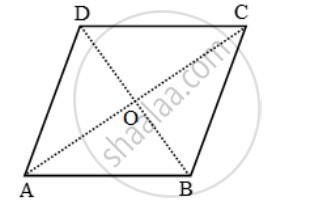
Let the diagonals AC and BD of rhombus ABCD intersect at O.

Since the diagonals of a rhombus bisect each other at right angles.

∴ ∠AOB = ∠BOC = ∠COD = ∠DOA = 90º and AO = CO, BO = OD.

Since ∆AOB is a right triangle right-angle at O.
∴ AB2 = OA2 + OB2

`AB^2=(1/2AC)^2 +(1/2BD)^2 `

⇒ 4AB2 = AC2 + BD2 ….(i)

Similarly, we have

`4BC^2 = AC^2 + BD^2 ….(ii)`

`4CD^2 = AC^2 + BD^2 ….(iii)`

and,

`4AD^2 = AC^2 + BD^2 ….(iv)`

Adding all these results, we get

`4(AB^2 + BC^2 + AD^2 ) = 4(AC^2 + BD^2 )`

`⇒ AB^2 + BC^2 + AD^2 + DA^2 = AC^2 + BD^2`

shaalaa.com

उत्तर २


In ΔAOB, ΔBOC, ΔCOD, ΔAOD

Applying Pythagoras theorem

AB2 = AO2 + OB2

BC2 = BO2 + OC2

CD2 = CO2 + OD2

AD2 = AO2 + OD2

Adding all these equations,

AB2 + BC2 + CD2 + AD2

= 2(AO2 + OB2 + OC2 + OD2)

= `2{("AC"/2)^2 + ("BD"/2)^2 + ("AC"/2)^2 + ("BD"/2)^2}`  ...(diagonals bisect each other)

= `2(("AC")^2/2 + ("BD")^2/2)`

= (AC)2 + (BD)2

shaalaa.com
  क्या इस प्रश्न या उत्तर में कोई त्रुटि है?
अध्याय 12: Pythagoras Theorem - Exercise 17.1

APPEARS IN

फ्रैंक Mathematics Part 1 [English] Class 9 ICSE
अध्याय 12 Pythagoras Theorem
Exercise 17.1 | Q 17

संबंधित प्रश्न

A ladder 10 m long reaches a window 8 m above the ground. Find the distance of the foot of the ladder from base of the wall.


An aeroplane leaves an airport and flies due north at a speed of 1,000 km per hour. At the same time, another aeroplane leaves the same airport and flies due west at a speed of 1,200 km per hour. How far apart will be the two planes after `1 1/2` hours?


Which of the following can be the sides of a right triangle?

2 cm, 2 cm, 5 cm

In the case of right-angled triangles, identify the right angles.


In ΔMNP, ∠MNP = 90˚, seg NQ ⊥ seg MP, MQ = 9, QP = 4, find NQ.


Prove that `(sin θ + cosec θ)^2 + (cos θ + sec θ)^2 = 7 + tan^2 θ + cot^2 θ`.


In ∆ ABC, AD ⊥ BC.
Prove that  AC2 = AB2 +BC2 − 2BC x BD


In the given figure, angle BAC = 90°, AC = 400 m, and AB = 300 m. Find the length of BC.


In the given figure, angle ACP = ∠BDP = 90°, AC = 12 m, BD = 9 m and PA= PB = 15 m. Find:
(i) CP
(ii) PD
(iii) CD


Use the information given in the figure to find the length AD.


Find the Pythagorean triplet from among the following set of numbers.

3, 4, 5


In a triangle ABC, AC > AB, D is the midpoint BC, and AE ⊥ BC. Prove that: AB2 = AD2 - BC x CE + `(1)/(4)"BC"^2`


AD is perpendicular to the side BC of an equilateral ΔABC. Prove that 4AD2 = 3AB2.


An isosceles triangle has equal sides each 13 cm and a base 24 cm in length. Find its height


In the figure, find AR


In ΔABC, if DE || BC, AD = x, DB = x – 2, AE = x + 2 and EC = x – 1, then value of x is ______.


Sides AB and BE of a right triangle, right-angled at B are of lengths 16 cm and 8 cm respectively. The length of the side of largest square FDGB that can be inscribed in the triangle ABE is ______.


In a quadrilateral ABCD, ∠A + ∠D = 90°. Prove that AC2 + BD2 = AD2 + BC2 

[Hint: Produce AB and DC to meet at E.]


In a triangle, sum of squares of two sides is equal to the square of the third side.


If the hypotenuse of one right triangle is equal to the hypotenuse of another right triangle, then the triangles are congruent.


The foot of a ladder is 6 m away from its wall and its top reaches a window 8 m above the ground. If the ladder is shifted in such a way that its foot is 8 m away from the wall, to what height does its top reach?


Share
Notifications

Englishहिंदीमराठी


      Forgot password?
Use app×