मराठी

ABCD is a rhombus. Prove that AB2 + BC2 + CD2 + DA2= AC2 + BD2 - Mathematics

Advertisements
Advertisements

प्रश्न

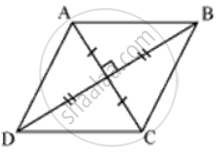
ABCD is a rhombus. Prove that AB2 + BC2 + CD2 + DA2= AC2 + BD2

बेरीज
Advertisements

उत्तर १

Let the diagonals AC and BD of rhombus ABCD intersect at O.

Since the diagonals of a rhombus bisect each other at right angles.

∴ ∠AOB = ∠BOC = ∠COD = ∠DOA = 90º and AO = CO, BO = OD.

Since ∆AOB is a right triangle right-angle at O.
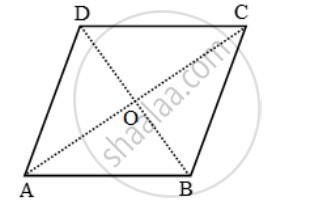
∴ AB2 = OA2 + OB2

`AB^2=(1/2AC)^2 +(1/2BD)^2 `

⇒ 4AB2 = AC2 + BD2 ….(i)

Similarly, we have

`4BC^2 = AC^2 + BD^2 ….(ii)`

`4CD^2 = AC^2 + BD^2 ….(iii)`

and,

`4AD^2 = AC^2 + BD^2 ….(iv)`

Adding all these results, we get

`4(AB^2 + BC^2 + AD^2 ) = 4(AC^2 + BD^2 )`

`⇒ AB^2 + BC^2 + AD^2 + DA^2 = AC^2 + BD^2`

shaalaa.com

उत्तर २


In ΔAOB, ΔBOC, ΔCOD, ΔAOD

Applying Pythagoras theorem

AB2 = AO2 + OB2

BC2 = BO2 + OC2

CD2 = CO2 + OD2

AD2 = AO2 + OD2

Adding all these equations,

AB2 + BC2 + CD2 + AD2

= 2(AO2 + OB2 + OC2 + OD2)

= `2{("AC"/2)^2 + ("BD"/2)^2 + ("AC"/2)^2 + ("BD"/2)^2}`  ...(diagonals bisect each other)

= `2(("AC")^2/2 + ("BD")^2/2)`

= (AC)2 + (BD)2

shaalaa.com
  या प्रश्नात किंवा उत्तरात काही त्रुटी आहे का?
पाठ 17: Pythagoras Theorem - Exercise 17.1

APPEARS IN

फ्रँक Mathematics [English] Class 9 ICSE
पाठ 17 Pythagoras Theorem
Exercise 17.1 | Q 17

संबंधित प्रश्‍न

Sides of triangle are given below. Determine it is a right triangle or not? In case of a right triangle, write the length of its hypotenuse. 7 cm, 24 cm, 25 cm


PQR is a triangle right angled at P and M is a point on QR such that PM ⊥ QR. Show that PM2 = QM . MR


A ladder 10 m long reaches a window 8 m above the ground. Find the distance of the foot of the ladder from base of the wall.


The perimeter of a triangle with vertices (0, 4), (0, 0) and (3, 0) is

(A)\[7 + \sqrt{5}\]
(B) 5
(C) 10
(D) 12


Identify, with reason, if the following is a Pythagorean triplet.
(24, 70, 74)


Find the length of the hypotenuse of a right angled triangle if remaining sides are 9 cm and 12 cm.


In ∆ABC, ∠BAC = 90°, seg BL and seg CM are medians of ∆ABC. Then prove that:
4(BL+ CM2) = 5 BC2


In the given figure, AB//CD, AB = 7 cm, BD = 25 cm and CD = 17 cm;
find the length of side BC.


In triangle ABC, given below, AB = 8 cm, BC = 6 cm and AC = 3 cm. Calculate the length of OC.


In the figure, given below, AD ⊥ BC.
Prove that: c2 = a2 + b2 - 2ax.


Find the value of (sin2 33 + sin2 57°)


In ∆ ABC, AD ⊥ BC.
Prove that  AC2 = AB2 +BC2 − 2BC x BD


In the given figure, angle ACP = ∠BDP = 90°, AC = 12 m, BD = 9 m and PA= PB = 15 m. Find:
(i) CP
(ii) PD
(iii) CD


A boy first goes 5 m due north and then 12 m due east. Find the distance between the initial and the final position of the boy.


A man goes 10 m due east and then 24 m due north. Find the distance from the straight point.


In an equilateral triangle ABC, the side BC is trisected at D. Prove that 9 AD2 = 7 AB2.


From a point O in the interior of aΔABC, perpendicular OD, OE and OF are drawn to the sides BC, CA and AB respectively. Prove that: AF2 + BD2 + CE= OA2 + OB2 + OC2 - OD2 - OE2 - OF2


In the adjoining figure, a tangent is drawn to a circle of radius 4 cm and centre C, at the point S. Find the length of the tangent ST, if CT = 10 cm.


The longest side of a right angled triangle is called its ______.


Two rectangles are congruent, if they have same ______ and ______.


Share
Notifications

Englishहिंदीमराठी


      Forgot password?
Use app×