Advertisements
Advertisements
प्रश्न
In triangle PQR, angle Q = 90°, find: PQ, if PR = 34 cm and QR = 30 cm
Advertisements
उत्तर
Given:
PR = 34 cm
QR = 30 cm
PQ =?
∠PQR = 90°
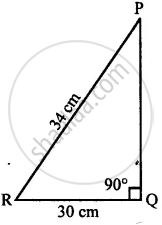
According to Pythagoras Theorem,
(PR)2 = (PQ)2 + (QR)2
(34)2 = PQ2 + (30)2
1156 = PQ2 + 900
1156 − 900 = PQ2
256 = PQ2
∴ PQ = `sqrt256` = 16 cm
APPEARS IN
संबंधित प्रश्न
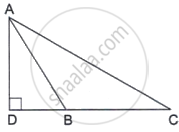
In the given figure, ∆ABC is an obtuse triangle, obtuse-angled at B. If AD ⊥ CB (produced) prove that AC2 = AB2 + BC2 + 2BC · BD.
In an equilateral triangle, prove that three times the square of one side is equal to four times the square of one of its altitudes.
In the given figure, AD is a median of a triangle ABC and AM ⊥ BC. Prove that:
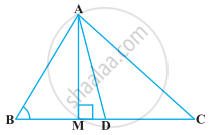
`"AC"^2 = "AD"^2 + "BC"."DM" + (("BC")/2)^2`
Which of the following can be the sides of a right triangle?
1.5 cm, 2 cm, 2.5 cm
In the case of right-angled triangles, identify the right angles.
Find the perimeter of the rectangle whose length is 40 cm and a diagonal is 41 cm.
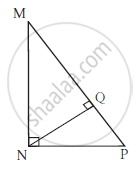
In ΔMNP, ∠MNP = 90˚, seg NQ ⊥ seg MP, MQ = 9, QP = 4, find NQ.
In the given figure, ∠B = 90°, XY || BC, AB = 12 cm, AY = 8cm and AX : XB = 1 : 2 = AY : YC.
Find the lengths of AC and BC.

In a rectangle ABCD,
prove that: AC2 + BD2 = AB2 + BC2 + CD2 + DA2.
Find the side of the square whose diagonal is `16sqrt(2)` cm.
In ∆PQR, PD ⊥ QR such that D lies on QR. If PQ = a, PR = b, QD = c and DR = d, prove that (a + b)(a – b) = (c + d)(c – d).
