Advertisements
Advertisements
प्रश्न
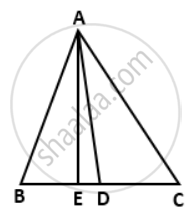
In a triangle ABC, AC > AB, D is the midpoint BC, and AE ⊥ BC. Prove that: AB2 = AD2 - BC x CE + `(1)/(4)"BC"^2`
Advertisements
उत्तर

We have ∠AED = 90°
∴ ∠ADE < 90° and ∠ADC > 90°
i.e. ∠ADE is acute and ∠ADC is obtuse.
In ΔABD, ∠ADE is an acute angle.
∴ AB2 = AD2 + BD2 - 2 x BD x DE
⇒ AB2 = AD2 + `(1/2"BC")^2 - 2 xx (1)/(2)"BC" xx "DE"`
⇒ AB2 = AD2 + `(1)/(4)"BC"^2 - "BC" xx "DE"`
⇒ AB2 = AD2 + BC x DE - `(1)/(4)"BC"^2`. ....(ii)
APPEARS IN
संबंधित प्रश्न
If ABC is an equilateral triangle of side a, prove that its altitude = ` \frac { \sqrt { 3 } }{ 2 } a`
P and Q are the mid-points of the sides CA and CB respectively of a ∆ABC, right angled at C. Prove that:
`(i) 4AQ^2 = 4AC^2 + BC^2`
`(ii) 4BP^2 = 4BC^2 + AC^2`
`(iii) (4AQ^2 + BP^2 ) = 5AB^2`
In a right triangle ABC right-angled at C, P and Q are the points on the sides CA and CB respectively, which divide these sides in the ratio 2 : 1. Prove that
`(i) 9 AQ^2 = 9 AC^2 + 4 BC^2`
`(ii) 9 BP^2 = 9 BC^2 + 4 AC^2`
`(iii) 9 (AQ^2 + BP^2 ) = 13 AB^2`
In Figure ABD is a triangle right angled at A and AC ⊥ BD. Show that AC2 = BC × DC

Nazima is fly fishing in a stream. The tip of her fishing rod is 1.8 m above the surface of the water and the fly at the end of the string rests on the water 3.6 m away and 2.4 m from a point directly under the tip of the rod. Assuming that her string (from the tip of her rod to the fly) is taut, ho much string does she have out (see Figure)? If she pulls in the string at the rate of 5 cm per second, what will be the horizontal distance of the fly from her after 12 seconds?

Identify, with reason, if the following is a Pythagorean triplet.
(5, 12, 13)
Identify, with reason, if the following is a Pythagorean triplet.
(10, 24, 27)
In ∆ABC, ∠BAC = 90°, seg BL and seg CM are medians of ∆ABC. Then prove that:
4(BL2 + CM2) = 5 BC2

In a trapezium ABCD, seg AB || seg DC seg BD ⊥ seg AD, seg AC ⊥ seg BC, If AD = 15, BC = 15 and AB = 25. Find A(▢ABCD)

In the given figure, ∠B = 90°, XY || BC, AB = 12 cm, AY = 8cm and AX : XB = 1 : 2 = AY : YC.
Find the lengths of AC and BC.

A boy first goes 5 m due north and then 12 m due east. Find the distance between the initial and the final position of the boy.
Use the information given in the figure to find the length AD.

Find the Pythagorean triplet from among the following set of numbers.
2, 4, 5
In an equilateral triangle ABC, the side BC is trisected at D. Prove that 9 AD2 = 7 AB2.
A man goes 18 m due east and then 24 m due north. Find the distance of his current position from the starting point?
There are two paths that one can choose to go from Sarah’s house to James's house. One way is to take C street, and the other way requires to take B street and then A street. How much shorter is the direct path along C street?

If ΔABC ~ ΔPQR, `("ar" triangle "ABC")/("ar" triangle "PQR") = 9/4` and AB = 18 cm, then the length of PQ is ______.
In an equilateral triangle PQR, prove that PS2 = 3(QS)2.

The longest side of a right angled triangle is called its ______.
The foot of a ladder is 6 m away from its wall and its top reaches a window 8 m above the ground. If the ladder is shifted in such a way that its foot is 8 m away from the wall, to what height does its top reach?