Advertisements
Advertisements
प्रश्न
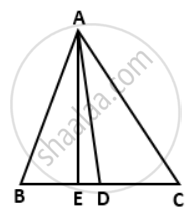
In a triangle ABC, AC > AB, D is the midpoint BC, and AE ⊥ BC. Prove that: AB2 + AC2 = 2AD2 + `(1)/(2)"BC"^2`
Advertisements
उत्तर

We have ∠AED = 90°
∴ ∠ADE < 90° and ∠ADC > 90°
i.e. ∠ADE is acute and ∠ADC is obtuse.
Adding (i) and (ii), we have
AC2 + AB2 = AD2 + BC x DE + `(1)/(4)"BC"^2 + "AD"^2 - "BC" xx "DE" + (1)/(4)"BC"^2`
⇒ AB2 + AC2 = `2"AD"^2 + (1)/(2)"BC"^2`. ....(iii)
APPEARS IN
संबंधित प्रश्न
A man goes 10 m due east and then 24 m due north. Find the distance from the starting point
Two towers of heights 10 m and 30 m stand on a plane ground. If the distance between their feet is 15 m, find the distance between their tops
In Figure ABD is a triangle right angled at A and AC ⊥ BD. Show that AC2 = BC × DC

ABC is an equilateral triangle of side 2a. Find each of its altitudes.
A ladder 10 m long reaches a window 8 m above the ground. Find the distance of the foot of the ladder from base of the wall.
Two poles of heights 6 m and 11 m stand on a plane ground. If the distance between the feet of the poles is 12 m, find the distance between their tops.
In ∆PQR, point S is the midpoint of side QR. If PQ = 11, PR = 17, PS = 13, find QR.
In ∆ABC, AB = 10, AC = 7, BC = 9, then find the length of the median drawn from point C to side AB.
Some question and their alternative answer are given. Select the correct alternative.
If a, b, and c are sides of a triangle and a2 + b2 = c2, name the type of triangle.
ABC is a triangle, right-angled at B. M is a point on BC.
Prove that: AM2 + BC2 = AC2 + BM2
In the following Figure ∠ACB= 90° and CD ⊥ AB, prove that CD2 = BD × AD

Triangle ABC is right-angled at vertex A. Calculate the length of BC, if AB = 18 cm and AC = 24 cm.
The sides of a certain triangle is given below. Find, which of them is right-triangle
16 cm, 20 cm, and 12 cm
In the given figure, angle ACB = 90° = angle ACD. If AB = 10 m, BC = 6 cm and AD = 17 cm, find :
(i) AC
(ii) CD

The sides of the triangle are given below. Find out which one is the right-angled triangle?
1.5, 1.6, 1.7
In ΔABC, AD is perpendicular to BC. Prove that: AB2 + CD2 = AC2 + BD2
In an equilateral triangle ABC, the side BC is trisected at D. Prove that 9 AD2 = 7 AB2.
In a triangle ABC right angled at C, P and Q are points of sides CA and CB respectively, which divide these sides the ratio 2 : 1.
Prove that : 9(AQ2 + BP2) = 13AB2
In an equilateral triangle PQR, prove that PS2 = 3(QS)2.

The foot of a ladder is 6 m away from its wall and its top reaches a window 8 m above the ground. Find the length of the ladder.