Advertisements
Advertisements
प्रश्न
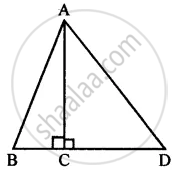
In the given figure, angle ACB = 90° = angle ACD. If AB = 10 m, BC = 6 cm and AD = 17 cm, find :
(i) AC
(ii) CD
Advertisements
उत्तर
∆ ABD
∠ACB = ∠ACD = 90°
and AB = 10 cm, BC = 6 cm and AD = 17 cm
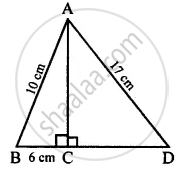
To find:
(i) Length of AC
(ii) Length of CD
Proof:
(i) In right-angled triangle ABC
BC = 6 cm, AB = 110 cm
According to Pythagoras Theorem,
AB2 = AC2 + BC2
(10)2 = (AC)2 + (6)2
100 = (AC)2 + 36
AC2 = 100 − 36 = 64 cm
AC2 = 64 cm
∴ AC = `sqrt(8xx8)` = 8 cm
(ii) In right-angle triangle ACD
AD = 17 cm, AC = 8 cm
According to Pythagoras Theorem,
(AD)2 = (AC)2 + (CD)2
(17)2 = (8)2 + (CD)2
289 – 64 = CD2
225 = CD2
CD =`sqrt(15xx15)` = 15 cm
APPEARS IN
संबंधित प्रश्न
A man goes 10 m due east and then 24 m due north. Find the distance from the starting point
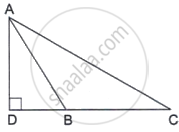
In the given figure, ∆ABC is an obtuse triangle, obtuse-angled at B. If AD ⊥ CB (produced) prove that AC2 = AB2 + BC2 + 2BC · BD.
ABC is a triangle, right-angled at B. M is a point on BC.
Prove that: AM2 + BC2 = AC2 + BM2
The top of a ladder of length 15 m reaches a window 9 m above the ground. What is the distance between the base of the wall and that of the ladder?
Find the Pythagorean triplet from among the following set of numbers.
4, 7, 8
Calculate the area of a right-angled triangle whose hypotenuse is 65cm and one side is 16cm.
The perpendicular PS on the base QR of a ∆PQR intersects QR at S, such that QS = 3 SR. Prove that 2PQ2 = 2PR2 + QR2
If in a ΔPQR, PR2 = PQ2 + QR2, then the right angle of ∆PQR is at the vertex ________
Find the unknown side in the following triangles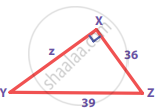
Height of a pole is 8 m. Find the length of rope tied with its top from a point on the ground at a distance of 6 m from its bottom.
