Advertisements
Advertisements
Question
The diagonals of a rhombus measure 16 cm and 30 cm. Find its perimeter.
Advertisements
Solution

Let ABCD be a rhombus (all sides are of equal length) and its diagonals, AC and BD, are intersecting each other at point O. Diagonals in a rhombus bisect each other at 90°. It can be observed that
AO = `(AC)/2`
= `16/2`
= 8 cm
BO = `(BD)/2`
= `30/2`
= 15 cm
By applying Pythagoras theorem in ΔAOB,
OA2 + OB2 = AB2
82 + 152 = AB2
64 + 225 = AB2
289 = AB2
AB = 17
Therefore, the length of the side of rhombus is 17 cm.
Perimeter of rhombus = 4 × Side of the rhombus
= 4 × 17
= 68 cm
RELATED QUESTIONS
PQR is a triangle right angled at P. If PQ = 10 cm and PR = 24 cm, find QR.
In ∆PQR, point S is the midpoint of side QR. If PQ = 11, PR = 17, PS = 13, find QR.
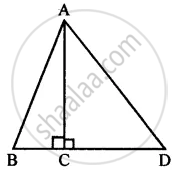
In the given figure, angle ACB = 90° = angle ACD. If AB = 10 m, BC = 6 cm and AD = 17 cm, find :
(i) AC
(ii) CD
The sides of the triangle are given below. Find out which one is the right-angled triangle?
8, 15, 17
A man goes 10 m due east and then 24 m due north. Find the distance from the straight point.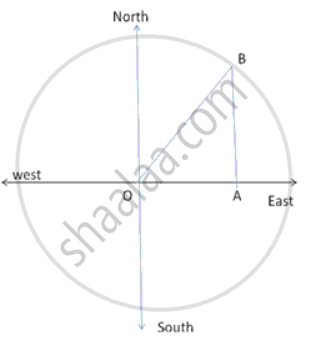
A ladder 25m long reaches a window of a building 20m above the ground. Determine the distance of the foot of the ladder from the building.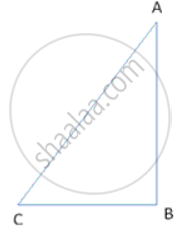
In an equilateral triangle ABC, the side BC is trisected at D. Prove that 9 AD2 = 7 AB2.
Determine whether the triangle whose lengths of sides are 3 cm, 4 cm, 5 cm is a right-angled triangle.
The hypotenuse of a right angled triangle of sides 12 cm and 16 cm is __________
Is the triangle with sides 25 cm, 5 cm and 24 cm a right triangle? Give reasons for your answer.
