Advertisements
Advertisements
Question
If the angles of a triangle are 30°, 60°, and 90°, then shown that the side opposite to 30° is half of the hypotenuse, and the side opposite to 60° is `sqrt(3)/2` times of the hypotenuse.
Advertisements
Solution
Given : In ΔCAB, m∠A=90°, m∠B = 60°, M∠C=30°
To prove : i AB = `1/2`BC ii. AC = `sqrt(3)/2 BC`
Construction: Take a point 'D' on ray BA such that AB = AD. join point C to point D.

Proof: In ΔCBD,
AD= AB ....[By construction]
∴ A is the midpoint of seg BD ....(i)
Also, m∠CAB = 90° ....[Given]
∴ seg CA ⊥ seg BD .....(ii)
∴ seg CA is the perpendicular bisector of seg BD ....[From(i) and (ii)]
∴ CD = CB ...........[By perpendicular bisector theorem]
∴ ΔCDB is an isosceles triangle
∴ ∠CDB ≅ ∠CBD .....(iii)[By isosceles triangle theorem]
But,∠CBD = 60° ....(iv) [Given]
∴ ∠CDB = 60° ....[from (iii) and (iv)]
∴ ∠BCD = 60° .....[Remaining angle of a triangle ]
∴ ΔCDB is an equilateral triangle ....[All angle are 60°]
∴ BD = BC = CD ....(vi)[Sides of equilateral triabgle ]
AB = `1/2` BD .....(vi) [By construction]
AB = `1/2` BC . ...(vii) [ From (v) and (vi)]
In ΔCAB,
∠CAB = 90° ....[Given]
∴ BC2 = AC2+AB2 ............[ By pythagoras theorem]
∴` BC^2 = AC^2 + (1/2 BC)^2` ...[From (vii)]
∴`BC^2 = AC^2 +1/4 BC^2`
∴ `AC^2 = BC^2 -1/4 BC^2`
∴ `Ac^2 = (4BC^2-BC^32)/4`
∴ `AC^2 = (3BC^2)/4`
∴ `AC = sqrt(3)/2 BC` ...[ Taking square root on both sides]
APPEARS IN
RELATED QUESTIONS
If ABC is an equilateral triangle of side a, prove that its altitude = ` \frac { \sqrt { 3 } }{ 2 } a`
Sides of triangle are given below. Determine it is a right triangle or not? In case of a right triangle, write the length of its hypotenuse. 7 cm, 24 cm, 25 cm
ABC is an isosceles triangle right angled at C. Prove that AB2 = 2AC2
ABC is an isosceles triangle with AC = BC. If AB2 = 2AC2, prove that ABC is a right triangle.
Find the perimeter of the rectangle whose length is 40 cm and a diagonal is 41 cm.
Identify, with reason, if the following is a Pythagorean triplet.
(4, 9, 12)
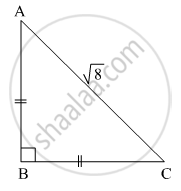
For finding AB and BC with the help of information given in the figure, complete following activity.
AB = BC .......... 
∴ ∠BAC =
∴ AB = BC = × AC
= × `sqrt8`
= × `2sqrt2`
=
Walls of two buildings on either side of a street are parallel to each other. A ladder 5.8 m long is placed on the street such that its top just reaches the window of a building at the height of 4 m. On turning the ladder over to the other side of the street, its top touches the window of the other building at a height 4.2 m. Find the width of the street.
Pranali and Prasad started walking to the East and to the North respectively, from the same point and at the same speed. After 2 hours distance between them was \[15\sqrt{2}\]
km. Find their speed per hour.
In the figure: ∠PSQ = 90o, PQ = 10 cm, QS = 6 cm and RQ = 9 cm. Calculate the length of PR.
In the given figure, ∠B = 90°, XY || BC, AB = 12 cm, AY = 8cm and AX : XB = 1 : 2 = AY : YC.
Find the lengths of AC and BC.

In triangle ABC, AB = AC = x, BC = 10 cm and the area of the triangle is 60 cm2.
Find x.
Prove that in a right angle triangle, the square of the hypotenuse is equal to the sum of squares of the other two sides.
Triangle ABC is right-angled at vertex A. Calculate the length of BC, if AB = 18 cm and AC = 24 cm.
Find the Pythagorean triplet from among the following set of numbers.
9, 40, 41
A point OI in the interior of a rectangle ABCD is joined with each of the vertices A, B, C and D. Prove that OB2 + OD2 = OC2 + OA2
In the given figure, PQ = `"RS"/(3)` = 8cm, 3ST = 4QT = 48cm.
SHow that ∠RTP = 90°.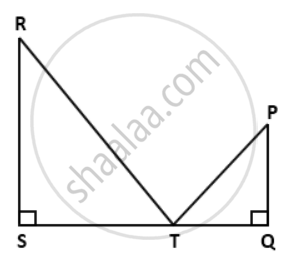
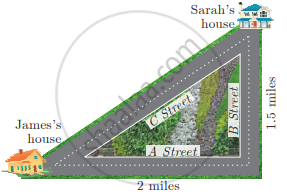
There are two paths that one can choose to go from Sarah’s house to James's house. One way is to take C street, and the other way requires to take B street and then A street. How much shorter is the direct path along C street?
In a right-angled triangle ABC, if angle B = 90°, BC = 3 cm and AC = 5 cm, then the length of side AB is ______.
Two angles are said to be ______, if they have equal measures.
