Advertisements
Advertisements
प्रश्न
If the angles of a triangle are 30°, 60°, and 90°, then shown that the side opposite to 30° is half of the hypotenuse, and the side opposite to 60° is `sqrt(3)/2` times of the hypotenuse.
Advertisements
उत्तर
Given : In ΔCAB, m∠A=90°, m∠B = 60°, M∠C=30°
To prove : i AB = `1/2`BC ii. AC = `sqrt(3)/2 BC`
Construction: Take a point 'D' on ray BA such that AB = AD. join point C to point D.

Proof: In ΔCBD,
AD= AB ....[By construction]
∴ A is the midpoint of seg BD ....(i)
Also, m∠CAB = 90° ....[Given]
∴ seg CA ⊥ seg BD .....(ii)
∴ seg CA is the perpendicular bisector of seg BD ....[From(i) and (ii)]
∴ CD = CB ...........[By perpendicular bisector theorem]
∴ ΔCDB is an isosceles triangle
∴ ∠CDB ≅ ∠CBD .....(iii)[By isosceles triangle theorem]
But,∠CBD = 60° ....(iv) [Given]
∴ ∠CDB = 60° ....[from (iii) and (iv)]
∴ ∠BCD = 60° .....[Remaining angle of a triangle ]
∴ ΔCDB is an equilateral triangle ....[All angle are 60°]
∴ BD = BC = CD ....(vi)[Sides of equilateral triabgle ]
AB = `1/2` BD .....(vi) [By construction]
AB = `1/2` BC . ...(vii) [ From (v) and (vi)]
In ΔCAB,
∠CAB = 90° ....[Given]
∴ BC2 = AC2+AB2 ............[ By pythagoras theorem]
∴` BC^2 = AC^2 + (1/2 BC)^2` ...[From (vii)]
∴`BC^2 = AC^2 +1/4 BC^2`
∴ `AC^2 = BC^2 -1/4 BC^2`
∴ `Ac^2 = (4BC^2-BC^32)/4`
∴ `AC^2 = (3BC^2)/4`
∴ `AC = sqrt(3)/2 BC` ...[ Taking square root on both sides]
APPEARS IN
संबंधित प्रश्न
In a right triangle ABC right-angled at C, P and Q are the points on the sides CA and CB respectively, which divide these sides in the ratio 2 : 1. Prove that
`(i) 9 AQ^2 = 9 AC^2 + 4 BC^2`
`(ii) 9 BP^2 = 9 BC^2 + 4 AC^2`
`(iii) 9 (AQ^2 + BP^2 ) = 13 AB^2`
ABC is an isosceles triangle with AC = BC. If AB2 = 2AC2, prove that ABC is a right triangle.
Prove that the sum of the squares of the sides of a rhombus is equal to the sum of the squares of its diagonals
Find the side and perimeter of a square whose diagonal is 10 cm.
A man goes 40 m due north and then 50 m due west. Find his distance from the starting point.
In the following figure, AD is perpendicular to BC and D divides BC in the ratio 1: 3.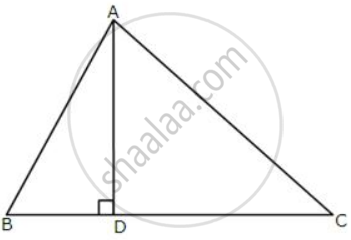
Prove that : 2AC2 = 2AB2 + BC2
Show that the triangle ABC is a right-angled triangle; if: AB = 9 cm, BC = 40 cm and AC = 41 cm
A boy first goes 5 m due north and then 12 m due east. Find the distance between the initial and the final position of the boy.
The sides of the triangle are given below. Find out which one is the right-angled triangle?
11, 60, 61
A right triangle has hypotenuse p cm and one side q cm. If p - q = 1, find the length of third side of the triangle.
The length of the diagonals of rhombus are 24cm and 10cm. Find each side of the rhombus.
AD is perpendicular to the side BC of an equilateral ΔABC. Prove that 4AD2 = 3AB2.
PQR is an isosceles triangle with PQ = PR = 10 cm and QR = 12 cm. Find the length of the perpendicular from P to QR.
The perimeters of two similar triangles ABC and PQR are 60 cm and 36 cm respectively. If PQ = 9 cm, then AB equals ______.
A 5 m long ladder is placed leaning towards a vertical wall such that it reaches the wall at a point 4 m high. If the foot of the ladder is moved 1.6 m towards the wall, then find the distance by which the top of the ladder would slide upwards on the wall.
In an isosceles triangle PQR, the length of equal sides PQ and PR is 13 cm and base QR is 10 cm. Find the length of perpendicular bisector drawn from vertex P to side QR.
Jayanti takes shortest route to her home by walking diagonally across a rectangular park. The park measures 60 metres × 80 metres. How much shorter is the route across the park than the route around its edges?
Height of a pole is 8 m. Find the length of rope tied with its top from a point on the ground at a distance of 6 m from its bottom.
