Advertisements
Advertisements
Question
The sides of a certain triangle is given below. Find, which of them is right-triangle
16 cm, 20 cm, and 12 cm
Advertisements
Solution
16 cm, 20 cm and 12 cm
The given triangle will be a right-angled triangle if square of its largest side is equal to the sum of the squares on the other two sides.
i.e., If (20)2 = (16)2 = (12)2
(20)2 = (16)2 + (12)2
400 = 256 + 144
400 = 400
So, the given triangle is right-angled.
APPEARS IN
RELATED QUESTIONS
Prove that the diagonals of a rectangle ABCD, with vertices A(2, -1), B(5, -1), C(5, 6) and D(2, 6), are equal and bisect each other.
In a ∆ABC, AD ⊥ BC and AD2 = BC × CD. Prove ∆ABC is a right triangle
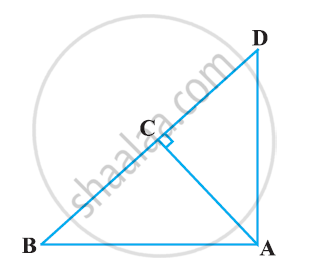
In Figure ABD is a triangle right angled at A and AC ⊥ BD. Show that AC2 = BC × DC
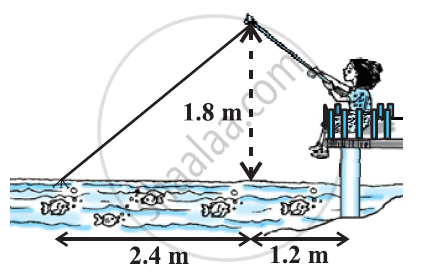
Nazima is fly fishing in a stream. The tip of her fishing rod is 1.8 m above the surface of the water and the fly at the end of the string rests on the water 3.6 m away and 2.4 m from a point directly under the tip of the rod. Assuming that her string (from the tip of her rod to the fly) is taut, how much string does she have out (see Figure)? If she pulls in the string at the rate of 5 cm per second, what will be the horizontal distance of the fly from her after 12 seconds?
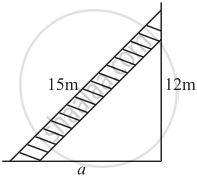
A 15 m long ladder reached a window 12 m high from the ground on placing it against a wall at a distance a. Find the distance of the foot of the ladder from the wall.
Which of the following can be the sides of a right triangle?
2 cm, 2 cm, 5 cm
In the case of right-angled triangles, identify the right angles.
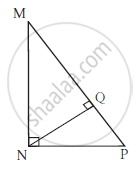
In ΔMNP, ∠MNP = 90˚, seg NQ ⊥ seg MP, MQ = 9, QP = 4, find NQ.
Find the distance between the helicopter and the ship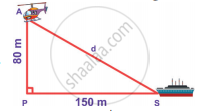
Two rectangles are congruent, if they have same ______ and ______.
A right-angled triangle may have all sides equal.
