Advertisements
Advertisements
Question
In triangle ABC, ∠C=90°. Let BC= a, CA= b, AB= c and let 'p' be the length of the perpendicular from 'C' on AB, prove that:
1. cp = ab
2. `1/p^2=1/a^2+1/b^2`
Advertisements
Solution
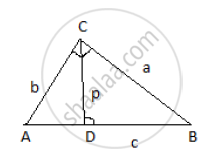
1. Area of a triangle = (1/2) x Base x Height
A(ΔABC) = (1/2) x AB x CD
A(ΔABC) = (1/2) x cp .......(i)
Area of right angle triangle ABC = A(ΔABC) = (1/2) x AC x BC
A(ΔABC) = (1/2) x ba ........(ii)
From (i) and (ii)
cp=ba⇒ cp⇒ab ..........(iii)
2. We have,
cp=ab ..........From(iii)
p = ab/c
Square both sides of the equation.
We get, `p^2=(a^2b^2)/c^2`
`1/p^2=c^2/(a^2b^2)" ..................(iv).....[By invertendo]"`
In right angled triangle ABC,
AB2 = AC2 + BC2 ................[By Pythagoras’ theorem]
c2 = b2 + a2 ............(v)
`c^2/(a^2b^2) = b^2/(a^2b^2) + a^2/(a^2b^2)`..........[Dividing throughout by `a^2b^2`]
`c^2/(ab)^2 = 1/a^2 + 1/b^2` .........(iii)
`c^2/(cp)^2 = 1/a^2 + 1/b^2` ...........[From (ii) and (iii)]
`c^2/(c^2p^2) = 1/a^2 + 1/b^2`
`1/p^2 = 1/a^2 + 1/b^2`
APPEARS IN
RELATED QUESTIONS
Two towers of heights 10 m and 30 m stand on a plane ground. If the distance between their feet is 15 m, find the distance between their tops
Sides of triangle are given below. Determine it is a right triangle or not? In case of a right triangle, write the length of its hypotenuse. 13 cm, 12 cm, 5 cm
ABC is an equilateral triangle of side 2a. Find each of its altitudes.
The diagonals of a rhombus measure 16 cm and 30 cm. Find its perimeter.
Identify, with reason, if the following is a Pythagorean triplet.
(10, 24, 27)
In ∆ABC, AB = 10, AC = 7, BC = 9, then find the length of the median drawn from point C to side AB.
If P and Q are the points on side CA and CB respectively of ΔABC, right angled at C, prove that (AQ2 + BP2 ) = (AB2 + PQ2)
The sides of a certain triangle is given below. Find, which of them is right-triangle
6 m, 9 m, and 13 m
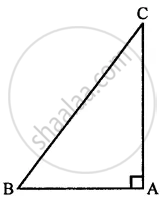
In the given figure, angle BAC = 90°, AC = 400 m, and AB = 300 m. Find the length of BC.
In triangle PQR, angle Q = 90°, find: PQ, if PR = 34 cm and QR = 30 cm
Show that the triangle ABC is a right-angled triangle; if: AB = 9 cm, BC = 40 cm and AC = 41 cm
A ladder, 6.5 m long, rests against a vertical wall. If the foot of the ladder is 2.5 m from the foot of the wall, find up to how much height does the ladder reach?
In the figure below, find the value of 'x'.
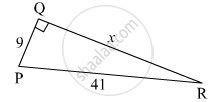
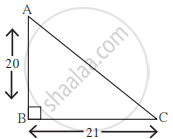
From the given figure, find the length of hypotenuse AC and the perimeter of ∆ABC.
From a point O in the interior of aΔABC, perpendicular OD, OE and OF are drawn to the sides BC, CA and AB respectively. Prove that: AF2 + BD2 + CE2 = OA2 + OB2 + OC2 - OD2 - OE2 - OF2
AD is perpendicular to the side BC of an equilateral ΔABC. Prove that 4AD2 = 3AB2.
Two trains leave a railway station at the same time. The first train travels due west and the second train due north. The first train travels at a speed of `(20 "km")/"hr"` and the second train travels at `(30 "km")/"hr"`. After 2 hours, what is the distance between them?
From the given figure, in ∆ABQ, if AQ = 8 cm, then AB = ?
Foot of a 10 m long ladder leaning against a vertical wall is 6 m away from the base of the wall. Find the height of the point on the wall where the top of the ladder reaches.
Two squares having same perimeter are congruent.
