Advertisements
Advertisements
Question
To get from point A to point B you must avoid walking through a pond. You must walk 34 m south and 41 m east. To the nearest meter, how many meters would be saved if it were possible to make a way through the pond?
Advertisements
Solution
In the right ∆ABC,
By Pythagoras theorem
AC2 = AB2 + BC2
= 342 + 412
= 1156 + 1681
= 2837
AC = `sqrt(2837)`
= 53.26 m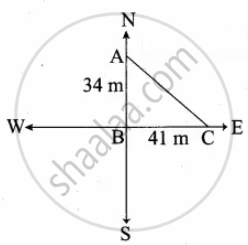
A one must walk (34m + 41m) 75m to reach C.
The difference in Distance = 75 – 53.26
= 21.74 m
APPEARS IN
RELATED QUESTIONS
A man goes 10 m due east and then 24 m due north. Find the distance from the starting point
In an equilateral triangle, prove that three times the square of one side is equal to four times the square of one of its altitudes.
Which of the following can be the sides of a right triangle?
1.5 cm, 2 cm, 2.5 cm
In the case of right-angled triangles, identify the right angles.
The diagonals of a rhombus measure 16 cm and 30 cm. Find its perimeter.
Identify, with reason, if the following is a Pythagorean triplet.
(24, 70, 74)
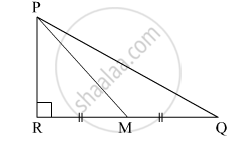
In the given figure, M is the midpoint of QR. ∠PRQ = 90°. Prove that, PQ2 = 4PM2 – 3PR2.
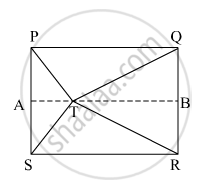
In the given figure, point T is in the interior of rectangle PQRS, Prove that, TS2 + TQ2 = TP2 + TR2 (As shown in the figure, draw seg AB || side SR and A-T-B)
If P and Q are the points on side CA and CB respectively of ΔABC, right angled at C, prove that (AQ2 + BP2) = (AB2 + PQ2)
Find the Pythagorean triplet from among the following set of numbers.
4, 5, 6
In a triangle ABC, AC > AB, D is the midpoint BC, and AE ⊥ BC. Prove that: AB2 = AD2 - BC x CE + `(1)/(4)"BC"^2`
