Advertisements
Advertisements
Question
Prove that, in a right-angled triangle, the square of the hypotenuse is equal to the sum of the square of remaining two sides.
Advertisements
Solution 1
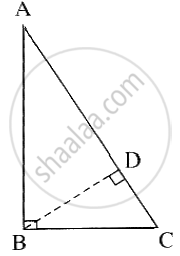
Draw perpendicular BD from the vertex B to the side AC. A – D
In right-angled ΔABC
seg BD ⊥ hypotenuse AC.
∴ By the similarity in right-angled triangles
ΔABC ~ ΔADB ~ ΔBDC
Now, ΔABC ~ ΔADB
∴ `"AB"/"AD" = "AC"/"AB"` ...(c.s.s.t)
∴ AB2 = AC × AD ...(1)
Also, ΔABC ~ ΔBDC
∴ `"BC"/"DC" = "AC"/"BC"` ...(c.s.s.t)
∴ BC2 = AC × DC ...(2)
From (1) and (2),
AB2 + BC2 = AC × AD + AC × DC
= AC × (AD + DC)
= AC × AC ...(A – D – C)
∴ AB2 + BC2 = AC2
i.e., AC2 = AB2 + BC2
Solution 2
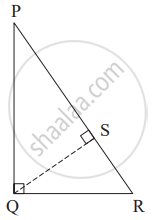
Given: In ΔPQR, ∠PQR = 90°.
To prove: PR2 = PQ2 + QR2.
Construction:
Draw seg QS ⊥ side PR such that P–S–R.
Proof: In ΔPQR,
∠PQR = 90° ...(Given)
Seg QS ⊥ hypotenuse PR ...(Construction)
∴ ΔPSQ ∼ ΔQSR ∼ ΔPQR ...(Similarity of right-angled triangles) ...(1)
ΔPSQ ∼ ΔPQR ...[From (1)]
∴ `"PS"/"PQ" = "PQ"/"PR"` ...(Corresponding sides of similar triangles are in proportion)
∴ PQ2 = PS × PR ...(2)
ΔQSR ∼ ΔPQR ...[From (1)]
∴ `"SR"/"QR" = "QR"/"PR"` ...(Corresponding sides of similar triangles are in proportion)
∴ QR2 = SR × PR ...(3)
Adding (2) and (3), we get
PQ2 + QR2 = PS × PR + SR × PR
∴ PQ2 + QR2 = PR(PS + SR)
∴ PQ2 + QR2 = PR × PR ...(P–S–R)
∴ PQ2 + QR2 = PR2 OR PR2 = PQ2 + QR2.
RELATED QUESTIONS
Two towers of heights 10 m and 30 m stand on a plane ground. If the distance between their feet is 15 m, find the distance between their tops
In figure, ∠B of ∆ABC is an acute angle and AD ⊥ BC, prove that AC2 = AB2 + BC2 – 2BC × BD
In a ∆ABC, AD ⊥ BC and AD2 = BC × CD. Prove ∆ABC is a right triangle
ABC is a right triangle right-angled at C. Let BC = a, CA = b, AB = c and let p be the length of perpendicular from C on AB, prove that
(i) cp = ab
`(ii) 1/p^2=1/a^2+1/b^2`
Prove that the sum of the squares of the sides of a rhombus is equal to the sum of the squares of its diagonals
A tree is broken at a height of 5 m from the ground and its top touches the ground at a distance of 12 m from the base of the tree. Find the original height of the tree.
Find the perimeter of the rectangle whose length is 40 cm and a diagonal is 41 cm.
In an isosceles triangle, length of the congruent sides is 13 cm and its base is 10 cm. Find the distance between the vertex opposite the base and the centroid.
A man goes 40 m due north and then 50 m due west. Find his distance from the starting point.
M andN are the mid-points of the sides QR and PQ respectively of a PQR, right-angled at Q.
Prove that:
(i) PM2 + RN2 = 5 MN2
(ii) 4 PM2 = 4 PQ2 + QR2
(iii) 4 RN2 = PQ2 + 4 QR2(iv) 4 (PM2 + RN2) = 5 PR2
Find the side of the square whose diagonal is `16sqrt(2)` cm.
Find the Pythagorean triplet from among the following set of numbers.
3, 4, 5
Find the Pythagorean triplet from among the following set of numbers.
9, 40, 41
The sides of the triangle are given below. Find out which one is the right-angled triangle?
11, 12, 15
A ladder 15m long reaches a window which is 9m above the ground on one side of a street. Keeping its foot at the same point, the ladder is turned to other side of the street to reach a window 12m high. Find the width of the street.
From the given figure, in ∆ABQ, if AQ = 8 cm, then AB =?

Is the triangle with sides 25 cm, 5 cm and 24 cm a right triangle? Give reasons for your answer.
If the areas of two circles are the same, they are congruent.
Height of a pole is 8 m. Find the length of rope tied with its top from a point on the ground at a distance of 6 m from its bottom.
The foot of a ladder is 6 m away from its wall and its top reaches a window 8 m above the ground. Find the length of the ladder.
