Advertisements
Advertisements
Question
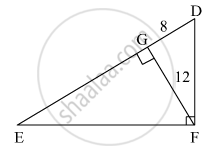
In the given figure, ∠DFE = 90°, FG ⊥ ED, If GD = 8, FG = 12, find (1) EG (2) FD and (3) EF
Advertisements
Solution
We know that,
In a right angled triangle, the perpendicular segment to the hypotenuse from the opposite vertex, is the geometric mean of the segments into which the hypotenuse is divided.
Here, seg GF ⊥ seg ED
\[\therefore {GF}^2 = EG \times GD\]
\[ \Rightarrow {12}^2 = EG \times 8\]
\[ \Rightarrow 144 = EG \times 8\]
\[ \Rightarrow EG = \frac{144}{8}\]
\[ \Rightarrow EG = 18\]
Hence, EG = 18.
Now,
According to Pythagoras theorem, in ∆DGF
\[{DG}^2 + {GF}^2 = {FD}^2 \]
\[ \Rightarrow 8^2 + {12}^2 = {FD}^2 \]
\[ \Rightarrow 64 + 144 = {FD}^2 \]
\[ \Rightarrow {FD}^2 = 208\]
\[ \Rightarrow FD = 4\sqrt{13}\]
In ∆EGF
\[{EG}^2 + {GF}^2 = {EF}^2 \]
\[ \Rightarrow {18}^2 + {12}^2 = {EF}^2 \]
\[ \Rightarrow 324 + 144 = {EF}^2 \]
\[ \Rightarrow {EF}^2 = 468\]
\[ \Rightarrow EF = 6\sqrt{13}\]
Hence, FD =\[4\sqrt{13}\] and EF=\[6\sqrt{13}\]
RELATED QUESTIONS
In a right triangle ABC, right-angled at B, BC = 12 cm and AB = 5 cm. The radius of the circle inscribed in the triangle (in cm) is
(A) 4
(B) 3
(C) 2
(D) 1
A man goes 10 m due east and then 24 m due north. Find the distance from the starting point
P and Q are the mid-points of the sides CA and CB respectively of a ∆ABC, right angled at C. Prove that:
`(i) 4AQ^2 = 4AC^2 + BC^2`
`(ii) 4BP^2 = 4BC^2 + AC^2`
`(iii) (4AQ^2 + BP^2 ) = 5AB^2`
A guy wire attached to a vertical pole of height 18 m is 24 m long and has a stake attached to the other end. How far from the base of the pole should the stake be driven so that the wire will be taut?
Nazima is fly fishing in a stream. The tip of her fishing rod is 1.8 m above the surface of the water and the fly at the end of the string rests on the water 3.6 m away and 2.4 m from a point directly under the tip of the rod. Assuming that her string (from the tip of her rod to the fly) is taut, ho much string does she have out (see Figure)? If she pulls in the string at the rate of 5 cm per second, what will be the horizontal distance of the fly from her after 12 seconds?

PQR is a triangle right angled at P. If PQ = 10 cm and PR = 24 cm, find QR.
In the given figure, ∆ABC is an equilateral triangle of side 3 units. Find the coordinates of the other two vertices ?

In an isosceles triangle, length of the congruent sides is 13 cm and its base is 10 cm. Find the distance between the vertex opposite the base and the centroid.
In the following figure, OP, OQ, and OR are drawn perpendiculars to the sides BC, CA and AB respectively of triangle ABC.
Prove that: AR2 + BP2 + CQ2 = AQ2 + CP2 + BR2

If the angles of a triangle are 30°, 60°, and 90°, then shown that the side opposite to 30° is half of the hypotenuse, and the side opposite to 60° is `sqrt(3)/2` times of the hypotenuse.
Show that the triangle ABC is a right-angled triangle; if: AB = 9 cm, BC = 40 cm and AC = 41 cm
Find the length of the hypotenuse of a triangle whose other two sides are 24cm and 7cm.
In a right-angled triangle PQR, right-angled at Q, S and T are points on PQ and QR respectively such as PT = SR = 13 cm, QT = 5 cm and PS = TR. Find the length of PQ and PS.
Two trains leave a railway station at the same time. The first train travels due west and the second train due north. The first train travels at a speed of `(20 "km")/"hr"` and the second train travels at `(30 "km")/"hr"`. After 2 hours, what is the distance between them?
Find the unknown side in the following triangles
In triangle ABC, line I, is a perpendicular bisector of BC.
If BC = 12 cm, SM = 8 cm, find CS
In the given figure, ∠T and ∠B are right angles. If the length of AT, BC and AS (in centimeters) are 15, 16, and 17 respectively, then the length of TC (in centimeters) is ______.

Foot of a 10 m long ladder leaning against a vertical wall is 6 m away from the base of the wall. Find the height of the point on the wall where the top of the ladder reaches.
In figure, PQR is a right triangle right angled at Q and QS ⊥ PR. If PQ = 6 cm and PS = 4 cm, find QS, RS and QR.
