Advertisements
Advertisements
प्रश्न
Prove that, in a right-angled triangle, the square of the hypotenuse is equal to the sum of the square of remaining two sides.
Advertisements
उत्तर १
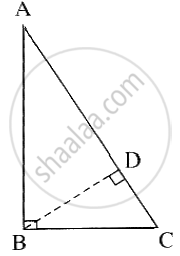
Draw perpendicular BD from the vertex B to the side AC. A – D
In right-angled ΔABC
seg BD ⊥ hypotenuse AC.
∴ By the similarity in right-angled triangles
ΔABC ~ ΔADB ~ ΔBDC
Now, ΔABC ~ ΔADB
∴ `"AB"/"AD" = "AC"/"AB"` ...(c.s.s.t)
∴ AB2 = AC × AD ...(1)
Also, ΔABC ~ ΔBDC
∴ `"BC"/"DC" = "AC"/"BC"` ...(c.s.s.t)
∴ BC2 = AC × DC ...(2)
From (1) and (2),
AB2 + BC2 = AC × AD + AC × DC
= AC × (AD + DC)
= AC × AC ...(A – D – C)
∴ AB2 + BC2 = AC2
i.e., AC2 = AB2 + BC2
उत्तर २
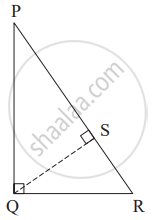
Given: In ΔPQR, ∠PQR = 90°.
To prove: PR2 = PQ2 + QR2.
Construction:
Draw seg QS ⊥ side PR such that P–S–R.
Proof: In ΔPQR,
∠PQR = 90° ...(Given)
Seg QS ⊥ hypotenuse PR ...(Construction)
∴ ΔPSQ ∼ ΔQSR ∼ ΔPQR ...(Similarity of right-angled triangles) ...(1)
ΔPSQ ∼ ΔPQR ...[From (1)]
∴ `"PS"/"PQ" = "PQ"/"PR"` ...(Corresponding sides of similar triangles are in proportion)
∴ PQ2 = PS × PR ...(2)
ΔQSR ∼ ΔPQR ...[From (1)]
∴ `"SR"/"QR" = "QR"/"PR"` ...(Corresponding sides of similar triangles are in proportion)
∴ QR2 = SR × PR ...(3)
Adding (2) and (3), we get
PQ2 + QR2 = PS × PR + SR × PR
∴ PQ2 + QR2 = PR(PS + SR)
∴ PQ2 + QR2 = PR × PR ...(P–S–R)
∴ PQ2 + QR2 = PR2 OR PR2 = PQ2 + QR2.
संबंधित प्रश्न
In a right triangle ABC, right-angled at B, BC = 12 cm and AB = 5 cm. The radius of the circle inscribed in the triangle (in cm) is
(A) 4
(B) 3
(C) 2
(D) 1
Prove that the diagonals of a rectangle ABCD, with vertices A(2, -1), B(5, -1), C(5, 6) and D(2, 6), are equal and bisect each other.
Sides of triangles are given below. Determine it is a right triangles? In case of a right triangle, write the length of its hypotenuse. 3 cm, 8 cm, 6 cm
Sides of triangle are given below. Determine it is a right triangle or not? In case of a right triangle, write the length of its hypotenuse. 50 cm, 80 cm, 100 cm
PQR is a triangle right angled at P and M is a point on QR such that PM ⊥ QR. Show that PM2 = QM . MR
ABC is an equilateral triangle of side 2a. Find each of its altitudes.
Two poles of heights 6 m and 11 m stand vertically on a plane ground. If the distance between their feet is 12 m;
find the distance between their tips.
AD is drawn perpendicular to base BC of an equilateral triangle ABC. Given BC = 10 cm, find the length of AD, correct to 1 place of decimal.
In triangle ABC, AB = AC = x, BC = 10 cm and the area of the triangle is 60 cm2.
Find x.
In the figure, given below, AD ⊥ BC.
Prove that: c2 = a2 + b2 - 2ax.
In the following figure, OP, OQ, and OR are drawn perpendiculars to the sides BC, CA and AB respectively of triangle ABC.
Prove that: AR2 + BP2 + CQ2 = AQ2 + CP2 + BR2

The sides of the triangle are given below. Find out which one is the right-angled triangle?
40, 20, 30
∆ABC is right-angled at C. If AC = 5 cm and BC = 12 cm. find the length of AB.
There are two paths that one can choose to go from Sarah’s house to James's house. One way is to take C street, and the other way requires to take B street and then A street. How much shorter is the direct path along C street?

If ΔABC ~ ΔPQR, `("ar" triangle "ABC")/("ar" triangle "PQR") = 9/4` and AB = 18 cm, then the length of PQ is ______.
Foot of a 10 m long ladder leaning against a vertical wall is 6 m away from the base of the wall. Find the height of the point on the wall where the top of the ladder reaches.
In the adjoining figure, a tangent is drawn to a circle of radius 4 cm and centre C, at the point S. Find the length of the tangent ST, if CT = 10 cm.

In a right-angled triangle ABC, if angle B = 90°, BC = 3 cm and AC = 5 cm, then the length of side AB is ______.
Jiya walks 6 km due east and then 8 km due north. How far is she from her starting place?
