Advertisements
Advertisements
प्रश्न
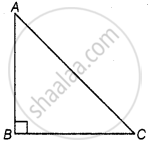
In a right-angled triangle ABC, if angle B = 90°, then which of the following is true?
पर्याय
AB2 = BC2 + AC2
AC2 = AB2 + BC2
AB = BC + AC
AC = AB + BC
Advertisements
उत्तर
AC2 = AB2 + BC2
Explanation:
According to Pythagoras theorem,
(Hypotenuse)2 = (Perpendicular)2 + (Base)2
⇒ AC2 = AB2 + BC2
APPEARS IN
संबंधित प्रश्न
The perpendicular AD on the base BC of a ∆ABC intersects BC at D so that DB = 3 CD. Prove that `2"AB"^2 = 2"AC"^2 + "BC"^2`
In an equilateral triangle ABC, D is a point on side BC such that BD = `1/3BC` . Prove that 9 AD2 = 7 AB2
A tree is broken at a height of 5 m from the ground and its top touches the ground at a distance of 12 m from the base of the tree. Find the original height of the tree.
In the figure: ∠PSQ = 90o, PQ = 10 cm, QS = 6 cm and RQ = 9 cm. Calculate the length of PR.
The sides of a certain triangle is given below. Find, which of them is right-triangle
16 cm, 20 cm, and 12 cm
The sides of a certain triangle is given below. Find, which of them is right-triangle
6 m, 9 m, and 13 m
The perpendicular PS on the base QR of a ∆PQR intersects QR at S, such that QS = 3 SR. Prove that 2PQ2 = 2PR2 + QR2
The hypotenuse of a right angled triangle of sides 12 cm and 16 cm is __________
In an isosceles triangle PQR, the length of equal sides PQ and PR is 13 cm and base QR is 10 cm. Find the length of perpendicular bisector drawn from vertex P to side QR.
Two squares are congruent, if they have same ______.
