Advertisements
Advertisements
प्रश्न
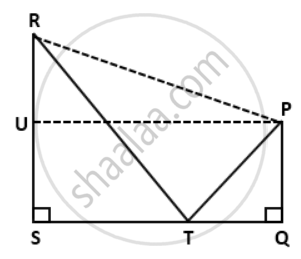
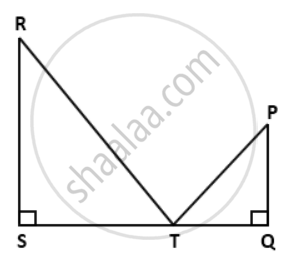
In the given figure, PQ = `"RS"/(3)` = 8cm, 3ST = 4QT = 48cm.
SHow that ∠RTP = 90°.
Advertisements
उत्तर

PQ = `"RS"/(3)` = 8cm
⇒ PQ = 8cm and RS = 3 x 8 = 24cm
3ST = 4QT = 48cm
⇒ ST = `(48)/(3) = 16"cm" and "QT" = (48)/(4)` = 12cm
In ΔPTQ,
PT2 = PQ2 + QT2
= 82 + 122
= 64 + 144
= 208
In ΔRTS,
RT2 = RS2 + ST2
= 242 + 162
= 576 + 256
= 832
Now, PT2 + RT2
= 208 + 832
= 1040 .....(i)
Draw PU ⊥ RS and Join PR.
PU = SQ
= ST + TQ
= 16 + 12
= 28cm
RU = RS - US
= RS - PQ
= 24 - 8
= 16cm
In ΔRUP,
PR2 = RU2 + PU2
= 162 + 282
= 256 + 784
= 1040 ....(ii)
From (i) and (ii), we get
PT2 + RT2 = PR2
Thus, ∠RTP = 90°.
APPEARS IN
संबंधित प्रश्न
The diagonal of a rectangular field is 16 metres more than the shorter side. If the longer side is 14 metres more than the shorter side, then find the lengths of the sides of the field.
In a right triangle ABC right-angled at C, P and Q are the points on the sides CA and CB respectively, which divide these sides in the ratio 2 : 1. Prove that
`(i) 9 AQ^2 = 9 AC^2 + 4 BC^2`
`(ii) 9 BP^2 = 9 BC^2 + 4 AC^2`
`(iii) 9 (AQ^2 + BP^2 ) = 13 AB^2`
In the following figure, O is a point in the interior of a triangle ABC, OD ⊥ BC, OE ⊥ AC and OF ⊥ AB. Show that

(i) OA2 + OB2 + OC2 − OD2 − OE2 − OF2 = AF2 + BD2 + CE2
(ii) AF2 + BD2 + CE2 = AE2 + CD2 + BF2
Identify, with reason, if the following is a Pythagorean triplet.
(24, 70, 74)
In a trapezium ABCD, seg AB || seg DC seg BD ⊥ seg AD, seg AC ⊥ seg BC, If AD = 15, BC = 15 and AB = 25. Find A(▢ABCD)

In right angle ΔABC, if ∠B = 90°, AB = 6, BC = 8, then find AC.
In Fig. 3, ∠ACB = 90° and CD ⊥ AB, prove that CD2 = BD x AD.

Prove that in a right angle triangle, the square of the hypotenuse is equal to the sum of squares of the other two sides.
In triangle PQR, angle Q = 90°, find: PR, if PQ = 8 cm and QR = 6 cm
The length of the diagonals of rhombus are 24cm and 10cm. Find each side of the rhombus.
From a point O in the interior of aΔABC, perpendicular OD, OE and OF are drawn to the sides BC, CA and AB respectively. Prove that: AF2 + BD2 + CE2 = OA2 + OB2 + OC2 - OD2 - OE2 - OF2
In a triangle ABC, AC > AB, D is the midpoint BC, and AE ⊥ BC. Prove that: AB2 + AC2 = 2AD2 + `(1)/(2)"BC"^2`
In a triangle ABC, AC > AB, D is the midpoint BC, and AE ⊥ BC. Prove that: AB2 + AC2 = 2(AD2 + CD2)
Sides AB and BE of a right triangle, right-angled at B are of lengths 16 cm and 8 cm respectively. The length of the side of largest square FDGB that can be inscribed in the triangle ABE is ______.

In ∆PQR, PD ⊥ QR such that D lies on QR. If PQ = a, PR = b, QD = c and DR = d, prove that (a + b)(a – b) = (c + d)(c – d).
Prove that the area of the equilateral triangle drawn on the hypotenuse of a right angled triangle is equal to the sum of the areas of the equilateral triangles drawn on the other two sides of the triangle.
Lengths of sides of a triangle are 3 cm, 4 cm and 5 cm. The triangle is ______.
In a right-angled triangle ABC, if angle B = 90°, then which of the following is true?
Two squares are congruent, if they have same ______.
Two poles of 10 m and 15 m stand upright on a plane ground. If the distance between the tops is 13 m, find the distance between their feet.