Advertisements
Advertisements
प्रश्न
Find the Pythagorean triplet from among the following set of numbers.
3, 4, 5
Advertisements
उत्तर
It is known that, if in a triplet of natural numbers, the square of the biggest number is equal to the sum of the squares of the other two numbers, then the three numbers form a Pythagorean triplet.
The given set of numbers is (3, 4, 5).
The biggest number among the given set is 5.
52 = 25; 42 = 16; 32 = 9
Now, 16 + 9 = 25
∴ 42 + 32 = 52
Thus, (3, 4, 5) form a Pythagorean triplet.
संबंधित प्रश्न
A guy wire attached to a vertical pole of height 18 m is 24 m long and has a stake attached to the other end. How far from the base of the pole should the stake be driven so that the wire will be taut?
A ladder 13 m long rests against a vertical wall. If the foot of the ladder is 5 m from the foot of the wall, find the distance of the other end of the ladder from the ground.
In equilateral Δ ABC, AD ⊥ BC and BC = x cm. Find, in terms of x, the length of AD.
If P and Q are the points on side CA and CB respectively of ΔABC, right angled at C, prove that (AQ2 + BP2) = (AB2 + PQ2)
In triangle PQR, angle Q = 90°, find: PQ, if PR = 34 cm and QR = 30 cm
In the given figure. PQ = PS, P =R = 90°. RS = 20 cm and QR = 21 cm. Find the length of PQ correct to two decimal places.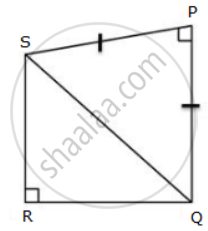
An isosceles triangle has equal sides each 13 cm and a base 24 cm in length. Find its height
In triangle ABC, line I, is a perpendicular bisector of BC.
If BC = 12 cm, SM = 8 cm, find CS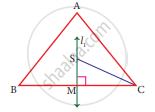
Foot of a 10 m long ladder leaning against a vertical wall is 6 m away from the base of the wall. Find the height of the point on the wall where the top of the ladder reaches.
In a right-angled triangle ABC, if angle B = 90°, then which of the following is true?
