Advertisements
Advertisements
Question
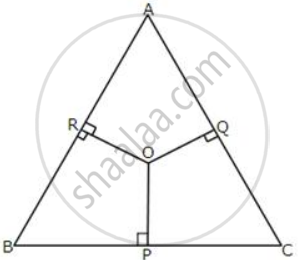
In the following figure, OP, OQ, and OR are drawn perpendiculars to the sides BC, CA and AB respectively of triangle ABC.
Prove that: AR2 + BP2 + CQ2 = AQ2 + CP2 + BR2
Advertisements
Solution
Here, we first need to join OA, OB, and OC after which the figure becomes as follows,
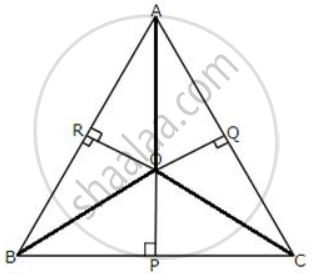
Pythagoras theorem states that in a right-angled triangle, the square on the hypotenuse is equal to the sum of the squares on the remaining two sides. First, we consider the ΔARO and applying Pythagoras theorem we get,
AQ2 = AR2 + OR2
AR2 = AQ2 - OR2 ...(i)
Similarly, from triangles, BPO, COQ, AOQ, CPO, and BRO we get the following results,
BP2 = BO2 - OP2 ...(ii)
CQ2 = OC2 - OQ2 ...(iii)
AQ2 = AO2 - OQ2 ...(iv)
CP2 = OC2 - OP2 ...(v)
BR2 = OB2 - OR2 ...(vi)
Adding (i), (ii) and (iii), we get
AR2 + BP2 + CQ2 = AQ2 - OR2 + BO2 - OP2 + OC2 - OQ2 ...(vii)
Adding (iv), (v) and (vi), we get,
AQ2 + CP2 + BR2 = AO2 - OR2 + BO2 - OP2 + OC2 - OQ2 ...(viii)
From (vii) and (viii), we get,
AR2 + BP2 + CQ2 = AQ2 + CP2 + BR2
Hence, proved.
APPEARS IN
RELATED QUESTIONS
In triangle ABC, ∠C=90°. Let BC= a, CA= b, AB= c and let 'p' be the length of the perpendicular from 'C' on AB, prove that:
1. cp = ab
2. `1/p^2=1/a^2+1/b^2`
P and Q are the mid-points of the sides CA and CB respectively of a ∆ABC, right angled at C. Prove that:
`(i) 4AQ^2 = 4AC^2 + BC^2`
`(ii) 4BP^2 = 4BC^2 + AC^2`
`(iii) (4AQ^2 + BP^2 ) = 5AB^2`
Tick the correct answer and justify: In ΔABC, AB = `6sqrt3` cm, AC = 12 cm and BC = 6 cm.
The angle B is:
Identify, with reason, if the following is a Pythagorean triplet.
(11, 60, 61)
For finding AB and BC with the help of information given in the figure, complete following activity.
AB = BC .......... 
∴ ∠BAC = 
∴ AB = BC =
× AC
=
× `sqrt8`
=
× `2sqrt2`
= 

Pranali and Prasad started walking to the East and to the North respectively, from the same point and at the same speed. After 2 hours distance between them was \[15\sqrt{2}\]
km. Find their speed per hour.
In ΔABC, Find the sides of the triangle, if:
- AB = ( x - 3 ) cm, BC = ( x + 4 ) cm and AC = ( x + 6 ) cm
- AB = x cm, BC = ( 4x + 4 ) cm and AC = ( 4x + 5) cm
In the figure: ∠PSQ = 90o, PQ = 10 cm, QS = 6 cm and RQ = 9 cm. Calculate the length of PR.
Diagonals of rhombus ABCD intersect each other at point O.
Prove that: OA2 + OC2 = 2AD2 - `"BD"^2/2`
O is any point inside a rectangle ABCD.
Prove that: OB2 + OD2 = OC2 + OA2.
In triangle PQR, angle Q = 90°, find: PQ, if PR = 34 cm and QR = 30 cm
In the figure below, find the value of 'x'.

From a point O in the interior of aΔABC, perpendicular OD, OE and OF are drawn to the sides BC, CA and AB respectively. Prove that: AF2 + BD2 + CE2 = OA2 + OB2 + OC2 - OD2 - OE2 - OF2
In a triangle ABC, AC > AB, D is the midpoint BC, and AE ⊥ BC. Prove that: AB2 = AD2 - BC x CE + `(1)/(4)"BC"^2`
There are two paths that one can choose to go from Sarah’s house to James's house. One way is to take C street, and the other way requires to take B street and then A street. How much shorter is the direct path along C street?

The perpendicular PS on the base QR of a ∆PQR intersects QR at S, such that QS = 3 SR. Prove that 2PQ2 = 2PR2 + QR2
Two trains leave a railway station at the same time. The first train travels due west and the second train due north. The first train travels at a speed of `(20 "km")/"hr"` and the second train travels at `(30 "km")/"hr"`. After 2 hours, what is the distance between them?
Prove that the area of the semicircle drawn on the hypotenuse of a right angled triangle is equal to the sum of the areas of the semicircles drawn on the other two sides of the triangle.
The top of a broken tree touches the ground at a distance of 12 m from its base. If the tree is broken at a height of 5 m from the ground then the actual height of the tree is ______.
Points A and B are on the opposite edges of a pond as shown in the following figure. To find the distance between the two points, the surveyor makes a right-angled triangle as shown. Find the distance AB.

