Advertisements
Advertisements
प्रश्न
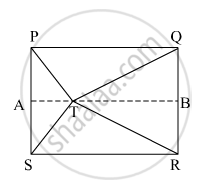
In the given figure, point T is in the interior of rectangle PQRS, Prove that, TS2 + TQ2 = TP2 + TR2 (As shown in the figure, draw seg AB || side SR and A-T-B)
Advertisements
उत्तर १
Construction: Through T, draw seg AB II side SR such that A-T-B, P- A-S and Q-B-R.
Proof:
seg PS || seg QR ...(Opposite sides of rectangle)
∴ seg AS || seg BR ...(P-A-S and Q-B-R)
also seg AB || seg SR ...(Construction)
∴ `square` ASRB is a parallelogram ...((By definition)
∠ASR = 90° ...(Angle of rectangle PSRQ)
∴ `square` ASRB is a rectangle ...(A parallelogram is a rectangle, if one of its angles is a right angle.)
∠SAB = ∠ABR = 90° ...(Angle of a rectangle)
∴ seg TA ⊥ side PS and seg TB ⊥ side QR ...(1)
AS = BR ...(2) (Opposite sides of rectangle are equal)
Similarly, we can prove AP= BQ ...(3)
In ΔTAS,
∠TAS = 90° ...[From (1)]
∴ by Pythagoras theorem,
TS2 = TA2 + AS2 ...(4)
In ΔTBQ,
∠TBQ = 90° ...[From (1)]
∴ by Pythagoras theorem,
TQ2 = TB2 + BQ2 ...(5)
Adding (4) and (5), we get,
TS2 + TQ2 = TA2 + AS2 + TB2 + BQ2 ...(6)
In ΔTAP,
∠TAP = 90° ...[From (1)]
∴ by Pythagoras theorem,
TP2 = TA2 + AP2 ...(7)
In ΔTBR,
∠TBR = 90° ...[From (1)]
∴ by Pythagoras theorem,
TR2 = TB2 + BR2 ...(8)
Adding (7) and (8), we get
TP2 + TR2 = TA2 + AP2 + TB2 + BR2
∴ TP2 + TR2 = TA2 + BQ2 + TB2 + AS2 ...(9) [From (2) and (3)]
∴ from (6) and (g), we get,
TS2 + TQ2 = TP2 + TR2
उत्तर २
Construction: Draw diagonals PR and QS and let them intersect at 0. Draw seg TO.

Proof: `square` PQRS is a rectangle ...(Given)
∴ PR=QS ...(Diagonals of rectangle are congruent)
Multiplying both the sides by `1/2`, we get,
`1/2`PR = `1/2`QS ...(1)
But, `1/2`PR = OP = OR ...(2)
and `1/2`QS = OS = OQ ...(3) [Diagonals of rectangle bisect each other]
∴ OP = OR = OS = OQ ...(4) [From (1), (2) and (3)]
In ΔTSQ,
seg TO is the median ...(By definition)
∴ by Apollonius theorem,
TS2 + TQ2 = 2TO2 + 2OQ2 ...(5)
In ΔPTR,
seg TO is the median ...(By definition)
∴ by Apollonius theorem,
TP2 + TR2 = 2TO2 + 2OR2
∴ TP2 + TR2 = 2TO2 + 2OQ2 ...(6) [From (4)]
∴ from (5) and (6), we get,
TS2 + TQ2 = TP2 + TR2
Notes
Students can refer to the provided solutions based on their preferred marks.
