Advertisements
Advertisements
प्रश्न
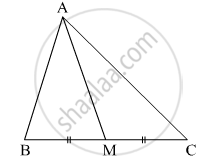
In ∆ABC, point M is the midpoint of side BC. If, AB2 + AC2 = 290 cm2, AM = 8 cm, find BC.
Advertisements
उत्तर
In ∆ABC, point M is the midpoint of side BC.
AB2 + AC2 = 2AM2 + 2BM2 ...[by Apollonius theorem]
290 = 2 (8)2 + 2BM2
290 = 2 (64) + 2BM2
290 = 128 + 2BM2
2BM2 = 290 - 128
2BM2 = 162
BM2 = 81
BM = `sqrt81`
BM = 9 cm
Point M is the midpoint of BC
∴ BC = 2BM = 2 × 9
∴ BC = 18 cm.
संबंधित प्रश्न
In the given figure, seg PS is the median of ∆PQR and PT ⊥ QR. Prove that,
PR2 = PS2 + QR × ST + `("QR"/2)^2`

Some question and their alternative answer are given.
In a right-angled triangle, if sum of the squares of the sides making right angle is 169 then what is the length of the hypotenuse?
Find the perimeter of a square if its diagonal is `10sqrt2` cm:
Some question and their alternative answer are given. Select the correct alternative.
In ∆ABC, AB = \[6\sqrt{3}\] cm, AC = 12 cm, BC = 6 cm. Find measure of ∠A.
A side of an isosceles right angled triangle is x. Find its hypotenuse.
In ∆RST, ∠S = 90°, ∠T = 30°, RT = 12 cm, then find RS and ST.
In ∆ABC, seg AP is a median. If BC = 18, AB2 + AC2 = 260, Find AP.
Seg AM is a median of ∆ABC. If AB = 22, AC = 34, BC = 24, find AM
If hypotenuse of a right angled triangle is 5 cm, find the radius of
the circle passing through all vertices of the triangle.
In ΔABC, seg AP is a median. If BC = 18, AB2 + AC2 = 260, then find the length of AP.
Out of given triplets, which is not a Pythagoras triplet?
Out of given triplets, which is not a Pythagoras triplet?
Height and base of a right angled triangle are 24 cm and 18 cm. Find the length of its hypotenuse?
"The diagonals bisect each other at right angles." In which of the following quadrilaterals is the given property observed?
In the given figure, triangle ABC is a right-angled at B. D is the mid-point of side BC. Prove that AC2 = 4AD2 – 3AB2.

