Advertisements
Advertisements
प्रश्न
In the given figure, triangle ABC is a right-angled at B. D is the mid-point of side BC. Prove that AC2 = 4AD2 – 3AB2.

Advertisements
उत्तर
Given: ∠ABC = 90°, D is mid-point of side BC.
To prove: AC2 = 4AD2 – 3AB2.
Proof: Since D is mid-point of side BC,
∴ BD = DC = `1/2` BC ......(i)
Now, in ΔABC, by Pythagoras theorem,
AB2 + BC2 = AC2
⇒ AB2 + (2BD)2 = AC2 .....[Using (i)]
⇒ AB2 + 4BD2 = AC2 ......(iii)
Similarly, in ΔABD, by Pythagoras theorem,
AB2 + BD2 = AD2
⇒ BD2 = AD2 – AB2
Putting the value of BD2 in equation (ii),
AB2 + 4(AD2 – AB2) = AC2
⇒ AB2 + 4AD2 – 4AB2 = AC2
⇒ 4AD2 – 3AB2 = AC2
or AC2 = 4AD2 – 3AB2
Hence proved.
APPEARS IN
संबंधित प्रश्न
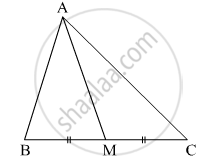
In ∆ABC, point M is the midpoint of side BC. If, AB2 + AC2 = 290 cm2, AM = 8 cm, find BC.
Some question and their alternative answer are given.
In a right-angled triangle, if sum of the squares of the sides making right angle is 169 then what is the length of the hypotenuse?
Find the perimeter of a square if its diagonal is `10sqrt2` cm:
Some question and their alternative answer are given. Select the correct alternative.
In ∆ABC, AB = \[6\sqrt{3}\] cm, AC = 12 cm, BC = 6 cm. Find measure of ∠A.
Find the height of an equilateral triangle having side 2a.
Do sides 7 cm, 24 cm, 25 cm form a right angled triangle ? Give reason
Find the length a diagonal of a rectangle having sides 11 cm and 60 cm.
A side of an isosceles right angled triangle is x. Find its hypotenuse.
In ∆RST, ∠S = 90°, ∠T = 30°, RT = 12 cm, then find RS and ST.
In ∆ABC, seg AP is a median. If BC = 18, AB2 + AC2 = 260, Find AP.
Prove that the sum of the squares of the diagonals of a parallelogram is equal to the sum of the squares of its sides.
Seg AM is a median of ∆ABC. If AB = 22, AC = 34, BC = 24, find AM
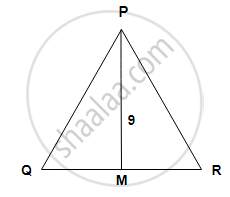
In ΔPQR, seg PM is a median, PM = 9 and PQ2 + PR2 = 290. Find the length of QR.
In ΔPQR, seg PM is the median. If PM = 9, PQ2 + PR2 = 290, Find QR.
In ΔABC, seg AP is a median. If BC = 18, AB2 + AC2 = 260, then find the length of AP.
Height and base of a right angled triangle are 24 cm and 18 cm. Find the length of its hypotenuse?
Which of the following figure is formed by joining the mid-points of the adjacent sides of a square?
