Advertisements
Advertisements
Question
In the following figure, QS ⊥ PR, RT ⊥ PQ and QS = RT.
- Is ∆QSR = ∆RTO? Give reasons.
- Is ∠PQR = ∠PRQ? Give reasons.

Advertisements
Solution
i. In ∆QSR and ∆RTQ,
∠QSR = ∠RTQ = 90° ...(∵ QS ⊥ PR and RT ⊥ PQ (given))
QS = RT ...(Given)
QR = RQ ...(Common hypotenuse)
∴ ∆QSR ≅ ∆RTQ ...(RHS criterion)
ii. Yes, by using (i) part, we get
∠TQR = ∠SRQ ...(By C.P.C.T)
⇒ ∠PQR = PRQ
APPEARS IN
RELATED QUESTIONS
Given below are measurements of some parts of two triangles. Examine whether the two triangles are congruent or not, using the RHS congruence rule. In the case of congruent triangles, write the result in symbolic form:
∆ABC, ∠A = 90°, AC = 5 cm, BC = 9 cm.
∆PQR, ∠Q = 90°, PR = 8 cm, PQ = 5 cm.
In Fig, DA ⊥ AB, CB ⊥ AB, and AC = BD. State the three pairs of equal parts in ∆ABC and ∆DAB. Which of the following statements is meaningful?
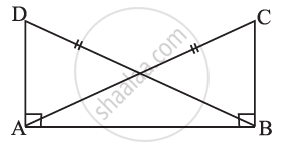
(i) ∆ABC ≅ ∆BAD
(ii) ∆ABC ≅ ∆ABD.
In Fig,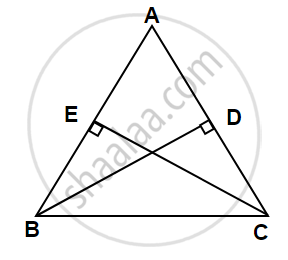
BD and CE are altitudes of ∆ABC such that BD = CE.
(i) State the three pairs of equal parts in ∆CBD and ∆BCE.
(ii) Is ∆CBD ≅ ∆BCE? Why or why not?
(iii) Is ∠DCB = ∠EBC? Why or why not?
ABC is an isosceles triangle with AB = AC and AD is one of its altitudes.
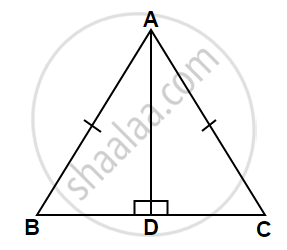
(i) State the three pairs of equal parts in ∆ADB and ∆ADC.
(ii) Is ∆ADB ≅ ∆ADC? Why or why not?
(iii) Is ∠B = ∠C? Why or why not?
(iv) Is BD = CD? Why or why not?
In the given figure, D is the midpoint of OE and ∠CDE = 90°. Prove that ΔODC ≡ ΔEDC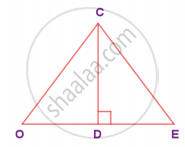
Is ΔPRQ ≡ ΔQSP? Why?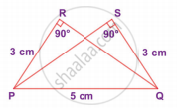
In the given pairs of triangles of the figure, using only RHS congruence criterion, determine which pairs of triangles are congruent. In congruence, write the result in symbolic form:

In the given pairs of triangles of the figure, using only RHS congruence criterion, determine which pairs of triangles are congruent. In congruence, write the result in symbolic form:

In the given pairs of triangles of the figure, using only RHS congruence criterion, determine which pairs of triangles are congruent. In congruence, write the result in symbolic form:

In the following figure, state the three pairs of equal parts in ΔABC and ΔEOD. Is ΔABC = ΔEOD? Why?

