Advertisements
Advertisements
Question
Prove theoretically (electromagnetic induction) `e = (dphi)/(dt)`
Advertisements
Solution
1) Consider a rectangular loop of conducting wire ‘PQRS’ partly placed in uniform magnetic field of induction ‘B’ as shown in figure.

2) Let 'l' be the length of the side PS and 'x' be the length of the loop within the field.
∴ A = lx = area of the loop, which lies inside the field.
3) The magnetic flux (Φ) through the area A at certain time ‘t’ is Φ = BA = Blx
4) The loop is pulled out of the magnetic field of induction ‘B’ to the right with a uniform
velocity ‘v’.
5) The rate of change of magnetic flux is given by, `(dphi)/dt = d/dt (B/x)`
`:. (dphi)/dt = Bl (dx/dt)`
But, `((dx)/(dt)) = v`
`:. (dphi)/dt` = Blv ....(1)
6) Due to change in magnetic flux, induced current is set up in the coil. The direction of this current is clockwise according to Lenz’s law. Due to this, the sides of the coil experiences the forces, F1, F2 and F as shown in figure. The directions of these forces is given by Flemings left hand rule.
7) The magnitude of force ‘F’ acting on the side PS is given by, F = BIl.
8)The force `vecF_1` and `vecF_2` are equal in magnitude and opposite in direction, therefore they cancel out. The only unbalanced force which opposes the motion of the coil is `vecF` Hence, work must be done against this force in order to pull the coil.
9) The work done in time ‘dt’ during the small displacement ‘dx’ is given by, dW = - Fdx
- ve sign shows that F and ‘dx’ are opposite to each other.
∴dW = - (BIl) dx ….(2)
10) This external work provides the energy needed to maintain the induced current I
through the loop (coil).
11) If ‘e’ is the e.m.f induced then, electric power = `(dW)/dt = eI`
∴ dW = eIdt ....3
12) From equations (2) and (3),
eIdt = - BIl dx
:. `e = -Bl(dx/dt)`
∴ e = - Blv .....(4)
13) From equation (1) and (4), `e = - (dphi)/dt`
APPEARS IN
RELATED QUESTIONS
Electric field intensity in free space at a distance ‘r’ outside the charged conducting sphere of radius ‘R’ in terms of surface charge density ‘ a ’ is............................
(a)`sigma / in_0[R/r]^2`
(b)`in_0/sigma[R/r]^2`
(c)`R/r[sigma/in_0]^2`
(d)`R/sigma[r/in_0]^2`
A solenoid of length 1.5 m and 4 cm in diameter possesses 10 turns per metre. A current of 5 A is flowing through it. The magnetic induction at a point inside the solenoid along the axis is ............................. .
(μ0 = 4π × 10-7 Wb/Am)
- π × 10-5 T
- 2π × 10-5 T
- 3π × 10-5 T
- 4π × 10-5 T
When a bar magnet is pushed towards (or away) from the coil connected to a galvanometer, the pointer in the galvanometer deflects. Identify the phenomenon causing this deflection and write the factors on which the amount and direction of the deflection depends. State the laws describing this phenomenon.
Explain different ways to induce current in a coil.
The magnetic flux through a loop is varying according to a relation `phi = 6t^2 + 7t + 1` where `phi` is in milliweber and t is in second. What is the e.m.f. induced in the loop at t = 2 second?
An emf of 2V is induced in a coil when the current in it is changed from 0A to 10A in 0·40 sec. Find the coefficient of self-inductance of the coil.
How does an electromagnet differ forma permanent magnet?
Explain why, an electromagnet is called a temporary magnet.
When current is 'switched on' and 'switched off' in a coil, a current is induced in another coil kept near it. What is this phenomenon known as?
What do you understand by the term "electromagnetic induction"? Explain with the help of a diagram.
When the magnet shown in the diagram below is moving towards the coil, the galvanometer gives a reading to the right.
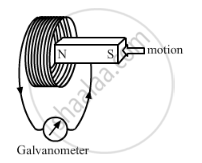
() What is the name of the effect being produced by the moving magnet?
(2) State what happens to the reading shown on the galvanometer when the magnet is moving away from the coil.
(3) The original experiment is repeated. This time the magnet is moved towards the coil at a great speed. State two changes you would notice in the reading on the galvanometer.
How is the working of an electric bell affected, if alternating current be used instead of direct current?
Describe one experiment to demonstrate the phenomenon of electromagnetic induction.
In which of the following case does the electromagnetic induction occur?
The current is stopped in a wire held near a loop of wire .
In which of the following case does the electromagnetic induction occur?
A loop of wire is held near a magnet.
When Puja, a student of 10th class, watched her mother washing clothes in the open, she observed coloured soap bubbles and was curious to know why the soap bubbles appear coloured. In the evening when her father, an engineer by profession, came home, she asked him this question. Her father explained to her the basic phenomenon of physics due to which the soap bubbles appear coloured.
(a) What according to you are the values displayed by Puja and her father?
(b) State the phenomenon of light involved in the formation of coloured soap bubbles.
Show diagrammatically how an alternating emf is generated by a loop of wire rotating in a magnetic field. Write the expression for the instantaneous value of the emf induced in the rotating loop.
Electromagnetic induction means ______.
Consider the energy density in a solenoid at its centre and that near its ends. Which of the two is greater?
A conducting square loop having edges of length 2.0 cm is rotated through 180° about a diagonal in 0.20 s. A magnetic field B exists in the region which is perpendicular to the loop in its initial position. If the average induced emf during the rotation is 20 mV, find the magnitude of the magnetic field.
Draw a simple labeled diagram of a step-up transformer.
The diagram 10 shows two coils X and Y. The coil X is connected to a battery S and a key K. The coil Y is connected to a galvanometer G.
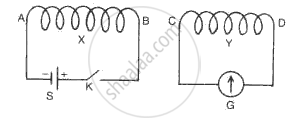
When the key K is closed. State the polarity
(i)At the end of the coil X,
(ii)At the end C of the coil Y,
(iii)At the end C of the coil Y if the coil Y is (a) Moved towards the coil X, (b) Moved away from the coil X.
Fig. shows a simple form of an A.C. generator.
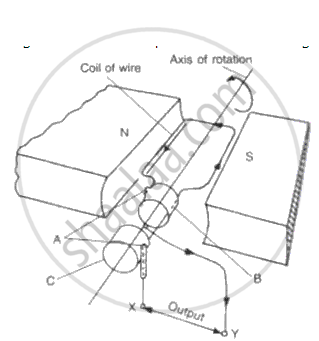
(a) Name the parts labeled A and B.
(b) What would be the effect of doubling the number of turns on the coil if the speed of rotation remains unchanged?
(c) Which of the output terminals is positive if the coil is rotating in the
direction shown in the diagram (anticlockwise)?
( d ) What is the position of the rotating coil when p.d. across its ends is zero? Explain why p.d. is zero when the coil is at this position .
(e) Sketch a graph showing how the p.d. across the ends of the rotating coil varies with time for an A.C. dynamo.
( f) On th e same sheet of paper and vertically below the first graph using the same time scale, sketch graphs to show the effect of
(i) Doubling the speed of rotation and at the same time keeping
the field and the number of turns constant,
(ii ) Doubling the number of turns on the coil and at the same time
doubling the speed of rotation of the coil, keeping th e speed
constant.
Fill in the blanks by writing (i) Only soft iron, (ii) Only steel, (iii) Both soft-iron and steel for the material of core and/or magnet.
D.C. motor ______.
A transformer has 400 turns in the primary winding and 10 turns in the secondary winding. The primary e.m.f. is 250 V and the primary current is 2.0 A. calculate:
(a) The secondary voltage,
(b) The secondary current, assuming 100% efficiency.
Complete the following diagram of a transformer and name the parts labeled A and B. Name the part you have drawn to complete the diagram . What is the material of this part? In this transformer a step-up or step-down? Why?
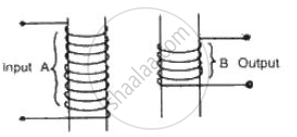
State Fleming’s Right Hand Rule.
Draw a labelled diagram to show how an electromagnet is made.
State the purpose of soft iron core used in making an electromagnet.
The energy stored in a 50 mH inductor carrying a current of 4 A is ______
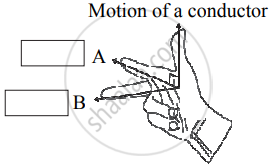
Observe the given figure of Fleming’s Right Hand Rule and write the labels of A and B correctly.
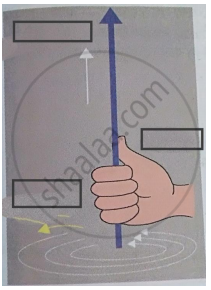
The right-hand thumb rule is also called _______ rule.
Fleming's left hand rule : electric current : : Fleming's right hand rule : _______
Write Fleming’s right hand thumb rule with the help of diagram.
Write the two names in the following diagram.
Right hand thumb rule.
A thin semi-circular conducting ring (PQR) of radius r is falling with its plane vertical in a horizontal magnetic field B, as shown in the figure.
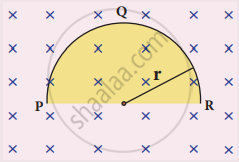
The potential difference developed across the ring when its speed v , is
State Lenz’s law.
State Fleming’s right-hand rule.
Give an illustration of determining direction of induced current by using Lenz’s law.
A straight metal wire crosses a magnetic field of flux 4 mWb in a time 0.4 s. Find the magnitude of the emf induced in the wire.
Shown in the figure below is a metre bridge set up with null deflection in the galvanometer. The value of the unknown resistance R is ______

There is a uniform magnetic field directed perpendicular and into the plane of the paper. An irregular shaped conducting loop is slowly changing into a circular loop in the plane of the paper. Then ______.
We can induce the current in a coil by ____________.
Ansari Sir was demonstrating an experiment in his class with the setup as shown in the figure below.

A magnet is attached to a spring. The magnet can go in and out of the stationary coil. He lifted the Magnet and released it to make it oscillate through the coil.
Based on your understanding of the phenomenon, answer the following question.
What is the principle which Ansari Sir is trying to demonstrate?
Ansari Sir was demonstrating an experiment in his class with the setup as shown in the figure below.
A magnet is attached to a spring. The magnet can go in and out of the stationary coil. He lifted the Magnet and released it to make it oscillate through the coil.
Based on your understanding of the phenomenon, answer the following question.
What will be observed when the Magnet starts oscillating through the coil. Explain the reason behind this observation.
Induced current flows through a coil ______.
A conducting bar of length L is free to slide on two parallel conducting rails as shown in the figure

Two resistors R1 and R2 are connected across the ends of the rails. There is a uniform magnetic field `vec"B"` pointing into the page. An external agent pulls the bar to the left at a constant speed v. The correct statement about the directions of induced currents I1 and I2 flowing through R1 and R2 respectively is:
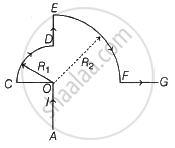
In the current carrying conductor (AOCDEFG) as shown, the magnetic induction at point O is ______.
(R1 and R2 are radii of CD and EF respectively. l = current in the loop, μ0 = permeability of free space)
Show that for a given positive ion species in a cyclotron, (i) the radius of their circular path inside a dee is directly proportional to their speed, and (ii) the maximum ion energy achievable is directly proportional to the square of the magnetic induction.
A sheet is placed on horizontal surface in front of a strong magnetic pole. A force is needed to:
- hold the sheet there if it is magnetic.
- hold the sheet there if it is non-magnetic.
- move the sheet away from the pole with uniform velocity if it is conducting.
- move the sheet away from the pole with uniform velocity if it is both, non-conducting and nonpolar.
Choose the correct statement(s) from the options given below:
