Advertisements
Advertisements
प्रश्न
Prove theoretically (electromagnetic induction) `e = (dphi)/(dt)`
Advertisements
उत्तर
1) Consider a rectangular loop of conducting wire ‘PQRS’ partly placed in uniform magnetic field of induction ‘B’ as shown in figure.

2) Let 'l' be the length of the side PS and 'x' be the length of the loop within the field.
∴ A = lx = area of the loop, which lies inside the field.
3) The magnetic flux (Φ) through the area A at certain time ‘t’ is Φ = BA = Blx
4) The loop is pulled out of the magnetic field of induction ‘B’ to the right with a uniform
velocity ‘v’.
5) The rate of change of magnetic flux is given by, `(dphi)/dt = d/dt (B/x)`
`:. (dphi)/dt = Bl (dx/dt)`
But, `((dx)/(dt)) = v`
`:. (dphi)/dt` = Blv ....(1)
6) Due to change in magnetic flux, induced current is set up in the coil. The direction of this current is clockwise according to Lenz’s law. Due to this, the sides of the coil experiences the forces, F1, F2 and F as shown in figure. The directions of these forces is given by Flemings left hand rule.
7) The magnitude of force ‘F’ acting on the side PS is given by, F = BIl.
8)The force `vecF_1` and `vecF_2` are equal in magnitude and opposite in direction, therefore they cancel out. The only unbalanced force which opposes the motion of the coil is `vecF` Hence, work must be done against this force in order to pull the coil.
9) The work done in time ‘dt’ during the small displacement ‘dx’ is given by, dW = - Fdx
- ve sign shows that F and ‘dx’ are opposite to each other.
∴dW = - (BIl) dx ….(2)
10) This external work provides the energy needed to maintain the induced current I
through the loop (coil).
11) If ‘e’ is the e.m.f induced then, electric power = `(dW)/dt = eI`
∴ dW = eIdt ....3
12) From equations (2) and (3),
eIdt = - BIl dx
:. `e = -Bl(dx/dt)`
∴ e = - Blv .....(4)
13) From equation (1) and (4), `e = - (dphi)/dt`
APPEARS IN
संबंधित प्रश्न
The magnetic flux through a loop varies according to the relation Φ = 8t2 + 6t + C, where ‘C’ is constant, 'Φ' is in milliweber and 't' is in second. What is the magnitude of induced e.m.f. in the loop at t = 2 seconds.
State Fleming’s right-hand rule.
State three differences between direct current and alternating current.
A metal rod `1/sqrtpi `m long rotates about one of its ends perpendicular to a plane whose magnetic induction is 4 x 10⁻³ T. Calculate the number of revolutions made by the rod per second if the e.m.f. induced between the ends of the rod is 16 mV.
The phenomenon of electromagnetic induction is
A rectangular wire loop of sides 8 cm and 2 cm with a small cut is moving out of a region of uniform magnetic field of magnitude 0.3 T directed normal to the loop. What is the emf developed across the cut if the velocity of the loop is 1 cm s−1 in a direction normal to the
- longer side,
- shorter side of the loop?
For how long does the induced voltage last in each case?
A horizontal straight wire 10 m long extending from east to west is falling with a speed of 5.0 m s−1, at right angles to the horizontal component of the earth’s magnetic field, 0.30 × 10⁻⁴ Wb m−2.
- What is the instantaneous value of the emf induced in the wire?
- What is the direction of the emf?
- Which end of the wire is at the higher electrical potential?
The magnetic flux through a loop is varying according to a relation `phi = 6t^2 + 7t + 1` where `phi` is in milliweber and t is in second. What is the e.m.f. induced in the loop at t = 2 second?
If ‘R’ is the radius of dees and ‘B’ be the magnetic field of induction in which positive charges (q) of mass (m) escape from the cyclotron, then its maximum speed (vmax) is _______.
A) `(qR)/(Bm)`
B)`(qm)/(Br)`
C) `(qBR)/m`
D) `m/(qBR)`
Write some of the important uses of electromagnets.
The north-south polarities of an electromagnet can be found easily by using:
(a) Fleming's right-hand rule
(b) Fleming's left-hand rule
(c) Clock face rule
(d) Left-hand thumb rule
The most suitable material for making the core of an electromagnet is:
(a) soft iron
(b) brass
(c) aluminium
(d) steel
State whether the following statement are true or false:
A generator works on the principle of electromagnetic induction.
Describe different ways to induce current in a coil of wire.
In which of the following case does the electromagnetic induction occur?
A magnet is moved through a loop of wire .
Consider the energy density in a solenoid at its centre and that near its ends. Which of the two is greater?
A conducting rod is moved with a constant velocity v in a magnetic field. A potential difference appears across the two ends _____________ .
The switches in figure (a) and (b) are closed at t = 0 and reopened after a long time at t = t0.
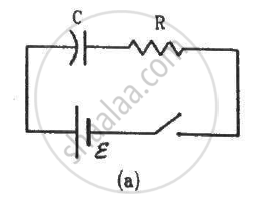
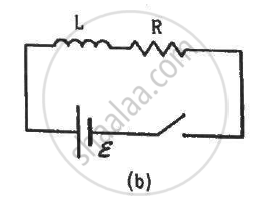
(a) The charge on C just after t = 0 is εC.
(b) The charge on C long after t = 0 is εC.
(c) The current in L just before t = t0 is ε/R.
(d) The current in L long after t = t0 is ε/R.
Calculate the dimensions of (a) \[\int \overrightarrow{E} . d \overrightarrow{l,}\] (b) vBl and (c) \[\frac{d \Phi_B}{dt}.\] The symbols have their usual meaning.
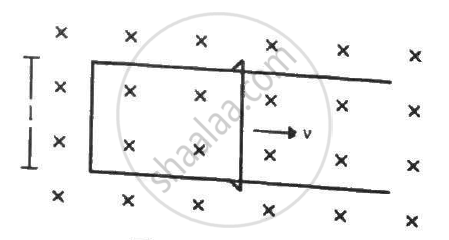
Figure shows a long U-shaped wire of width l placed in a perpendicular magnetic field B. A wire of length l is slid on the U-shaped wire with a constant velocity v towards right. The resistance of all the wires is r per unit length. At t = 0, the sliding wire is close to the left edge of the U-shaped wire. (a) Calculate the force needed to keep the sliding wire moving with a constant velocity v. (b) If the force needed just after t = 0 is F0, find the time at which the force needed will be F0/2.0
Can a transformer work when it is connected to a D.C. source? Give a reason.
The following diagram shows a fixed coil of several turns connected to a center zero galvanometer G and a magnet NS which can move in the direction shown in the diagram.
- Describe the observation in the galvanometer if
- The magnet is moved rapidly,
- The magnet is kept still after it has moved into the coil
- The magnet is then rapidly pulled out the coil.
- How would the observation in (i) of part (a) change if a more powerful magnet is used?

Fill in the blanks by writing (i) Only soft iron, (ii) Only steel, (iii) Both soft-iron and steel for the material of core and/or magnet.
D.C. motor ______.
What is an electromagnet?
Draw a labelled diagram to show how an electromagnet is made.
What is an electromagnet? What do you know about the simplest form of an electromagnet?
Draw a labelled diagram to make an electromagnet from a soft iron bar. Mark the polarity at its ends in your diagram. What precaution would you observe while making it?
The energy stored in a 50 mH inductor carrying a current of 4 A is ______
Write Fleming’s right hand thumb rule with the help of diagram.
A thin semi-circular conducting ring (PQR) of radius r is falling with its plane vertical in a horizontal magnetic field B, as shown in the figure.
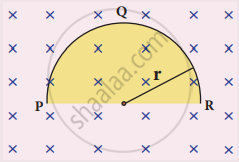
The potential difference developed across the ring when its speed v , is
State Lenz’s law.
A straight metal wire crosses a magnetic field of flux 4 mWb in a time 0.4 s. Find the magnitude of the emf induced in the wire.
An alternating emf of 0.2 V is applied across an L-C-R series circuit having R = 4Q, C = 80µF, and L = 200 mH. At resonance the voltage drop across the inductor is
A layer of atmosphere that reflects medium frequency radio waves which is ineffective during night, is ______.
A cylindrical bar magnet is kept along the axis of a circular coil. If the magnet is rotated about its axis, then ____________.
A metal plate can be heated by ______.
The instrument that use to defect electric current in the circuit is known as ____________.
What should be the core of an electromagnet?
Ansari Sir was demonstrating an experiment in his class with the setup as shown in the figure below.

A magnet is attached to a spring. The magnet can go in and out of the stationary coil. He lifted the Magnet and released it to make it oscillate through the coil.
Based on your understanding of the phenomenon, answer the following question.
What will be observed when the Magnet starts oscillating through the coil. Explain the reason behind this observation.
Induced current flows through a coil ______.
A galvanometer is an instrument that can detect the presence of a current in a circuit.
A 0.4 m wire, stretched horizontally, carries an electric current of 15 A, in a magnetic field whose magnetic field intensity is 0.1 N/Am. What is the magnitude of the wire?
A current I = 10 sin(100π t) A is passed in first coil, which induces a maximum e.m.f of 5π volt in second coil. The mutual inductance between the coils is ______.
An expression for oscillating electric field in a plane electromagnetic wave is given as Ez = 300 sin(5π × 103x - 3π × 1011t)Vm-1 Then, the value of magnetic field amplitude will be ______. (Given: speed of light in Vacuum c = 3 × 10⁸ ms-1)
When an electric current is passed through a wire or a coil, a magnetic field is produced. Is the reverse phenomenon possible i.e, can a magnetic field produce an electric current? Explain with the help of an appropriate example.
A sheet is placed on horizontal surface in front of a strong magnetic pole. A force is needed to:
- hold the sheet there if it is magnetic.
- hold the sheet there if it is non-magnetic.
- move the sheet away from the pole with uniform velocity if it is conducting.
- move the sheet away from the pole with uniform velocity if it is both, non-conducting and nonpolar.
Choose the correct statement(s) from the options given below:
Which movement of a coil can produce a current?
What is a coil?
What is a solenoid?
Which type of motor works on electromagnetic induction?
