Advertisements
Advertisements
Question
Give a reason for the following:
It is necessary to use satellites for long-distance TV transmission. Why?
Advertisements
Solution
- It is necessary to use satellites for long-distance TV transmissions because television signals are of high frequencies and high energies. Thus, these signals are not reflected by the ionosphere.
- Hence, satellites are helpful in reflecting TV signals. Also, they help in long-distance TV transmissions.
RELATED QUESTIONS
How are infrared waves produced?
Use the formula λm T= 0.29 cm K to obtain the characteristic temperature ranges for different parts of the electromagnetic spectrum. What do the numbers that you obtain tell you?
The small ozone layer on top of the stratosphere is crucial for human survival. Why?
If the earth did not have an atmosphere, would its average surface temperature be higher or lower than what it is now?
State an additional use of the X-rays waves
A wave has wavelength 50 Å.
- Name the wave.
- State its speed in vacuum.
- State its one use.
What do you understand by the statement, "Electromagnetic waves transport momentum"?
The wavelengths for the light of red and blue colours are roughly 7.8 × `10^7` m and 4.8 × `10^7` m respectively.
(a) Which colour has the greater speed in vacuum?
(b) Which colour has the greater speed in glass?
State the approximate range of wavelength associated with infrared rays.
Give one use of ultraviolet radiation.
Name the waves used for taking photographs in dark.
Name two sources, each of infrared radiations and ultraviolet radiations.
In a Coolidge tube, electrons strike the target and stop inside it. Does the target get more and more negatively charged as time passes?
Can X-rays be used for photoelectric effect?
Characteristic X-rays may be used to identify the element from which they are being emitted. Can continuous X-rays be used for this purpose?
Is it possible that in a Coolidge tube characteristic Lα X-rays are emitted but not Kα X-rays?
Can a hydrogen atom emit characteristic X-rays?
Frequencies of Kα X-rays of different materials are measured. Which one of the graphs in the figure may represent the relation between the frequency v and the atomic number Z ?
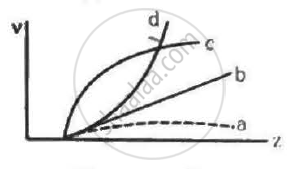
One of the following wavelengths is absent and the rest are present in the X-rays coming from a Coolidge tube. Which one is the absent wavelength?
Iron emits Kα X-ray of energy 6.4 keV. Calculate the times taken by an iron Kα photon to cross through a distance of 3 km.
(Use Planck constant h = 4.14 × 10⁻¹⁵ eVs, speed of light c = 3 × 10⁸ m/s.)
What potential difference should be applied across an X-ray tube to get X-ray of wavelength not less than 0.10 nm? What is the maximum energy of a photon of this X-ray in joule?
(Use Planck constant h = 6.63 × 10⁻³⁴ Js= 4.14 × 10⁻¹⁵ eVs, speed of light c = 3 × 10⁸ m/s.)
The X-ray coming from a Coolidge tube has a cutoff wavelength of 80 pm. Find the kinetic energy of the electrons hitting the target.
(Use Planck constant h = 6.63 × 10⁻³⁴ Js= 4.14 × 10⁻¹⁵ eVs, speed of light c = 3 × 10⁸ m/s.)
The Kβ X-ray of argon has a wavelength of 0.36 nm. The minimum energy needed to ionize an argon atom is 16 eV. Find the energy needed to knock out an electron from the K shell of an argon atom.
The Kα and Kβ X-rays of molybdenum have wavelengths 0.71 A and 0.63 A respectively. Find the wavelength of Lα X-ray of molybdenum.
The energy of a silver atom with a vacancy in K shell is 25.31 keV, in L shell is 3.56 keV and in M shell is 0.530 keV higher than the energy of the atom with no vacancy. Find the frequency of Kα, Kβ and Lα X-rays of silver.
(Use Planck constant h = 6.63 × 10⁻³⁴ Js= 4.14 × 10⁻¹⁵ eVs, speed of light c = 3 × 10⁸ m/s.)
An X-ray tube operates at 40 kV. Suppose the electron converts 70% of its energy into a photon at each collision. Find the lowest there wavelengths emitted from the tube. Neglect the energy imparted to the atom with which the electron collides.
(Use Planck constant h = 6.63 × 10⁻³⁴ Js= 4.14 × 10⁻¹⁵ eVs, speed of light c = 3 × 10⁸ m/s.)
Name the scientist who discovered Infra-red waves
| Gamma rays | D | C | Visible light | B | A |
The above table shows different parts of the electromagnetic spectrum.
(a) Identify the parts of the spectrum marked as A, B, C and D.
(b) Which of the radiations A or B has the higher frequency?
(c) State two properties which are common to all parts of the electromagnetic spectrum.
(d) Name one source of each of the radiation of electromagnetic spectrum.
(e) Name one detector for each of the radiation.
(f) Name one use of each of the radiation.
-
- Calculate the speed of the wave.
- Name the medium through which it is traveling.
Name the part of the electromagnetic spectrum which is:
Suitable for radar systems used in aircraft navigation.
Identify the part of the electromagnetic spectrum used in (i) radar and (ii) eye surgery. Write their frequency range.
State three properties of ultra-violet radiation similar to visible light.
Give one use of electromagnetic radiation in Microwaves.
What is the wavelength of the wave whose frequency is 1012 Hz? Name the electromagnetic wave.
Solve the numerical problem.
Calculate the frequency in MHz of a radio wave of wavelength 250 m. Remember that the speed of all EM waves in a vacuum is 3.0 × 10⁸ m/s.
Solve the numerical problem.
The speed of light is 3 × 10⁸ m/s. Calculate the frequency of red light of a wavelength of 6.5 × 10⁻⁷ m.
Light of wavelength `3500A` is incident on two metals A and B whose work functions are 3.2 eV and 1.9 eV respectively. Which metal will emit photoelectrons?
Following QN ∴ 14, the radiation force on the roof will be
Electromagnetic waves with wavelength
- λ1 is suitable for radar systems used in aircraft navigation.
- λ2 is used to kill germs in water purifiers.
- λ3 is used to improve visibility in runways during fog and mist conditions.
Identify and name the part of the electromagnetic spectrum to which these radiations belong. Also arrange these wavelengths in ascending order of their magnitude.
The half-value thickness of an absorber is defined as the thickness that will reduce exponentially the intensity of a beam of particles by a factor of 2. The half-value thickness in (µm) for lead assuming X-ray beam of wavelength 20 pm, µ = 50 cm-1 for X-rays in lead at wavelength λ = 20 pm, is ______ µm.
In uranium (Z = 92) the K absorption edge is 0.107 Å and the Kα line is 0.126 Å, and the wavelength of the L absorption edge is ______.
Identify the electromagnetic radiation and write its wavelength range, which is used to kill germs in water purified. Name the two sources of these radiations.
Name one radiation having the wavelength longer than the wavelength of these radiations.
What happens to wavelength as the frequency of electromagnetic radiation increases?
How do the wavelengths and frequencies of microwaves compare with those of radio waves?
Which set lists uses of ultraviolet rays?
