Advertisements
Advertisements
Question
Explain the mechanism of action of hydroiodic acid on 3-methylbutan-2-ol.
Advertisements
Solution

Mechanism:
Step-1:
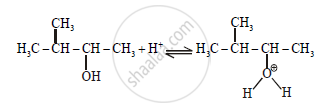
Step-2:
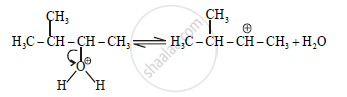
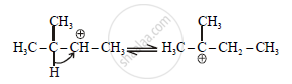
Step-3:
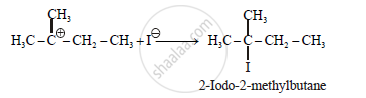
APPEARS IN
RELATED QUESTIONS
How are propan-1-amine and propan-2-amine prepared from oxime?
How do you convert the following: Ethanenitrile to ethanamine
Give the structures of A, B and C in the following reactions :

Give the structures of A, B and C in the following reactions :

Give the structure of A, B and C in the following reaction:
\[\ce{CH3CH2I ->[NaCN] A ->[OH-][Partial hydrolysis] B ->[NaOH + Br2] C}\]
Give the structure of A, B and C in the following reaction:
\[\ce{C6H5NO2 ->[Fe/HCl] A ->[NaNO2 + HCl][273 K] B ->[H2O/H+][\Delta] C}\]
Give a plausible explanation for the following:
Why are amines less acidic than alcohols of comparable molecular masses?
Mention 'two' uses of propan-2-one.
Identify 'A' and 'B' in the following reaction and rewrite the complete reaction :

Give the structures of A, B and C in the following reactions :

Account for the following:
Gabriel phthalimide synthesis is not preferred for preparing aromatic primary amines.
Answer in one sentence.
Predict the product of the following reaction.
\[\ce{Nitrobenzene ->[Sn/conc.HCl]?}\]
Answer the following
Identify A and B in the following reactions.
\[\ce{C6H5CH2Br->[alco.][KCN]A ->[Na/ethanol]B.}\]
Name the process of breaking C-X bond by ammonia in preparation of amines.
Explain Hoffmann’s exhaustive alkylation with suitable reactions.
The end product C of the following reaction is
\[\ce{C2H5NH2 ->[HNO2] A ->[PCl5] B ->[NH3][Alcohol] C}\]
Which of the following amines exhibits maximum degree of intermolecular hydrogen bonding?
\[\ce{CH3-CN ->[Na/C2H5OH]}\]
The product formed is ____________.
Which of the following amines forms a clear solution when treated with benzene sulphonyl chloride and excess of potassium hydroxide?
Identify the product obtained when benzamide is treated with bromine and aqueous sodium hydroxide?
Identify product B in the following reaction.
\[\ce{Aniline ->[NaNO2][HCl] A ->[KI] B}\]
Which of the following does NOT give carbylamine test?
Which of the following reactions does NOT yield an amine?
Nitro compounds are reduced by iron scrap and hydrochloric acid to yield one of the following compounds:
Quaternary ammonium salt is formed:
Given below are two statements labelled as Assertion (A) and Reason (R).
Assertion (A): Alkyl halides are insoluble in water.
Reason (R): Alkyl halides have halogen attached to sp3 hybrid carbon.
Select the most appropriate answer from the options given below:
Amongst the following, the strongest base in aqueous medium is ______.
Amongst the given set of reactants, the most appropriate for preparing 2° amine is ______.
Hoffmann Bromamide Degradation reaction is shown by ______.
Reduction of aromatic nitro compounds using \[\ce{Fe}\] and \[\ce{HCl}\] gives ______.
Which of the following methods of preparation of amines will give same number of carbon atoms in the chain of amines as in the reactant?
The reagents that can be used to convert benzenediazonium chloride to benzene are:
(i) \[\ce{SnCl2/HCl}\]
(ii) \[\ce{CH3CH2OH}\]
(iii) \[\ce{H3PO2}\]
(iv) \[\ce{LiAlH4}\]
Which of the following reactions are correct?
(i)

(ii)

(iii)

(iv)

What is the product when \[\ce{C6H5CH2NH2}\] reacts with \[\ce{HNO2}\]?
Write following conversions:
acetanilide `->` p-nitroaniline
Match the reactions given in Column I with the statements given in Column II.
| Column I | Column II | ||
| (i) | Ammonolysis | (a) | Amine with lesser number of carbon atoms |
| (ii) | Gabriel phthalimide synthesis | (b) | Detection test for primary amines. |
| (iii) | Hoffmann Bromamide reaction | (c) | Reaction of phthalimide with \[\ce{KOH}\] and \[\ce{R-X}\] |
| (iv) | Carbylamine reaction | (d) | Reaction of alkylhalides with \[\ce{NH3}\] |
Assertion: Hoffmann’s bromamide reaction is given by primary amines.
Reason: Primary amines are more basic than secondary amines.
The Gabriels' phthalimide synthesis is used in the synthesis of
Which of the following reactions will not give a primary amine?
Ethylamine can be prepared by the action of bromine and caustic potash on which compound?
In the given reaction what is the X?
\[\begin{array}{cc}
\ce{O}\phantom{.......................}\\
||\phantom{.......................}\\
\phantom{}\ce{R - C - OH <-[H3O] Χ ->[H] RCH2NH2}
\end{array}\]
C6H5CONHCH3 can be converted into C6H5CH2NHCH3 by:-
Give reasons for the following:
Ammonolysis of alkyl halides is not a good method to prepare pure primary amines.
Methyl amine on reaction with chloroform in the presence of NaOH gives ______.
Which of the following amines can be prepared by Gabriel phthalimide reaction?
Which of the following statement(s) is/are incorrect in case of Hofmann bromamide degradation?
What is the IUPAC name of \[\ce{(CH3)2 - N - CH3}\]?
Identify the product ‘C’ in the following reaction.
\[\ce{Aniline ->[(CH3CH)2O][Pyridine] A ->[Br2][CH3COOH] B ->[H^+ or OH^-] C}\]
Write the name of the product formed by the action of LiAlH4/ether on acetamide.
Amides can be converted into amines by the reaction named ______.
Write short note on the following:
Ammonolysis
Write a short note on the following:
Ammonolysis
Write a short note on Ammonolysis.
Write short note on the following:
Ammonolysis
Write short note on the following.
Ammonolysis.
Write short notes on the following:
Ammonolysis
Write a short note on the following:
Ammonolysis
