Advertisements
Advertisements
Question
Explain how the formation of a rainbow occurs.
Advertisements
Solution
(i) The formation of a rainbow in the sky is a combined result of refraction, dispersion and reflection of sunlight by water droplets present in the atmosphere after it has rained.

(ii) Sunlight is a mixture of seven colours: Violet, indigo, blue, green, yellow, orange and red. After it has stopped raining, the atmosphere contains a large number of water droplets. When sunlight is incident on a water droplet, there is
- Refraction and dispersion of light as it passes from air to water
- Internal reflection of light inside the droplet
- Refraction of light as it passes from water to air
(iii) The refractive index of water is different for different colours, being maximum for violet and minimum for red. Hence, there is dispersion of light (separation into different colours) as it passes from air to water.
(iv) The combined action of different water droplets (acting like tiny prisms) produces a rainbow with red colour on the outer side and violet colour on the inner side. The remaining five colours lie between these two colours. The rainbow is seen when the Sun is behind the observer and the water droplets are in the front.
APPEARS IN
RELATED QUESTIONS
Choose the correct alternative and rewrite the following sentence.
A ray of light strikes the glass slab at an angle of 50°. What is the angle of incidence?
A student very cautiously traces the path of a ray through a glass slab for different values of the angle of incidence (∠i). He then measures the corresponding values of the angle of refraction (∠r) and the angle of emergence (∠e) for every value of the angle of incidence. On analysing these measurements of angles, his conclusion would be
(A) ∠i > ∠r > ∠e
(B) ∠i = ∠e > ∠r
(C) ∠i < ∠r < ∠e
(D) ∠i = ∠e < ∠r
Draw a ray diagram to show the refraction of a monochromatic ray through a prism when it suffers minimum deviation
Write a relationship between the angle of incidence and angle of refractions for a given pair of media
The speed of light in glass is 2 × 10⁵ km/s. What is the refractive index of glass?
Draw the diagram given below and clearly show the path taken by the emergent ray.
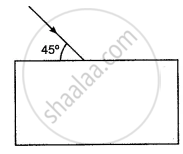
Draw the diagram of refraction of light in the glass slab
For which colour of white light, is the refractive index of a transparent medium the most?
A light ray in passing from water to a medium
(a) speeds up
(b) slows down. In each case, give one example of the medium.
A ray of light is passing from a transparent medium 1 to another transparent medium 2 (i) Speed up (ii) slows down. In each case, state whether the refractive index of medium 2 is equal to, less than or greater than the refractive index of medium 1.
The diagram alongside shows the refraction of a ray of light from air to a liquid.
- Write the values of (i) angle of incidence, (ii) angle of refraction.
- Use Snell’s law to find the refractive index of liquid with respect to air.

Name the colour of white light which is deviated the most on passing through a prism.
A postage stamp kept below a rectangular glass block of refractive index 1.5 when viewed from vertically above it, appears to be raised by 7.0 mm. Calculate the thickness of the glass slab.
The refractive index of air with respect to glass is expressed as `""_g μ_a=sin i /sin r`.
- Write down a similar expression for aμg in terms of the angles i and r.
- If angle r = 90°, what is the corresponding angle i called?
- What is the physical significance of the angle i in part (b)?
Observe the figure and write accurate conclusion regarding refraction of light.
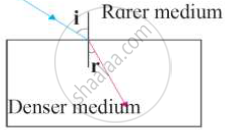
(i) What is the relation between the refractive index of water with respect to air `("_aμ_\text(w))` and the refractive index of air with respect to water `("_\text(w)μ_ a)` .
(ii) If the refractive index of water with respect to air `("_aμ_\text(w))` is`5/3`. Calculate the refractive index of air with respect to water `("_\text(w)μ_ a)` .
Define the term refractive index of a medium. What do you understand by the statement 'the refractive index of glass is 1.5 for white light'?
Make the correct for each of the following :
With reference to the fig, the refractive index of the glass block is
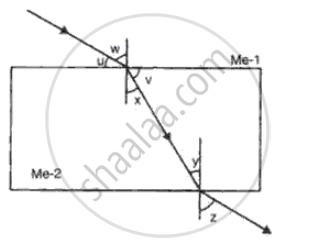
The critical angle for glass-air interface is :
Choose the correct alternative and rewrite the following:
A glass slab is placed in the path of convergent light. The point of convergence of light
Why does a fisherman aim at the tail of fish during spearfishing?
Name one main factor on which the direction of bending of a ray of light depends.
What should be the ratio of the speed of light through the liquid to the speed through the glass so that there is no refraction of light at the boundaries of the glass block when the system is illuminated by the light of one colour?
Comment on the statement ‘The refractive index of glass is 3/2.’
What do you understand by the deviation produced by a prism?
The refractive index of air with respect to glass is defined: as gµa = sin i/sin r
If r = 90°, what is the corresponding angle i called?
After a robbery, if a window has been broken, there will be tiny particles of glass. Some of these will be found at the scene of the crime and some may be caught in the thief’s clothing. If the police can prove that these particles are identical, they have a strong case.
A method of doing this is to suspend the particles of glass in a special liquid. Light of a single colour is thrown through the liquid and the particles viewed through a microscope. The temperature of the liquid is then slowly altered. This alters the speed of light through the liquid (i.e., it alters the refractive index). At one particular temperature, the particles of glass disappear. It this happens at the same temperature for both sets of glass particles, they probably came from the same broken pane of glass.
Complete and copy the diagram to show how light bends when it travels from the liquid to the glass and back to the liquid, If the light slows down in the glass.
How does the angle of deviation produced by a prism depend on the angle of incidence of light at the prism surface? Draw a graph to illustrate your answer.
How will you verify the laws of refraction or how the refractive index of glass is determined in the laboratory?
The diagram shows the path of a ray of light through a rectangular glass block placed in a liquid of uniform density.

What is the angular, deviation of the emergent ray from the glass block with respect to the incident ray?
Trace a ray of light incident at 30° on a surface if travelling from glass to air. What is the angle of refraction in this case? (R.I. for glass = 3/2).
Draw a diagram of a prism and label:
(i) the base,
(ii) the refracting surfaces,
(iii) the refracting edge,
(iv) the refracting angle in it.
A ray of light PQ is incident normally on the hypotenuse of a right-angled prism ABC as shown in the diagram given below:

(i) Copy the diagram and complete the path of the ray PQ till it emerges from the prism.
(ii) What is the value of the angle of deviation of the ray?
(iii) Name an instrument where this action of the prism is used.
The speed of light in air is 3 × 10⁸ ms-1. Calculate the speed of light in water. The refractive index of water is 4/3.
A coin placed at the bottom of a beaker appears to be raised by 4.0 cm. If the refractive index of water is 4/3, find the depth of the water in the beaker.
