Advertisements
Advertisements
Question
Discuss in pairs or in small groups
The Indian family system offers more security to the aged than what is found in the West.
Advertisements
Solution
DISCLAIMER
In India, the very basic family values which are followed are respecting elders, taking care of parents at old age, respecting our Guru or spiritual teacher, contributing towards the society and mankind as a whole selflessly and passing on our cultural, spiritual and ancient heritage to our children. It is very well known and a very age-old fact of Indians to take care of their parents in old age. Senior citizen homes and assisted living concept has just begun. They are still more prominent and often practised abroad and not in India. In India, it is still considered a taboo and hasn't yet become conventional to send our aged parents or relatives to Old Age Homes. Taking care of parents in their old age is a basic duty of a child – and, as believed in India, he or she gets a lot of ‘sukarma’ points for doing so, and substantial negative karma for not doing so.
The elderly in India are generally obeyed, revered, considered to be fountains of knowledge and wisdom, and treated with respect and dignity by family and community members, unlike the way aged people are treated abroad. Old age is a time when a person is expected to relax, enjoy solitude, retirement, pray, enjoy spending time with the grandchildren, and not worry about running the household or about finances because the oldest son is now in charge of the finances and family matters, and the oldest daughter-in-law is generally running the household. In most instances, the elderly care for their grandchildren and assist with cooking and household chores. Even grown-up children continue to consult their parents on most of the important aspects of life.
APPEARS IN
RELATED QUESTIONS
In the following items, sentence A is complete, while sentence B is not. Complete sentence B, making it as similar as possible to sentence A. Write sentence B.
(A) He is so old that be cannot remember events of the past.
(B) He is too ............................................................................
Fill in the blank with the suitable word.
The Principal looks _____________ matters of complaint from teachers and students.
In what way is the poet relevant to our times?
What was the great victory? Who had won the victory?
Can it be argued that this is an anti- war poem?
Explain and discuss the themes in the poem.
Describe in your own words the poet’s feelings when he sees the host of golden daffodils ?
Show liow Narayan depicts women in the story and their role in a man’s life.
What is the theme of all summer in a day by Ray Bradbury?
Why was Margot unhappy on Venus in “All Summer in a Day”?
Relate something unpleasant that happened to you during your childhood that nevertheless helped you to grow up and mature.
They have to go to bed early every night. They are allowed to stay update on Saturdays.
The programme ran________six hours.
Study the picture given below. Write a story or a description or an account of what it suggests to you. Your composition may be about the subject of the picture or you may take suggestions from it; however, there must be a clear connection between the picture and your composition.
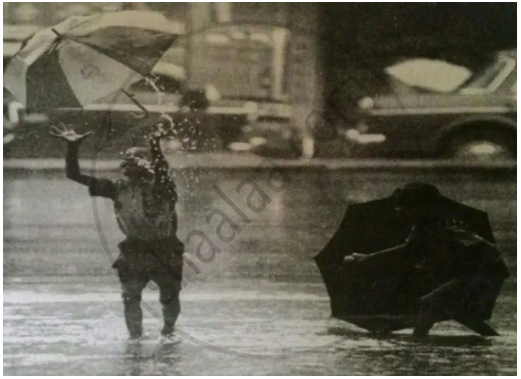
In your opinion, does Boori Ma, the main protagonist of the story A Real Durwan, deserve the life that she meets at the end of the story? Give reasons for your answer.
I prefer going out with friends to staying alone at home.
(Begin : I would rather ………….)
Think of a time when you found yourself in an embarrassing situation. Narrate how you got into that situation, how you dealt with it and the lesson you learned from it.
Write an original short story that begins with the words: "It was raining hard that night. In my hurry to get into the house, I didn't notice the black car parked across the road. I realized something was, wrong when .........
‘Catamaran’ is a kind of a boat. Do you know which Indian language this word is derived from? Check the dictionary.
Notice these expressions in the text. Infer their meaning from the context.
-
anecdote
-
delicate realism
-
figurative painting
-
illusionistic likeness
-
conceptual space
Discuss the following statement in groups of four.
“The landscape is an inner one, a spiritual and conceptual space.”
The contrast between the outward elegance of a person and his private behaviour.
‘Mrs. Croft’s was the first death I mourned in America, for, hers was the first life I had admired; she had left this world, at last, ancient and alone, never to return’—how do these lines encapsulate the bond that is possible between two strangers?
Give reasons for the following.
Satyajit’s recollection of the forgerer when he was on the train.
‘Forgiveness is often better than punishment’. Write two paragraphs – one for and another against this notion.
Go to your college library and collect and read the poems written by Sarojini Naidu.
Find out information about the Mahavastra of Maharashtra - Paithani.
What was the quarrel about between the brother and his sister? How did they become friends again?
Re-word the lines from the story:
I had heard a great deal about Miss Beam’s school.
Write a summary of the poem using the following points.
- Title
- Introductory paragraph (about the poem, type, Nature, tone)
- Main body (central idea, the gist of the poem)
- Conclusion (opinion, views, appeal)
Complete the tabular columns to specify Dos and Don’ts associated with the 'Expansion of Ideas'.
| Expansion of Ideas | |
| Dos | Don’ts |
| (i) Begin impressively | (i) Do not go off-track |
| (ii) | (ii) |
| (iii) | (iii) |
| (iv) | (iv) |
Think of different ways of classifying them, for example, electric and non-electric, day-time sources and night-time sources
Hold a discussion in the classroom about the differences between printed newspapers, radio news bulletins, TV news bulletins. Discuss the merits, demerits, and popularity of each.
Discuss the following elements of a detective or mystery story.
- a mystery
- strange happenings
- a smart detective who investigates the happenings
- a crime/possibility of a crime
- preventing the crime and catching the criminal.
- characteristics of the victim
- characteristics of the criminal
- characteristics of the detective
Use the elements to prepare outlines of detective stories using your imagination. Write a story using any one of the outlines.
Write your own interpretation of the story.
Have you ever eaten any fruit/vegetable picking it straight from the tree or field? Write about that experience in 3-5 lines.
Discuss with your friend/brother/sister/your classmate and write your list of wishes to make your village/town/city people happy.
You can use the following words.
- great
- wish
- share
- talk
- help
- cooperate
- communicate
Expand the theme in a write-up of about 20 lines.
‘Rumours are spread by fools and accepted by greater fools.’
How can you prove this maxim to be incorrect - ‘Too many cooks spoil the broth’. Write a counterview on the given topic. (Clue - Teamwork)
You have an Environment Protection Week to be celebrated in your school. You have invited an environmentalist. You have to interview him/her about how to save environment. Frame about 10-12 questions for the interview.
Imagine that you are the Captain of your team. A famous cricketer is going to visit your school. You are assigned the task to conduct an interview of that famous cricketer. Frame a set of 10 questions that you will ask the cricketer. Take help of the points given below.
- Early life
- Interest in this field
- Inspiration
- Coaching and guidance
- Achievement/Records
- Future plans
- Advice to youngsters
Taking clues from the lists on the board, complete the following chart.

Look at the image of the familiar advertisement given below. Identify the product and try to frame your own slogan for them.

Venba was walking along the beach. When she saw a beautiful green perfume bottle that had been washed up on the shore she bent down and picked it up. There was something inside the bottle and it was calling her. When she opened the bottle….?!!!
Imagine you are Venba and act the situations in the class. Then conclude this mysterious story in your own words. Write at least five or six sentences with the help of the words given in the box.
| Tiny | Sing | Talk | Bird | Free | Fly | Gift | Thank |
Develop the following hints.
Akbar - Birbal - courtiers jealous of Birbal - ask Akbar - test Birbal wiseness - Courtier puts a question - How many crows in Agra - Birbal asks for a week - every day sitting on the terrace - looking at the crows- after a week - courtier asks - Birbal says 156757 crows - asks the courtier to check- Akbar laughs.
Have a conversation with your partner based on the picture below. You can start as -
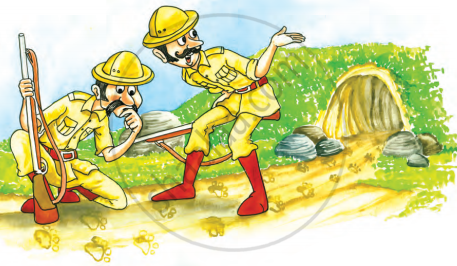
| Hunter 1 | “Look at the footprints in the mud!” |
| Hunter 2 | |
| Hunter 1 | |
| Hunter 2 |
Correct the use of the describing word in the following sentence.
This is the simpler problem of them all.
Correct the use of the describing word in the following sentence.
The flood became badder as the rain increased.
Some words have similar sound, but different meaning. Choose the correct word from the options and fill in the blank.
I have to leave at ______.
In the sentence below the capital letter, comma, full stop and question mark are missing. Put these in the correct place.
on monday i will go to school
List as many summer activities as you can.

Why didn’t Jimmy Wells, being a cop himself, arrest Bob?
Can you spot 10 differences between these pictures?

How observant are you? Individually, try to spot as many differences as possible in five minutes. If you have spotted less than five, then you really need to improve your observation skill just to save yourself from being misled.
‘Seeing is believing’. How is this humorously disproved in this story? Bring out the irony in the situation.
Why did Leacock visit the studio on Saturday?
Write a paragraph of about 150 word, on the following topic.
The importance of Good Health
Imagine someone has invited your family to a program and you were the only person at home when the invitation was given orally.
Why according to Maya Angelou, does the caged bird sing?
What do you like better - to listen to a joke, or to tell a joke?
Using the given informal letter as a model, write a letter about the topic given below.
Write a letter to your father asking permission to go on an educational tour.
