Advertisements
Advertisements
Question
Have a conversation with your partner based on the picture below. You can start as -
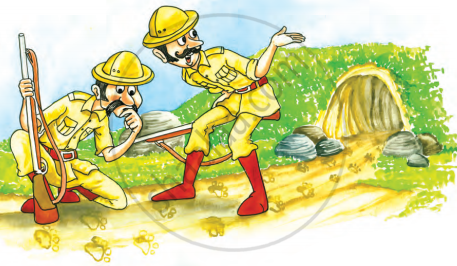
| Hunter 1 | “Look at the footprints in the mud!” |
| Hunter 2 | |
| Hunter 1 | |
| Hunter 2 |
Advertisements
Solution
| Hunter 1 | “Look at the footprints in the mud!” |
| Hunter 2 | This does not look like human footprints. |
| Hunter 1 | Of course! This looks like a giant elephant’s footprints. |
| Hunter 2 | But, how is it possible? There is not a single elephant in this jungle. |
APPEARS IN
RELATED QUESTIONS
Read the following extract carefully and present the information in the form of notes with the help of the given clues :
Sarvepalli Radhakrishnan was the first Vice President and second President of India.
He was a teacher, a philosopher and 'an author. He had introduced the thinking of Western idealist philosophers like Plato, Plontinus, Bergson into Indian thought.
He was born on 5th of September, 1888 in a poor Brahmin family. As his father could not afford his education expenses, Radhakrishnan supported most of his education
through scholarships. He completed his B.A. and M.A. with majors in philosophy. He went on to become a professor of philosophy. He showed that Indian Philosophy, once translated into standard academic jargon, is worthy of being called philosophy by Western standards.
He thus, placed Indian Philosophy on world map.
Sarvepalli Radhakrishnan had established a strong relationship with the Soviet Union when he w Is appointed as the ambassador to the Soviet Union.
He has been honoured with many awards for his achievements nationally and internationally. He was honoured with the Bharat Ratna in 1954. He is also acknowledged with the Templeton Prize, Peace Prize of German Book Trade, Order of Merit and many other honours.
Title : Sarvepalli Radhakrishnan
Birth : 5th September, 1888
Qualifications : B.A. ___________
Introduced thinking of : _________,_________and ____ into Indian thought.
Work : Translated_____________ into standard____________
Ambassador : __________________________________
Honours : National___________
International Order of Merit
Does the poet use the literary devices in the poem?
What are the five words used in the poem to describe the role of a middle-aged woman?
Is there repetition used in the poem? Why?
Who and what does the free bird symbolize?
Join the following sentence to make one complete sentence without using and, but or so.
They bought a new car. They can travel long distances.
There has been heavy rain in your city/town. You went to school but found that it was closed because of the rain. Describe the sights and sounds near the school and narrate how you finally reached home and spent the rest of the day.
What do you like the most about the poem?
Which do you think are the most poetic lines? Why?
Give, in your own words, TWO reasons for each of the following :
The schoolboys were in a happy mood.
Why should seniors not overprotect or over - pamper juniors?
Using the given informal letter as a model, write a letter about the topic given below.
Write a letter to your father asking permission to go on an educational tour.
Punctuate the following sentence.
wasn't tim born on the 26th of january 1989.
Do you know that there are seven wonders in the world? Can you tell the name of the one which is in India? Find out and write the names of all the seven wonders and the countries they are located in.
| Wonders of the world | Countries | |
| (i) | The Taj Mahal | |
| (ii) | The Great Wall of China | |
| (iii) | ||
| (iv) | ||
| v) | ||
| (vi) | ||
| vii) |
What story did the man standing near the hardware store tell the passing cop?
Given below are hints about a renowned British science-fiction writer Arthur C. Clarke. Write a biographical sketch on the author in not more than 80-100 words based on the information given below.
| Name | Arthur C. Clarke |
| Pen names | Charles Willis, E.G.O’Brien |
| Birth | 16 Dec 1917, England |
| Career | novelist, television host, inventor, and film screenwriter. |
| Genre | Science-Fiction, Television series, Film screenplay |
| Awards and Honours | 1961, Kalinga Prize - an award given by UNESCO for popularising science Hugo and Nebula Awards Chairman of the Interplanetary Society Highest Civil Honour of Sri Lanka – ‘Sri Lankabhimanya 2005’ |
| Titles | Clarke, Robert Heinlein, and Isaac Asimov – ‘Big Three’ of Science Fiction ‘The Prophet of the Space Age’ |
| Famous Works | Childhood’s End 2001: A Space Odyssey Rendezvous with Rana |
Who were the patients waiting for?
You have planned to organize a health camp at school. Write a letter to the Manager of a supermarket requesting sponsorship for the event. Name the event and explain how it will benefit both the community as well as the supermarket.
Write points and counterpoints on the following topic:
You should study all subjects in your mother tongue
- Within one minute, write as many meaningful phrases as possible using the numbers given below. Do not repeat the ideas.
- One: ______
- Two: ______
- Three: ______
- Four: ______
- Five: ______
- Six: ______
- Seven: ______
- Forty: ______
- A hundred: ______
- Try to imagine a situation/context where all the above items fit in. Describe it in 8-10 lines.
- Think of a title for your passage.
- Try to draw a map incorporating your phrases in a meaningful way. (Two examples are given below.) Write a key/index for your map.