Advertisements
Advertisements
Question
Write a composition (in approximately 400 – 450 words) on any one of the following subjects.
You become what you read. Present your reflections on this statement.
Advertisements
Solution
Reflecting on my life, I firmly believe in the statement, "You become what you read." Throughout my journey, books played a major role in shaping my thoughts, beliefs, and personality. Each book left a lifelong mark on me, influencing the way I saw the world and how I interacted with it.
During my early years, I devoured storybooks filled with tales of adventure, heroism, and magic. These stories sparked my imagination and implanted a sense of wonder and curiosity in me. Characters like Harry Potter, Sherlock Holmes, and Anne Shirley became my friends and role models. Their adventures taught me about bravery, friendship, and the importance of staying true to oneself. I found myself often daydreaming about fantastical worlds and adventures, which made my childhood rich and vibrant.
As I grew older, my reading preferences evolved. In my teenage years, I turned to books that explored deeper themes and complex emotions. Novels like "To Kill a Mockingbird" and "The Catcher in the Rye" opened my eyes to social issues, justice, and the struggles of growing up. These books made me more empathetic and aware of the world around me. They encouraged me to think critically about society and my place in it. I began to develop my own opinions and views, influenced by the characters and stories I encountered.
In high school, I was introduced to classic literature, science fiction, and non-fiction books. Science fiction novels have driven my interest in technology and the future, making me ponder the ethical implications of scientific advancements. Non-fiction books provided me with knowledge and insights into various fields, from history to psychology.
Throughout my academic journey, textbooks and academic papers also played a crucial role. They provided me with the knowledge and skills necessary for my studies and future career. Reading academic material taught me the importance of research, evidence-based thinking, and the pursuit of knowledge. It made me a more disciplined and analytical thinker.
Looking back, I realized that the books I read shaped my character, values, and aspirations. They influenced my worldview and helped me navigate the complexities of life. Each book contributed to my intellectual and emotional growth, making me a more well-rounded and informed individual.
In conclusion, the statement "You become what you read" held true for me. Reading had a profound impact on my life, shaping who I became and how I viewed the world. Books were not just a source of entertainment but a powerful tool for learning, growth, and transformation. Reflecting on my journey, I was grateful for the countless books that accompanied me and guided me through different stages of my life.
APPEARS IN
RELATED QUESTIONS
What is the advice of the poet? Is there any relevance of this advice to our present day?
What are the advantages of reading mentioned by Dahl?
Which is the turning point in the poem?
Show how the story demonstrates that a good deed begets good.
The children were delighted. The exams had been cancelled.
Notice these expressions in the text. Infer their meaning from the context.
-
anecdote
-
delicate realism
-
figurative painting
-
illusionistic likeness
-
conceptual space
See if you understand what the following words that are parts of a house mean. Look up the dictionary if you don't.
|
parlour |
foyer |
lounge |
porch |
|
lobby |
attic |
portico |
|
We add ‘un-’ to make opposites. For example, true — untrue. Add ‘un’– to the word below to make its opposite. Then look up the meaning of the word you have formed in the dictionary.
qualified: ____________
Find words in the story, which show things striking violently against each other.
The crow and the myna c_ll____in mid-air.
In groups of four discuss some more ‘whatifs’ that you experience in your day to day life and list them out.
(i) ______________________________
(ii) ______________________________
(iii) _____________________________
(iv) _____________________________
(v) _____________________________
(vi) ____________________________
(vii) ___________________________
(viii) ___________________________
And now write a poem of five or six lines with the ‘whatifs’ that you have listed.
Write down the significance of the following in the context of ‘On to the Summit’:
Red Scarf
Look at the sentences given below. Find out which one is correct. If the sentence is wrong give reasons.
Find out from your grandparents or parents the names of vegetables and fruits they had eaten in their childhood and mention how the vegetables and fruits are different from the one's today.
| Name of the vegetable or fruit | Shape | Colour | Taste |
| 1. | |||
| 2. | |||
| 3. |
Refer to a standard dictionary and find out the meaning of the following word:
Reporter
Different arms and ammunitions are mentioned in the excerpt. Find their names.
The pride of any city is its skyline.
Write 5 lines about the place where you reside and what makes you feel proud of it.
A brilliant student from your school has won a Mathematics Quiz at the National Level.
Frame questions to interview him/her when the school felicitates him/her. Follow the steps given below.
- Greetings
- Introduction of the interviewee and achievements.
- 2 or 3 questions about growing years.
- 4 to 6 questions about the achievements.
- 2 or 3 questions about future plans and prospects.
- Expression of thanks and good wishes.
‘Once you begin to learn there is no end to learning’. Write your views on this statement.
Write your opinion, in your own words:-
What did the aunt fail to realize in Bertha’s story?
Imagine yourself as the writer. Narrate the story of your visit to your ancestral house.
Write a paragraph comparing Don Quixote and Sancho Panza. The following words will help you to write a compare and contrast paragraph.
| Similarities | Differences |
| is similar to | on the other hand |
| both | however |
| also | But |
| too | in contrast to |
| differs from | |
| while | |
| unlike |
What does the poet say about the crocodile? Write in your own words. (in about fifty words)
Write a narrative paragraph on Kamarajar, using the given information and add more information on your own.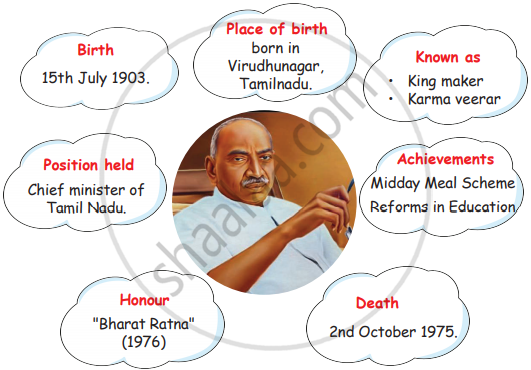
Answer the question by looking at the picture.
Example: What is happening in picture 5?

How did the grandmother spend the last few hours of her life?
Why were the streets devoid of people?
Why did the friends part ways?
Imagine someone has invited your family to a programme and you were the only person at home when the invitation was given orally.
Write a note (4-5 lines) to pass on the message to the other people in your family. Or, Write an imaginary conversation in which you pass on the message to your parents.
Think of an occasion when you did not like the decision/actions of your family members but realised later on that they were right. Write about it in 5-8 lines.
Can you think of any events in your own or someone else’s life to support the quote-
‘If you tell the truth, you don’t have to remember anything.’
What is likely to happen if you don’t tell the truth?’
