Advertisements
Advertisements
Question
Can you think of any events in your own or someone else’s life to support the quote-
‘If you tell the truth, you don’t have to remember anything.’
What is likely to happen if you don’t tell the truth?’
Advertisements
Solution
Yes, I remember an incident that supports the saying, 'If you tell the truth, you don't have to remember anything.'
My friend Sameer once skipped a day of work, claiming to be sick, only to be caught on live television at a sporting event. Sameer's faked illness required a series of lies to cover up, resulting in constant anxiety and a complicated story to maintain, especially around attentive coworkers. Finally, Sameer's reputation and trust among coworkers suffered due to his dishonesty. This true story mirrors the statement, 'If you tell the truth, you don't have to remember anything' by showing how dishonesty complicates life.
APPEARS IN
RELATED QUESTIONS
Greenland is the largest island in the world.
(Rewrite: Using ‘larger’.)
Explain the difference between welcome scene and departure scene from the poem “The Patriot” by Robert Browning.
Examine how cross cultural differences bring out humor in “A Horse and Two Goats.”
(A) We did not know that Mr. Francis was retiring and leaving for Ooty.
(B) Little……………………………
Your class wants to visit a well-known historical monument in a nearby town. Write a letter to your Principal seeking permission and say why you would benefit from the visit.
Why couldn't the narrator sleep?
Fill in the blank with an appropriate word:
The young child carried the heavy bucket _______ the stairs.
Give reasons for the following.
Carter had to chisel away the solidified resins to raise the king’s remains.
Notice the following sentence patterns.
I am the Poem of Earth, said the voice of the rain.
Rewrite the above sentences in prose.
Why does the author aver that the growth of the world population is one of the strongest factors distorting the future of human society?
How did the narrator adjust to the ways of life first in London and then in Cambridge, U.S.A.?
Go to your college library and collect and read the poems written by Sarojini Naidu.
Your teacher will speak the word given below. Write against two new words that rhyme with it.
wax ______ ______
Multiple Choice Question:
The poet had a quarrel with her ______
Form pairs and make a 'pair presentation' of any one of the two stories. To do so, each person presents only one sentence at a time, and the next one is immediately presented by the partner. Thus, each person in the pair presents alternate sentences without breaking the flow of the narration.
You are going to meet a Great Indian Bustard very soon. Prepare at least 10 questions to interview him.
Following are the ways to preserve ‘World Heritage Sites.’ Transfer these points into a small paragraph. Suggest a suitable title.
- Practical conservation of posterity
- Human/animal trespassing
- Unmonitored/uncontrolled/unrestricted access
- Threat of local administrative negligence
Read the extract beginning from:
“Her name was Sulekha..... find bridegrooms for them.” Narrate this extract in short, making Sulekha (Bholi) the narrator. Write it in your notebook. Begin with “I was named Sulekha ..................”
What is the name of her diary?
Look at the picture given below and frame your own slogan.

What will Glory say? Do you think you can help Glory by giving some ideas to Ravi?
| Glory |
You can write a story about the ______ and the ______. |
| Ravi | Great idea! Thank you! |
| Glory | ______ Ravi. |
Here is a word, morning. Now write down words related to it.

Describe the grandfather as seen in the portrait.
The grandmother appreciated the value of education. Give instances in support of your answer.
What would you do in this situation, if you were Jimmy Wells? Substantiate your reason.
Why had Miss Meadows chosen 'A Lament' as the lesson that particular day?
School examinations do not test intelligence. Express your views either for or against this statement
When Luz Long said, 'something must be eating you' he meant that Jesse Owens must be ______.
- What do you like best about your school?
- Do you think school is fun?
- Which is the part that you don’t like?
- How often should the teacher give you a test?
Observe the tourist leaflets given and answer the following.
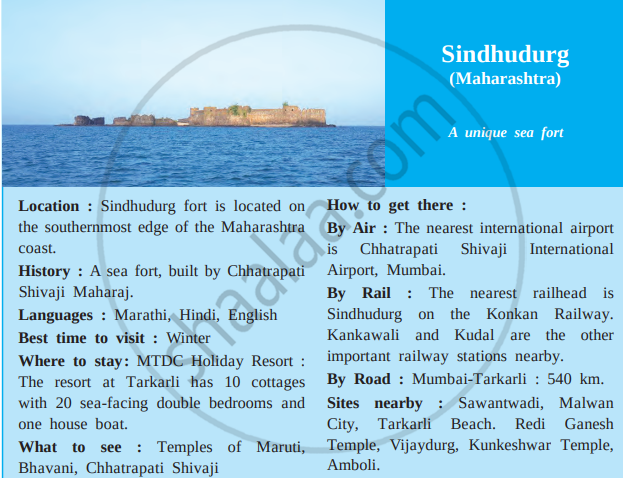

- Which places do these leaflets describe?
- What are the main points given in each leaflet?
- How can one reach Tadoba?
- Which is the best season to visit Tadoba? Why?
- List tourism-related words, e.g., tourist, booking etc.
