Advertisements
Advertisements
Question
Write a brief summary of the story of the young man and his spiritual teacher, making the young man the narrator.
You may begin as given below.
'I went quickly to my spiritual teacher for advice because I had ______ (Now continue)
Advertisements
Solution
I went quickly to my spiritual teacher for advice because I had hurt and insulted my dear friend with unkind and harsh words. When I asked him for the solution, he gave me a fresh sheet of blank paper and a pen and instructed me to write down on that paper all the harsh things l had told, my friend. I obeyed. He then asked me to tear it into as many bits as I could and throw the bits out of the window. The tiny bits scattered far and wide in no time. But to my surprise, he then asked me to collect as many bits as possible. I ran to collect it but in vain. I couldn't get hold of even a single bit of paper. I returned all exhausted. He then revealed to me that spoken words are like those bits of paper, easy to scatter but difficult to take back. I learned that I should think before I speak.
APPEARS IN
RELATED QUESTIONS
Imagine that you are Santosh Yadav, or Maria Sharapova. You have been invited to speak at an All India Girls’ Athletic Meet, as chief guest. Prepare a short speech to motivate the girls to think and dream big and make an effort to fulfil their dreams, not allowing difficulties or defeat to discourage them. The following words and phrases may help you.
• self confident/confidence/sure of yourself
• self assured/assurance/belief in yourself
• morale/boost morale/raise morale
• giving somebody a boost/fillip/lift
• demoralising/unsure of yourself/insecure/lack confidence
It rained so heavily that they could not go for the picnic. (Rewrite: Using ‘too………………to’)
How does the poem make use of contrast? Consider the contrast between the poet and the daffodils, and between his feeling before, while and after seeing the daffodils.
What is the message of the poem?
Fill in each of the numbered blanks with the correct form of the word given in brackets. Do not copy the passage, but write in correct serial order the word or phrase appropriate to the blank space.
Example:
(0) beginning
Alice was (0)__________(begin) to get very tired of (1)__________(sit) by her sister on the bank and of having nothing to do: once or twice she had (2)__________(peep) into the book her sister was reading, but it (3)__________ (have) no pictures or conversations in it, "and what is the use of a book," (4)__________(think) Alice, "without pictures or conversations?" Alice wondered whether the pleasure of (5)__________(make) a daisy-chain would be worth the trouble of getting up and picking the daisies when suddenly a White Rabbit with pink eyes (6)__________(run) close by her. Alice did not think this was very remarkable, until the Rabbit actually (7)__________ (take) a watch out of its waistcoat-pocket, and (8) (look) at it, and then hurried on.
Referring closely to the essay Unbirthday and Other Presents, discuss why E V Lucas feels that `unbirthday‘ gifts are better than the regular gifts people give.
Hardly had the teacher left the room, when all the children started making a noise.
(Begin : No sooner ………..)
Discuss the following in groups of two pairs, each pair in a group taking opposite points of view.
Traditions, rituals, and funerary practices must be respected.
Words which describe ‘sleek’, ‘alert’, and ‘abrupt’
Find out about as many Indian schools of painting as you can. Write a short note on the distinctive features of each school.
There is a parallel drawn between rain and music. Which words indicate this? Explain the similarity between the two.
Your teacher will speak the word given below. Write against two new words that rhyme with it.
bed ______ ______
The traits of the characters you meet in the extract are jumbled. Sort them out and write them in the appropriate columns.
(Shy, bold, gruff, friendly, withdrawn, perceptive, empathetic, playful, lonely, happy, gentlemanly, frank, mature, dull, sharp, adventurous.)
| Jo | Laurie | Grandpa |
Give your opinion: Whether we should or should not participate in adventure sports because __________________.
The poem creates a delightful picture of the city, rich in its natural beauty. Work in pairs, groups and pick out the lines from the poem which give the pictorial effect to the poem. Write it in your own words.
Prepare a formal invitation for a function you have arranged at home. It should clearly state the following points:
- Who is inviting people to the function.
- What the program is.
- The date and time.
- The venue. (The place where
- A polite request to attend the function. the function will take place.)
Gather information on any one of the following by talking to your elders, family members, and from other sources in your mother tongue and write a short note on it in English.
A special dish that is prepared on a special occasion at home.
Imagine the Stranger-man narrates how the Neolithic ladies overpowered him. Write an account of the same making him the narrator.
‘The Storyteller’ has a story within a story.
Search from the Internet or your library books for other stories that have another story within. Enlist at least 3 to 5 of them.
Find any other story of three brothers or three sisters and rewrite it in your own words.
Write a short essay on the following.
What I would like to do for my country.
Work in groups and write a paragraph on “Laughter is the best medicine.”
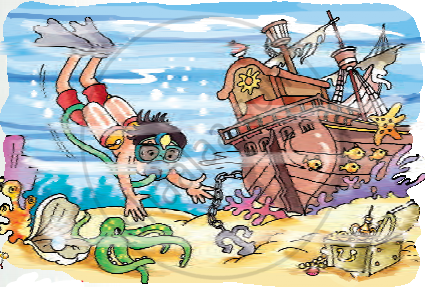
Work in groups of four. See the picture of a shipwreck at the bottom of the ocean.
Suppose you went deep-sea diving. What would you find? Think of all the words that come to your mind, then build a paragraph. Share your story with other groups.
Punctuate the following passage.
mother father neelam said i have got a fire engine ive got a fire engine whats this whats this called mother somewhat confused by the noise ive got a fire engine mother come and see it.
Answer the question by looking at the picture.
Example: What is happening in picture 5?

The word in the sentence is jumbled. Write them in order.
alone was not Robinson an island on
Read Sheela's notice. Discuss the questions that follow.
|
Notice The Drama Committee will meet in the classroom on Monday, at two o’clock. We’ll plan a play for our Annual Day. Will each one of you please bring a play? SHEELA |
- Who was to meet?
- When were they to meet?
- Where were they to meet?
- What were they to do?
Why was Mary Kom named the ‘Queen of Boxing’ and ‘Magnificent Mary'?
Read the information in the table below and answer the following questions.
| Sl. No | Event | Year | Affected Area |
| 1. | Earthquake | 2001 | Bhuj, Gujarat |
| 2. | Tsunami | 2004 | Coastline TN, Kerala, A.P., A&N Islands, Pondicherry |
| 3. | Floods | July 2005 | Maharashtra |
| 4. | Earthquake | 2008 | Kashmir |
| 5. | Floods | 2008 | North Bihar |
| 6. | Cyclone | 2008 | Tamil Nadu |
| 7. | Floods | 2009 | Andhra Pradesh & Karnataka |
| 8. | Cyclone | 2011 | Tamil Nadu/Cuddalore |
| 9. | Flash floods | June 2013 | Uttarkhand |
| 10. | Cyclone | Oct. 2013 | Coastline of Orissa & Jharkhand |
| 11. | Floods | Dec. 2015 | Tamil Nadu/Chennai |
| 12. | Cyclone | Dec. 2016 | Tamil Nadu/Chennai |
- What kinds of natural disasters have occurred before 2005?
- Name the disasters that are common in India.
- Mention the states often affected by disasters.
- List out the disasters that are common in North India
- Write three sentences on your inference about the data given.
Write conversation on the following situation.
Between two friends on an exciting cricket match
The photographer was pleased after ______.
What was the knife that Miss Meadows carried with her?
What kind of relationship existed between Miss Meadows and the Science Mistress?
We may not have money to buy all our wants at the same time. In such a situation, what are the options available?
Write slogan to create awareness of the following topic using the tips given above.
- Junk food
- Labour Day
- Save Water
- Yoga
- Blood Donation
A certain book/chapter has been included in your syllabus. You have heard that a film version is now available. Write a letter to the Manager of a film theatre near your school, requesting that the film be shown. Tell him/her why it will be beneficial to the students.
Why does Portia ask Shylock if he had arranged for a surgeon to be present at Antonio's trial?
What might success mean to the following people? Think about it and write.
A teacher
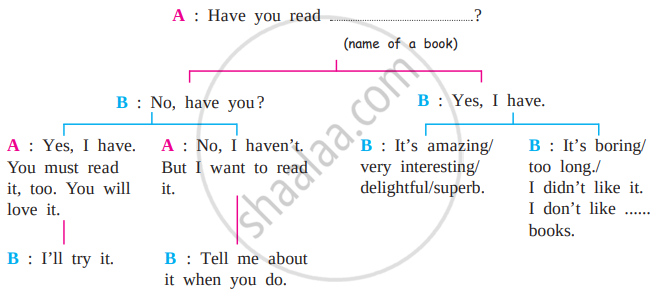
Use the following charts to prepare meaningful dialogues.
Use your ideas to fill in the blanks.