Advertisements
Advertisements
Question
How does the author succeed in raising crucial social issues not through open criticism but through subtle suggestion?
Advertisements
Solution
Roy hit the nail right on the head in describing the male chauvinistic society we live in, though suggestively. How pride is all that matters to a male and for a female, no matter how cruel her husband is and even if the love is worn out of their relationship, she wants for him never ceases. This the society we live in where a male beats her wife no matter how qualified he is. It does not matter if he is a top-notch government official who comes from a so-called modern background, he can not tolerate his wife's success. A man always wants his wife to be subordinate to him. It is in our minds that a woman can not rise higher to her husband. It is also highlighted in the story that how we run after momentary pleasures. Recognition is important for a human undoubtedly; however, the way Pappachi ruined all his life and relations because of what he did not get, rather than accepting that maybe it was not fated after all. We humans, especially men, crave for fame and recognition. In what of what we can not have, we lose what we have.
APPEARS IN
RELATED QUESTIONS
In the following items, sentence A is complete, while sentence B is not. Complete sentence B, making it as similar as possible to sentence A. Write sentence B.
(A) His attitude towards his parents has always puzzled the
(B) I have ..................................................................................
Who holds ‘all the growth of our land’? Which land has the poet in mind?
How does Dahl compare the leisure activities of children in the past and their activities now.
The poet uses the word lonely in reference to a cloud. Explain.
What is the symbolic significance of the sun, sky and wind in the first stanza?
But a caged BIRD stands on the grave of dreams
His shadow shouts on a nightmare scream
His wings are clipped and his feet are tied
So he opens his throat to sing.
Read the above lines and answer the question that follow.
Explain with reference to the context.
The caged bird sings with
A fearful trill of things unknown
But longed for still and his
Tune is heard on the distant hill
For the caged bird sings of freedom.
Read the above lines and answer the question that follow.
What parallel can be drawn to the poet’s feelings and that of the caged bird?
Alack, it was I who leaped at the sun
To give it my loving friends to keep!
Naught man could do,have I left undone:
And you see my harvest, what I reap
This very day, now a year is run.
Read the above lines and answer the question that follow.
Explain with reference to the context.
What is the conflict and twist to the short story “Heart and Hands”?
Write a composition (350 - 400 words) on the following:
Study the picture given below. Write a story or a description or an account of what it suggests to you. Your composition may be about the subject of the picture or you may take suggestions from it; however, there must be a clear connection between the picture and your composition.

Fill in the blank with an appropriate word:
The poet's mother was stung __________ a scorpion.
Fill in the blank with an appropriate word :
Sheila's grandmother found it difficult to climb __________ the steep staircase.
Fill in the blank with an appropriate word:
There was a steep rise ……… onion prices.
Join the following sentence to make one complete sentence without using and, but or so.
Mumbai is densely populated. It is one of the major cities in the country.
Read the extract given below and answer the questions that follow:
The morning stretched calm, beautiful, and warm.
Sprawling half-clad, I gazed out at the form
Of shimmering leaves and shadows. Suddenly
A strong flash, then another, startled me.
I saw the old stone lantern brightly lit.
(A Doctor’s Journal Entry for August 6, 1945: Vikram Seth)
(i) In which country did the incident described in the poem occur? What had caused the flashes? What happened to his home soon after?
(ii) Describe the injuries suffered by the Doctor.
(iii) What was his wife’s name? What happened to a house standing before them?
(iv) How does he describe the people he met on the way?
(v) Why were the people walking with their hands away from their bodies? What was common to all of them? What message does the poem convey?
My daughter believes_____________ fairies.
Notice these expressions in the text. Infer their meaning from the context.
-
anecdote
-
delicate realism
-
figurative painting
-
illusionistic likeness
-
conceptual space
Below is a topic for essay writing. Follow the steps listed above to write on this topic.
Those who can bear all can dare all
Below is a topic for essay writing. Follow the steps listed above to write on this topic.
Human Population Grows Up
What do you understand the character of Mrs. Croft from the story?
Look at this cartoon by R.K. Laxman. Read the sentence given below the cartoon. Discuss the following questions with your partner.
- What is it about?
- Do you find it funny? If so, why?
- Do you think a cartoon is a serious drawing? Why or why not?

Multiple Choice Question:
Which phrase means the same as to ‘quarrel’?
We add ‘un-’ to make opposites. For example, true — untrue. Add ‘un’– to the word below to make its opposite. Then look up the meaning of the word you have formed in the dictionary.
answerable: ____________
Re-word the lines from the story:
I had heard a great deal about Miss Beam’s school.
1. Given below is a page from a dictionary. Look at it carefully an
(i) find a word which means the same as ghastly. Write down the word and its two meanings.
(ii) find a word meaning a part of the school year.
(iii) find a word that means examination.

2. Now make lists of
(i) all the words on the page (plus any more that you can think of) that begin with terr-
(ii) five words that may follow the last word on the page, that.
(iii) write down your own meaning of the word thank. Then write down the meaning given in the dictionary.
Your teacher will speak the words listed below. Write against each a word of opposite meaning.
Examples:
liquid-solid
hard-soft
1. old —————
2. wet —————
3. open —————
4. blunt —————
5. forget —————
The extract deals with the atmosphere of two homes. Collect the words associated with - Library.
Discuss the following with your partner and complete the following sentence.
Food adulteration means _________________.
'Seems to touch the starry skies'. The poet has used word imagery. Describe the idea and pick out other similar examples from the poem.
Your examinations are only two months ahead. Plan your schedule of studies and write in your notebook.
Discuss with your partner on the following topic. Express your views and opinions in favour of and against the topic.
Should the 'Earn and Learn' concept be made mandatory for students?
Describe the climax scene in your own words. Write your comments on it.
Gather information on any one of the following by talking to your elders, family members, and from other sources in your mother tongue and write a short note on it in English.
A special type of embroidery
Gather information on any one of the following by talking to your elders, family members, and from other sources in your mother tongue and write a short note on it in English.
Something that you use to decorate your home on special occasions.
When a family member is very ill for long, the grandmother of the family urges everyone to send for a person who claims he can cure victims of black magic. Compose a dialogue with her, in which her granddaughter politely convinces her that she should not believe in such things.
Write the reason in your own words.
Akbar had to dress like a slave.
Form groups and discuss each element of planning an interview and prepare notes on each element.
- Format - Structure: ......................
- Size/Length - How much: ......................
- Do’s and Dont’s - Rules and Regulations: ......................
- Type of Questions - Yes/No questions or Wh Type: ......................
Describe in your notebook the challenges you faced while learning to ride a bicycle, swimming, or any skill. Take hints from the web to complete your write-up.

How can you prove this maxim to be incorrect - ‘Too many cooks spoil the broth’. Write a counterview on the given topic. (Clue - Teamwork)
Draft Letter for the following
You are Sudha. Your neighbour has a pet dog that barks continuously. Write a letter to the Editor of a weekly newspaper of your locality, highlighting the nuisance and noise pollution created thus. Also, suggest ways to solve the problem.
The word in the sentence is jumbled. Write them in order.
was island the inhabited.
Complete the following stories by using an appropriate word from the box given below –
| my, his, he, your |
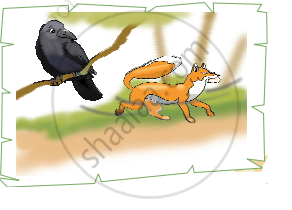
Sitting on a tree a crow was enjoying a piece of bread. A hungry fox wanted to have that bread. said very sweetly, “Dear brother, I've heard that ______ voice is very sweet. Please sing a song for me.” The foolish crow opened ______ beak and the piece of bread fell down. The fox picked it up in ______ mouth and ran away.
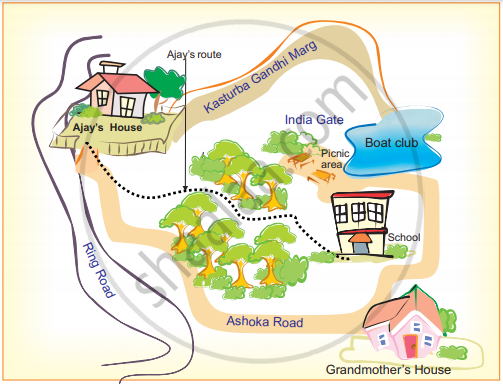
Use the above map to answer the questions.
- What does the dotted line on the map show?
- What road would Ajay take to get to the boat club?
- What building is next to the picnic area?
- What road passes by Ajay’s house?
- What other way could Ajay use to get from his house to his grandmother’s house?
Now write:
Use verbs like go, turn, cross
Use prepositions like: across, between, in front of, beside, near, behind, and write how you get home from school.
What was the happiest time of the day for grandmother?
The grandmother was strong-minded. Justify
What story did the man standing near the hardware store tell the passing cop?
When and how did Bob realise that the tall man was not his friend?
Read and understand the data presented in the pie-chart below on factors affecting health, and write an article for your school magazine highlighting the fact that it’s our lifestyle that determines how healthy we remain. Write your article in about 150 words. Give a suitable title too.

The factors which affect health are given percentage-wise in the pie chart.
The photographer had made changes ______.
Respond to the following advertisements.
Classified Advertisement
| WANTED 100 part-time Graphic Artists Experienced in Photoshop and InDesignSalary negotiable. Apply to: MM Graphics, Triplicane, Chennai - 5 or Mail your Resume to [email protected] |
Block Advertisement
|
Female IELTS Teachers Required Postgraduates in English with a minimum of 3 years experience Must be bold and confident Good salary, transport and food allowance provided Apply to: ARV Institute of Languages 149B, Bose Road, Coimbatore Ph: 98400 xxxxx Email: [email protected] |
What is the conflict between Margot and the other children in the story, “All Summer in a day”?
Answer the following question as briefly as possible and with close reference to the relevant text.
Referring closely to the conversation between Prospero and Ferdinand at the beginning of Act IV of The Tempest, bring out Prospero’s concerns as a father.
Read the given sentence and underline the no word.
Can no one help him?
Imagine someone has invited your family to a programme and you were the only person at home when the invitation was given orally.
Write a note (4-5 lines) to pass on the message to the other people in your family. Or, Write an imaginary conversation in which you pass on the message to your parents.
Using the given informal letter as a model, write a letter on any one of the topics given below.
Write letter to your father asking permission to go on a educational tour.
These two passages are examples of a short introduction to works of art - a short review. They cover the following points:
- The name of the creator
- The theme or subject matter
- Type of art
- Individual style
- Presentation techniques
- Its effect on viewers
- Message or interpretation
What points will you include if you had to review a book or film or a play? List the points.
Which is the last play you saw?
Show how Carol Ann Duffy presents a disturbing picture of confinement and exploitation in the poem, The Dolphins. Write your answer in about 200-250 words.
Write a composition (in approximately 400 – 450 words) on the following subject.
Parents should not influence their children when choosing the subjects they wish to study. Argue either FOR or AGAINST the given statement.
