Advertisements
Advertisements
Question
Read the passage given below and answer the questions (i), (ii) and (iii) that follow.
| (1) | “Can I see the Manager?” I said, and added solemnly, “Alone.” I don't know why I said “Alone.” “Certainly,” said the accountant and fetched him. | |
| (2) | The Manager was a grave, calm man. I held my fifty-six dollars clutched in a crumpled ball in my pocket. “Are you the Manager?” I asked. God knows I did not doubt it. “Yes,” he said. “Can I see you …. alone?” I asked. |
5 |
| (3) | The Manager looked at me in some alarm. He felt that I had an awful secret to reveal. “Come in here,” he said, and led the way to a private room. He turned the key in the lock. “We are safe from interruption here,” he said; “Sit down.” We both sat down and looked at each other. I found no voice to speak. “You are one of Pinkerton’s men, I presume,” he said. |
10 |
| (4) |
He had gathered from my mysterious manner that I was a detective. I knew what he was thinking, and it made me worse. |
15
20
|
| (5) | The Manager got up and opened the door. He called to the accountant. “Mr. Montgomery,” he said unkindly loud, “this gentleman is opening an account, he will deposit fifty-six dollars. Good morning.” I rose. A big iron door stood open at the side of the room. “Good morning,” I said, and stepped into the safe. “Come out,” said the Manager coldly and showed me the other way. |
30 |
| (6) | I went up to the accountant’s wicket and poked the ball of money at him with a quick convulsive movement as if I were doing a conjuring trick. My face was ghastly pale. “Here,” I said, “deposit it.” The tone of the words seemed to mean, “Let us do this painful thing while the fit is on us.” He took the money and gave it to another clerk. |
35 |
| (7) | He made me write the sum on a slip and sign my name in a book. I no longer knew what I was doing. The bank swam before my eyes. “Is it deposited?” I asked in a hollow, vibrating voice. “It is,” said the accountant. “Then I want to draw a cheque.” My idea was to draw out six dollars of it for present use. Someone gave me a chequebook through a wicket and someone else began telling me how to write it out. The people in the bank had the impression that I was an invalid millionaire. I wrote something on the cheque and thrust it in at the clerk. He looked at it. |
40
45 |
| (8) | “What! Are you drawing it all out again?” he asked in surprise. Then I realised that I had written fifty-six instead of six. I was too far gone to reason now. I had a feeling that it was impossible to explain the thing. I had burned my boats. All the clerks had stopped writing to look at me. Reckless with misery, I made a plunge. “Yes, the whole thing.” “You withdraw all your money from the bank?” “Every cent of it.” “Are you not going to deposit anymore?” said the clerk, astonished. “Never.” |
50
55 |
| (9) | An idiot hope struck me that they might think something had insulted me while I was writing the cheque and that I had changed my mind. I made a wretched attempt to look like a man with a fearfully quick temper. | |
| (10) | The clerk prepared to pay the money. “How will you have it?” he said. This question came as a bolt from the blue. “What?” “How will you have it?” “Oh!”— I caught his meaning and answered without even trying to think— “in fifties.” He gave me a fifty-dollar bill. “And the six?” he asked dryly. “In sixes,” I said. He gave it to me and I rushed out. As the big door swung behind me. I caught the echo of a roar of laughter that went up to the ceiling of the bank. Since then, I bank no more. I keep my money in cash in my trousers pocket and my savings in silver dollars in a sock. |
60
65
70 |
| Adapted from: My Financial Career By Stephen Leacock |
||
-
- Find a single word from the passage that will exactly replace the underlined word or words in the following sentences. [3]
- The kind stranger went and got back the ball from where it had rolled into the bush.
- I took offence at the expression on his face that was clearly meant to insinuate I was a liar.
- The firm experienced a financial loss when the contract went to a contender who had just entered the business.
- For each of the words given below, choose the correct sentence that uses the same word unchanged in spelling, but with a different meaning from that which it carries in the passage. [3]
- alarm (line 8)
- The silence from the other end set off alarm bells in her head.
- The pallor of his skin alarmed those standing around.
- I set my alarm for six o’clock but slept through it.
- The sound of the approaching jets caused some alarm in the war room.
- wicket (line 44)
- The wicketkeeper was the true saviour of the day for that one match.
- The team wanted to bat while the wicket was still dry.
- The man at the window handed us our tickets through the wicket.
- The quick loss of wickets demoralised the team.
- reason (line 48)
- After the tragedy, his ability to reason is severely diminished.
- They reasoned they could get better seats if they arrived early.
- Recipients of funds were selected without rhyme or reason.
- We have every reason to celebrate.
- alarm (line 8)
- Find a single word from the passage that will exactly replace the underlined word or words in the following sentences. [3]
- Answer the following questions as briefly as possible in your own words.
- With reference to the passage, explain the meaning of the expression of the ‘I had burned my boats?’ [2]
- Cite any two instances of the behaviour of the bank employees that indicate the insignificance of a deposit of fifty-six dollars. [2]
- Why do you think the people in the bank thought of the narrator as an “invalid millionaire?” [2]
- Summarise why the narrator decided ‘to bank no more’ (paragraphs 6 to 10). You are required to write the summary in the form of a connected passage in about 100 words. Failure to keep within the word limit will be penalised. [8]
Advertisements
Solution
-
- fetched
- imply
- rival
- I set my alarm for six o’clock but slept through it.
- The team wanted to bat while the wicket was still dry.
- We have every reason to celebrate.
-
- “I had burned my boats” means deciding or taking an action that makes it impossible to return to the previous situation. Here, it signifies that the narrator could not go back on his decision.
- The manager asked the narrator to leave the safe and said a cold ‘Good morning’.
- When the narrator was withdrawing the amount, the clerk sarcastically asked the denomination in which he wanted it.
- The clerks stopped writing and looked at him.
- The narrator’s exit was followed by a roar of laughter.
- The narrator was nervous. At the accountant’s window, he grew pale and his movements became convulsive. As he wrote and signed his name, he became even more nervous, and his voice became hollow. When the chequebook was handed to him, somebody tried explaining how to write it out since it was obvious. He was physically distressed and fumbling. Since he wanted to make a withdrawal, people in the bank must have assumed he had a substantial deposit.
| The | narrator | wanted | to | open |
| an | account | with | fifty-six | dollars. |
| The | Manager | coldly | instructed | the |
| accountant | to | help | him. | The |
| narrator | unsteadily | passed | on | his |
| money | to | the | accountant | who |
| passed | it | to | the | clerk |
| The | narrator | had | to | write |
| the | sum | down | and | sign |
| He | asked | to | make | a |
| withdrawal | intending | to | withdraw | six |
| dollars | In | his | agitation | he |
| withdrew | the | entire | sum | He |
| could | not | reason | or | explain |
| his | action | so | recklessly | stated |
| that | he | was | withdrawing | the |
| entire | amount | he | had | deposited |
APPEARS IN
RELATED QUESTIONS
Fill in the blank with the suitable word.
She turned _____________ the offer to work at the factory.
Write a composition (350 - 400 words) on the following:
"Money is important for happiness." Express your views either for or against this statement.
You are the editor of your school magazine. You have recently attended a cultural program in your city. Write an account of this program (in approximately 300 words) using the points given below:
| Date and venue — occasion — Chief Guest — other invitees — inauguration — events —other important features — highlights — reaction of audience — conclusion. |
Raina :
[timidly] Nine thousand hotels?
Bluntschli :
Hotels! Nonsense. If you only knew! Oh, it's too ridiculous. Excuse me: I must give my fellow orders about starting. [He leaves the room hastily, with the documents in his hand].
Louka :
[knowing instinctively that she can annoy Raina by disparaging Bluntschli] He has not much heart, that Swiss. He has not a word of grief for his poor father.
Raina :
[bitterly] Grief! A man who has been doing nothing but killing people for years! What does he care about? What does any soldier care about? [She goes to the door, restraining her tears with difficulty].
Louka :
Major Saranoff has been fighting too, and he has plenty of heart left. [Raina, at the door, draws herself up haughtily and goes out].
(i) What news has Bluntschli just received?
(ii) What makes Raina ask, `Nine thousand hotels'?
(iii) Why is Bluntschli in such a hurry to leave? What does Louka comment about him?
(iv) Why is Raina upset with Bluntschli?
(v) Why in your opinion, does Louka compare Bluntschli to Sergius? What does she comment when Raina leaves the room?
(vi) Who enters the room at this point? What news does he give Louka?
‘Working women make better mothers than women who stay at home’. Express your views either for or against this statement.
Mrs. Kumar has been a teacher for thirty years. She will now retire.
Every one of them was an experienced mountaineer.
(Begin: There was no .................................)
Explain the following phrase
Spinning yarns
Use it in a sentence of your own.
Do you have a ‘dream’, or something you very much wish to do? Write a paragraph saying what you want or wish to do. Then say (in another paragraph) how you think you can make your dream come true.
The cherry tree is a narrative poem. Features that make it a narrative poem are given below. Justify them with proper examples.
Incidents are arranged in sequence.
‘Once you begin to learn there is no end to learning’. Write your views on this statement.
Imagine someone has invited your family to a programme and you were the only person at home when the invitation was given orally.
Write a note (4-5 lines) to pass on the message to the other people in your family. Or, Write an imaginary conversation in which you pass on the message to your parents.
Answer the following question :
What are the benefits of travel?
Write a report of the following event in about 100-120 words.
You are the School Pupil Leader. You have been asked to write a report on the Inaugural Ceremony of English Literary Association of your school which was held recently. Write a report on the same in not more than 120 words.
Nalan’s grandfather showed him an old treasure trunk. A road map was stuck on the trunk. It showed the spot where a key was hidden. Look at the road map and write five directions to reach the spot where the key is hidden. Discuss with your partner and compare your directions with those of your classmates.
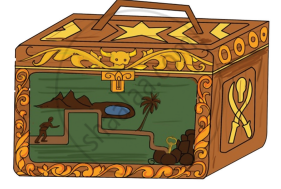
- ____________
- ____________
- ____________
- ____________
- ____________
Look at the picture and write a paragraph using the clues in the picture.
| GROW AND PROTECT TREES |

The word in the sentence is jumbled. Write them in order.
was afraid I now.
Use the option to fill in the blank.
My toys ______broken.
Use the option to fill in the blank.
The flowers ______kept in a vase.
Why do patients leave the clinic without meeting the dentist?
The photographer had made changes ______.
‘Just one more installment and BABY’S REALLY OURS!’ This tells us that the couple
Summarizing is to briefly sum up the various points from the notes made from the below passage.
The Sherpas were nomadic people who first migrated from Tibet approximately 600 years ago, through the Nangpa La pass and settled in the Solukhumbu District, Nepal. These nomadic people then gradually moved westward along salt trade routes. During 14th century, Sherpa ancestors migrated from Kham. The group of people from the Kham region, east of Tibet, was called “Shyar Khamba”. The inhabitants of Shyar Khamba, were called Sherpa. Sherpa migrants travelled through Ü and Tsang, before crossing the Himalayas. According to Sherpa oral history, four groups migrated out of Solukhumbu at different times, giving rise to the four fundamental Sherpa clans: Minyagpa, Thimmi, Sertawa and Chawa. These four groups have since split into the more than 20 different clans that exist today.
Sherpas had little contact with the world beyond the mountains and they spoke their own language. AngDawa, a 76-year-old former mountaineer recalled “My first expedition was to Makalu [the world’s fifth highest mountain] with Sir Edmund Hillary’’. We were not allowed to go to the top. We wore leather boots that got really heavy when wet, and we only got a little salary, but we danced the Sherpa dance, and we were able to buy firewood and make campfires, and we spent a lot of the time dancing and singing and drinking. Today Sherpas get good pay and good equipment, but they don’t have good entertainment. My one regret is that I never got to the top of Everest. I got to the South Summit, but I never got a chance to go for the top.
The transformation began when the Sherpa Tenzing Norgay and the New Zealander Edmund Hillary scaled Everest in 1953. Edmund Hillary took efforts to build schools and health clinics to raise the living standards of the Sherpas. Thus life in Khumbu improved due to the efforts taken by Edmund Hillary and hence he was known as ‘Sherpa King’.
Sherpas working on the Everest generally tend to perish one by one, casualties of crevasse falls, avalanches, and altitude sickness. Some have simply disappeared on the mountain, never to be seen again. Apart from the bad seasons in 1922, 1970 and 2014 they do not die en masse. Sherpas carry the heaviest loads and pay the highest prices on the world’s tallest mountain. In some ways, Sherpas have benefited from the commercialization of the Everest more than any group, earning income from thousands of climbers and trekkers drawn to the mountain. While interest in climbing Everest grew gradually over the decades after the first ascent, it wasn’t until the 1990s that the economic motives of commercial guiding on Everest began. This leads to eclipse the amateur impetus of traditional mountaineering. Climbers looked after each other for the love of adventure and “the brotherhood of the rope” now are tending to mountain businesses. Sherpas have taken up jobs as guides to look after clients for a salary. Commercial guiding agencies promised any reasonably fit person a shot at Everest.
Write a paragraph of about 150 word, on the following topic.
The importance of Reading
Answer the following question as briefly as possible and with close reference to the relevant text.
Referring closely to the conversation between Prospero and Ferdinand at the beginning of Act IV of The Tempest, bring out Prospero’s concerns as a father.
What reason does Portia give for refusing the Duke's invitation to dinner?
You are the editor of your school magazine. You want to bring about awareness among the students on the topic -Noise Pollution: A threat to all life forms. Write an article in about 300 words based on the following points:
Causes of noise pollution - effects on humans - effects on other living creatures - measures to reduce noise pollution - role of authorities - conclusion.
Prepare a set of questions to interview -
A famous author
Imagine someone has invited your family to a program, and you were the only person at home when the invitation was given orally.
Write a note (4–5 lines) to pass on the message to the other people in your family. Or, write an imaginary conversation in which you pass on the message to your parents.
Imagine someone has invited your family to a programme and you were the only person at home when the invitation was given orally.
Write a note (4-5 lines) to pass on the message to the other people in your family. Or, write an imaginary conversation in which you pass on the message to your parents.
