Advertisements
Advertisements
प्रश्न
Read the passage given below and answer the questions (i), (ii) and (iii) that follow.
| (1) | “Can I see the Manager?” I said, and added solemnly, “Alone.” I don't know why I said “Alone.” “Certainly,” said the accountant and fetched him. | |
| (2) | The Manager was a grave, calm man. I held my fifty-six dollars clutched in a crumpled ball in my pocket. “Are you the Manager?” I asked. God knows I did not doubt it. “Yes,” he said. “Can I see you …. alone?” I asked. |
5 |
| (3) | The Manager looked at me in some alarm. He felt that I had an awful secret to reveal. “Come in here,” he said, and led the way to a private room. He turned the key in the lock. “We are safe from interruption here,” he said; “Sit down.” We both sat down and looked at each other. I found no voice to speak. “You are one of Pinkerton’s men, I presume,” he said. |
10 |
| (4) |
He had gathered from my mysterious manner that I was a detective. I knew what he was thinking, and it made me worse. |
15
20
|
| (5) | The Manager got up and opened the door. He called to the accountant. “Mr. Montgomery,” he said unkindly loud, “this gentleman is opening an account, he will deposit fifty-six dollars. Good morning.” I rose. A big iron door stood open at the side of the room. “Good morning,” I said, and stepped into the safe. “Come out,” said the Manager coldly and showed me the other way. |
30 |
| (6) | I went up to the accountant’s wicket and poked the ball of money at him with a quick convulsive movement as if I were doing a conjuring trick. My face was ghastly pale. “Here,” I said, “deposit it.” The tone of the words seemed to mean, “Let us do this painful thing while the fit is on us.” He took the money and gave it to another clerk. |
35 |
| (7) | He made me write the sum on a slip and sign my name in a book. I no longer knew what I was doing. The bank swam before my eyes. “Is it deposited?” I asked in a hollow, vibrating voice. “It is,” said the accountant. “Then I want to draw a cheque.” My idea was to draw out six dollars of it for present use. Someone gave me a chequebook through a wicket and someone else began telling me how to write it out. The people in the bank had the impression that I was an invalid millionaire. I wrote something on the cheque and thrust it in at the clerk. He looked at it. |
40
45 |
| (8) | “What! Are you drawing it all out again?” he asked in surprise. Then I realised that I had written fifty-six instead of six. I was too far gone to reason now. I had a feeling that it was impossible to explain the thing. I had burned my boats. All the clerks had stopped writing to look at me. Reckless with misery, I made a plunge. “Yes, the whole thing.” “You withdraw all your money from the bank?” “Every cent of it.” “Are you not going to deposit anymore?” said the clerk, astonished. “Never.” |
50
55 |
| (9) | An idiot hope struck me that they might think something had insulted me while I was writing the cheque and that I had changed my mind. I made a wretched attempt to look like a man with a fearfully quick temper. | |
| (10) | The clerk prepared to pay the money. “How will you have it?” he said. This question came as a bolt from the blue. “What?” “How will you have it?” “Oh!”— I caught his meaning and answered without even trying to think— “in fifties.” He gave me a fifty-dollar bill. “And the six?” he asked dryly. “In sixes,” I said. He gave it to me and I rushed out. As the big door swung behind me. I caught the echo of a roar of laughter that went up to the ceiling of the bank. Since then, I bank no more. I keep my money in cash in my trousers pocket and my savings in silver dollars in a sock. |
60
65
70 |
| Adapted from: My Financial Career By Stephen Leacock |
||
-
- Find a single word from the passage that will exactly replace the underlined word or words in the following sentences. [3]
- The kind stranger went and got back the ball from where it had rolled into the bush.
- I took offence at the expression on his face that was clearly meant to insinuate I was a liar.
- The firm experienced a financial loss when the contract went to a contender who had just entered the business.
- For each of the words given below, choose the correct sentence that uses the same word unchanged in spelling, but with a different meaning from that which it carries in the passage. [3]
- alarm (line 8)
- The silence from the other end set off alarm bells in her head.
- The pallor of his skin alarmed those standing around.
- I set my alarm for six o’clock but slept through it.
- The sound of the approaching jets caused some alarm in the war room.
- wicket (line 44)
- The wicketkeeper was the true saviour of the day for that one match.
- The team wanted to bat while the wicket was still dry.
- The man at the window handed us our tickets through the wicket.
- The quick loss of wickets demoralised the team.
- reason (line 48)
- After the tragedy, his ability to reason is severely diminished.
- They reasoned they could get better seats if they arrived early.
- Recipients of funds were selected without rhyme or reason.
- We have every reason to celebrate.
- alarm (line 8)
- Find a single word from the passage that will exactly replace the underlined word or words in the following sentences. [3]
- Answer the following questions as briefly as possible in your own words.
- With reference to the passage, explain the meaning of the expression of the ‘I had burned my boats?’ [2]
- Cite any two instances of the behaviour of the bank employees that indicate the insignificance of a deposit of fifty-six dollars. [2]
- Why do you think the people in the bank thought of the narrator as an “invalid millionaire?” [2]
- Summarise why the narrator decided ‘to bank no more’ (paragraphs 6 to 10). You are required to write the summary in the form of a connected passage in about 100 words. Failure to keep within the word limit will be penalised. [8]
Advertisements
उत्तर
-
- fetched
- imply
- rival
- I set my alarm for six o’clock but slept through it.
- The team wanted to bat while the wicket was still dry.
- We have every reason to celebrate.
-
- “I had burned my boats” means deciding or taking an action that makes it impossible to return to the previous situation. Here, it signifies that the narrator could not go back on his decision.
- The manager asked the narrator to leave the safe and said a cold ‘Good morning’.
- When the narrator was withdrawing the amount, the clerk sarcastically asked the denomination in which he wanted it.
- The clerks stopped writing and looked at him.
- The narrator’s exit was followed by a roar of laughter.
- The narrator was nervous. At the accountant’s window, he grew pale and his movements became convulsive. As he wrote and signed his name, he became even more nervous, and his voice became hollow. When the chequebook was handed to him, somebody tried explaining how to write it out since it was obvious. He was physically distressed and fumbling. Since he wanted to make a withdrawal, people in the bank must have assumed he had a substantial deposit.
| The | narrator | wanted | to | open |
| an | account | with | fifty-six | dollars. |
| The | Manager | coldly | instructed | the |
| accountant | to | help | him. | The |
| narrator | unsteadily | passed | on | his |
| money | to | the | accountant | who |
| passed | it | to | the | clerk |
| The | narrator | had | to | write |
| the | sum | down | and | sign |
| He | asked | to | make | a |
| withdrawal | intending | to | withdraw | six |
| dollars | In | his | agitation | he |
| withdrew | the | entire | sum | He |
| could | not | reason | or | explain |
| his | action | so | recklessly | stated |
| that | he | was | withdrawing | the |
| entire | amount | he | had | deposited |
APPEARS IN
संबंधित प्रश्न
How does a tree planter do civic good?
What do you think of the old man’s point of view?
Dahl is annoyed that people – including children – watch too much television. Do you agree, or disagree? Why, or why not?
Why does the poet use the word ‘wandered’?
What is the symbolic significance of the sun, sky and wind in the first stanza?
Besides being an amusing tale about a failure to communicate the story “A Horse and Two Goats” makes some crucial points also. Justify.
You had been waiting outside the examination hall. Describe what you saw and the sounds you heard when you arrived at the place. What were your feelings? Describe how the scene changed once you entered the hall and the examination started.
Fill in the blank with an appropriate word:
The poet's mother was stung __________ a scorpion.
Fill in the blank with an appropriate word:
The soldier fought bravely__________ his country.
Write a composition (350 - 400 words) on the following:
Narrate an incident from your own experience when you expected to do very well, but for some reason were unable to do so. Explain what happened and why it happened. What lesson did you learn from it?
I have never seen a film as bad as this. ·
(Begin: This is ........................................ )
What do you think are the reasons for the extinction of languages?
Multiple Choice Question:
Which phrase means the same as to ‘quarrel’?
Re-word the line from the story:
I went to the window which overlooked a large garden.
The cherry tree is a narrative poem. Features that make it a narrative poem are given below. Justify them with proper examples.
The poem has a beginning, a middle, and an end.
The poem describes the beauty of Nature. Make a list of careers that are related to Nature, the environment, and the forest. One is done for you.
- Forest Department - (Forest officer, Ranger, etc.)
- .....................................
- .....................................
- .....................................
- .....................................
Discuss and explain the movie 'The Jungle Book' with the help of the following points.
- Classic element.
- Fantasy.
- Photorealism
- Blending of emotions
From the passage, find and write any two examples of the following:
Sentences containing
- 'must'
- 'can'
You are waiting to board a train in a railway station. The train is delayed by an hour. Write a paragraph about the crowded scene in the railway station based on your observation.
| vendors | tea vendors | shops | families | piles of luggage |
| porters | trolley | scroll board | announcement | ticket counter queue |

Read scene I. Discuss with your partner what Mrs Reed might write about Jane in her letter to the owner of a school. Now complete her letter to Mr. Brocklehurst.
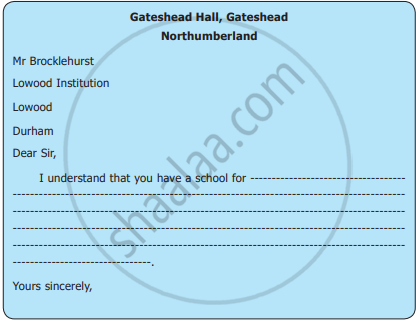
Read the informal letter given below.
|
Sender’s address: 15, Beach Road Salutation: Dear Rosy, Body of the letter: How are you? I am fine. I couldn’t write earlier, because I was very busy. I like my new home. It is a lovely house. I have a big bedroom looking over the garden. I helped Mummy paint the bedroom walls yesterday. We chose a pretty yellow. A boy called Sundar lives next door. He likes animals not just like we do but even more. He says he is going to be a Vet when he grows up. I am still thinking about being a writer. Do you want me to send the story I am writing. It is all about Ooty – the Queen of Hill Stations. Write soon. I am looking forward to hear all your news. Subscription: Yours lovingly Signature: Mangai |
Now write a reply to Mangai.
| Sender’s Address | |
| Date | |
| Salutation | |
| Body of the letter | |
| Subscription | |
| Signature |
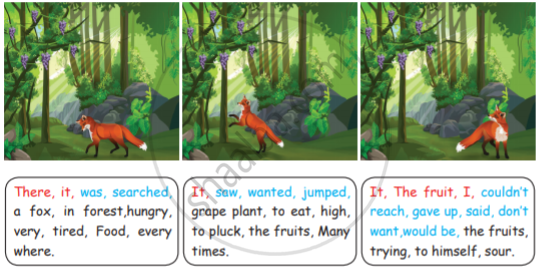
Write the hungry fox story on your own by looking at the pictures and using the clues given under each picture.
Some word have similar sound, but different meaning. Choose the correct word from the options and fill in the blank.
Do you ______ a secret?
The ______of robbers escaped.
Animals are capable of empathy. Substantiate this statement with examples from the story as well as your own experiences.
Describe the photographer.
Why did William and the other children bully Margot?
Write a paragraph on ‘Online Shopping’ using the points in the below table.
| Advantages | Disadvantages | ||
| 1. | Time-saving | 1. | Delay in delivery |
| 2. | Variety of products | 2. | Products are not always genuine. |
| 3. | Easy to Pay | 3. | Prone to scams |
| 4. | Easy to order | 4. | At times, it is challenging to return. |
| 5. | Good discounts | 5. | Cannot see or touch the product before purchase. |
Translate the following sentence into your mother tongue.
The second question to ask is - is it pleasant?
What might success mean to the following people? Think about it and write.
A doctor
