Advertisements
Advertisements
Question
There are many legends about the ‘nine gems’ in Akbar’s Court. These are popular tales and they may not have a historical basis. Can you name some of the nine gems and the stories associated with them?
Advertisements
Solution
Akbar was an ardent admirer of art and learning. His court was full of many scholars and talented artists. The Nine most learned men in his court were known as Navratnas.
- Abul Fazal
- Faizi Miyan
- Tansen
- Raja Birbal
- Raja Todar Mal
- Raja Man Singh
- Abdul Rahim.Khan-I-Khana
- Fakir Aziao-Din
- Mirza Aziz Koka
| Abul Fazal: | Abul Faz! was the chronicler of Akbamama in three volumes over seven years, the third volume is known as the Ain-i-Akbari. |
| Faizi: | Faizi was Abul Faz!' s brother, the poet laureate of Akbar. The name of the father of Abul Fazal and Faizi was Mubarak Nagori, a scholar in· the philosophy and literature of Greece as well as in Islamic theology. |
| Miyan Tansen: | Miyan Tansen was born as Tanna Mishra, in 1520. He was a disciple of Swami Haridas and later became a disciple of Hazrat Muhammad Ghaus (Gwalior). He was a court musician with the prince of Mewar and later was recruited by Akbar as his court musician. |
| Raja Birbal: | Raja Birbal, a poor Hindu Brahrnin Maheshdas was appointed to the court of Akbar for his intelligence and became the court jester. The name Raja Birbal was given by the Emperor. Birbal's duties in Akbar's court were mostly military and administrative. He was also a poet and his collections under the pen name "Brahma" are preserved in Bharatpur Museum. Raja Birbal died in battle, in an attempt to subdue unrest amongst Afghani tribes in Northwest India. |
| Raja Todar Mal: | Raja Todar Mal, a Hindu Khatri was Akbar's finance minister, who from 1560 onwards overhauled the revenue system in the kingdom. |
| Raja Man Singh: | Raja Man Singh, the prince of Amber was a trusted general in Akbar's army and was the grandson of Akbar's father-in-law Bharmal. Raja Man Singh was the foremost (7000 Mansabdari) and ablest among Akbar's military commanders and assisted Akbar in many fronts including holding off advancing Hakim (Akbar's half-brother) in Lahore. He was also the Mughal viceroy of Afghanistan, led campaigns in Bihar, Orissa, Deccan, and was also the viceroy of Bengal. |
| Abdul Rahim Khan-I-Khana: | Abdul Rahim KhanI-Khana, son of Akbar's trusted general and tutor. Best known for his Hindi couplets. |
| Fakir Aziao-Din: | Fakir Aziao-Din was a Sufi mystic and an advisor. |
| Mirza Aziz Koka: | Mirza Aziz Koka aka. Khan-i-Azam or Kotaltash was one of the leading nobles and also the foster brother of Akbar. He also served as a Subedar of Gujarat. |
APPEARS IN
RELATED QUESTIONS
Explain:
‘Some are aglow with the bloom that cleaves
To the limpid glory of new born leaves.’
What is the rhyme of ‘The Patriot: An Old Story’?
Why is the old man at the bridge?
Discuss how the author uses comic irony to describe the incident surrounding the statue?
You have recently moved to a new neighborhood in your city. Describe the new neighbourhood, comparing it to the one you have just left.
Read the following passage carefully and answer the questions that follow:
Lying in bed, Swami realized with a shudder that it was Monday morning. It looked as though only a moment ago, it had been the last period on Friday; already, Monday was here. He hoped that an earthquake would reduce the school building to dust but that my good building, Albert Mission School, had withstood similar prayers for over a hundred years now.
At nine o'clock, Swaminathan wailed, “I have a headache.”
His mother said, “Why don’t you go to school in a bullock cart?”
“So that I may be completely dead at the other end? Have you any idea what it means to be jolted in a cart?”
“Have you any important lessons today?”
“Important! Bah! That geography teacher has been teaching the same lesson for over a year now. And we have arithmetic, which means for a whole period we are going to be beaten by the teacher............ Important lessons!”
And Mother generously suggested that Swami might stay at home.
At 9:30, when he ought to have been lining up in the school prayer hall, Swami was lying on the bench in Mother’s room.
Father asked him, “Have you no school today?”
“Headache,” Swami replied,
“Nonsense! Dress up and go.”
“Headache.”
“Loaf about less on Sundays, and you will be without a headache on Monday.”
Swami knew how stubborn his father could be and changed his tactics.
“I can’t go so late to class.”
“I agree, but you’ll have to; it is your own fault. You should have asked me before deciding to stay away.”
“What will the teacher think if I go so late?”
“Tell him you had a headache, and so are late.”
“He will beat me if I say so.”
“Will he? Let us see. What is his name?”
“Mr. Samuel.”
“Does he beat the boys?”
“He is very violent, especially with boys who come late. Some days ago, a boy was made to stay on his knees for a whole period in a corner of the class because he came late, and after getting six cuts from the cane and having his ears twisted, I wouldn’t like to go late to Mr Samuel’s class.”
“If he is so violent, why not tell your headmaster about it?”
“They say that even the headmaster is afraid of him. He is such a violent man.”
And then Swami gave a lurid account of Samuel’s violence; how when he started caning, he would not stop till he saw blood on the boy’s hand, which he made the boy press to his forehead like a Vermillion marking. Swami hoped his father would be made to see that he couldn’t go to his class late. But his father’s behaviour took an unexpected turn. He became excited.
“What do these people mean by beating our children? They must be driven out of service. I will see…..”
The result was that he proposed to send Swami late to his class as a kind of challenge. He was also going to send a letter with Swami to the headmaster. No amount of protest from Swami was of any avail: Swami had to go to school.
By the time he was ready, his father had composed a long letter to the headmaster, put it in an envelope, and sealed it.
“What have you written, father?” Swaminathan asked apprehensively.
“Nothing for you. Give it to your headmaster and go to your class.”
Swami’s father did not know the truth—that, actually, Mr. Samuel was a very kind gentleman.
(a) Give the meaning of each of the following words as used in the passage. (3)
One-word answers or short phrases will be accepted.
- jolted
- stubborn
- avail
(b) Answer the following questions briefly in your own words:
- What did Swami wish for on a Monday morning? Why was his wish unlikely to be answered? (2)
- Which sentence tells us that Swami’s father was completely unsympathetic to his son’s headache? (2)
- In what way was Swami’s mother’s response different from his father’s? (2)
- Why did Swami give a colourful account of Mr. Samuel to his father? (2)
- In what way did Father’s behaviour take an unexpected turn? (2)
- What was Swami finally ordered to do by his father? (2)
(c)
(i) In not more than 60 words, describe how Swami tries to prove that Mr. Samuel is a violent man. (8)
(ii) Give a title to your summary in 3
(c). Give a reason to justify your choice. (2)
Re-write the following sentences according to the instructions given after each. Make other changes that may be necessary, but do not change the meaning of each sentence.
- As soon as we lit the candle, the power supply was restored.
(Begin: No sooner………. ) - The bee is more industrious than all other creatures.
(Use: ‘most industrious’) - The old woman was too slow to catch the bus.
(Begin : The old woman was so……… ) - “I’ll do it tomorrow,” he promised.
(Rewrite in indirect speech) - Though Reema got an expensive gift she was not happy.
(Begin: In spite of……… ) - I prefer reading a book to watching a movie.
(Begin: I would rather…….. ) - I have never seen Mr. Roy lose his temper.
(Begin: Never…….. ) - She found your keys in the garage.
(Begin: The keys……… )
Distinguish between the following pairs of sentences.
The team played two matches successively.
Prepare a set of 10-12 questions that you would ask at an interview of a person who has strongly acted against social injustice and has achieved success inspite of a long struggle against so many odds in his/her life. Write them down in your notebook.
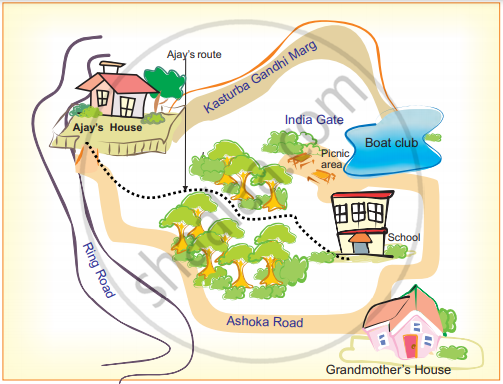
Use the above map to answer the questions.
- What does the dotted line on the map show?
- What road would Ajay take to get to the boat club?
- What building is next to the picnic area?
- What road passes by Ajay’s house?
- What other way could Ajay use to get from his house to his grandmother’s house?
Now write:
Use verbs like go, turn, cross
Use prepositions like: across, between, in front of, beside, near, behind, and write how you get home from school.
