Advertisements
Advertisements
प्रश्न
Can you think of any events in your own or someone else’s life to support the quote-
‘If you tell the truth, you don’t have to remember anything.’
What is likely to happen if you don’t tell the truth?’
Advertisements
उत्तर
Yes, I remember an incident that supports the saying, 'If you tell the truth, you don't have to remember anything.'
My friend Sameer once skipped a day of work, claiming to be sick, only to be caught on live television at a sporting event. Sameer's faked illness required a series of lies to cover up, resulting in constant anxiety and a complicated story to maintain, especially around attentive coworkers. Finally, Sameer's reputation and trust among coworkers suffered due to his dishonesty. This true story mirrors the statement, 'If you tell the truth, you don't have to remember anything' by showing how dishonesty complicates life.
APPEARS IN
संबंधित प्रश्न
Do you agree with his justification of the war? Why/ why not?
Comment on the contrasted viewpoints in the poem.
What docs the line “and his shadow shouts on a nightmare scream” mean?
The caged bird sings with
A fearful trill of things unknown
But longed for still and his
Tune is heard on the distant hill
For the caged bird sings of freedom.
Read the above lines and answer the question that follow.
Explain, ‘stands on the grave of dreams / his shadow shouts on a nightmare scream’.
Anderson through the story a Little Match Girl gives an idea about the Victorian society of his times?
We are not allowed to play in the sun. We are not allowed to play in the rain.
You walk home from school one afternoon to find the door unlocked and on entering you are shocked to see the house in total disarray. You call out but get no answer. Describe in detail what you saw, the reason behind your house being in total disarray and how you found your family. Mention also how the experience ended and what impact it had on your life.
In what ways do you think we could help prevent the extinction of languages and dialects?
There are two voices in the poem. Who do they belong to? Which lines indicate this?
What according to the poem is involved in the process of growing up?
Comment on the relationship shared by Mammachi and Pappachi.
How is Satyajit's financial crash introduced to the reader?
You might have learned about organic farming. Make groups and discuss the difference between conventional farming and organic farming and write it down.
| Sr.No. | Conventional Farming | Organic Farming |
| 1. | ||
| 2. | ||
| 3. |
Prompt reporting is of strategic importance during a war. Refer to the above extract and explain.
Note down ways in which you can make your life less ordinary in terms of nurturing relationships.
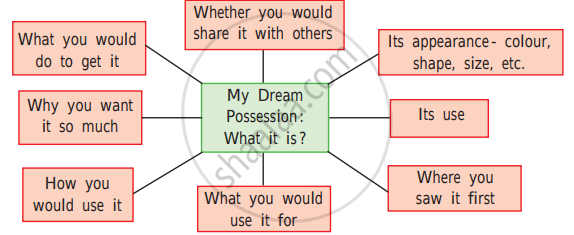
Is there something that you would like to own more than anything else? Describe your dream possession with the help of the following points. You may add your own points, too.
Write what you think about the following thoughts and actions of Mathilde :
Mathilde wrote a note to her friend as dictated by her husband.
Can you think of a parallel scene of dawn or evening when everything is steeped in golden light?
‘Invictus’ is an example of Traditional Poetry. ‘Please Listen’ is an example of Free Verse.
Prepare a ‘tourism leaflet’ on the following.
Your Home Town
Among your classmates, one is unable to walk properly, the second one can’t hear properly and the third one can’t see this beautiful world. All of them are facing lots of difficulties in life. Compose a dialogue among them, about the problems and difficulties faced by them. You can take help of the following dialogue to expand your ideas.
| Student 1: | Do you know, how many problems I have to face when I decide to go anywhere? |
| Student 2: | I can’t hear anything. |
| Student 3: | So, sad! You both can’t walk or hear but my problem is more serious than yours. You know, I can’t see this beautiful world. |
(Now continue in your notebook.)
Use the option to fill in the blank.
The cows ______ grazing in the field.
Describe the author’s grandmother.
What used to be there in the place of that shop twenty years ago?
Write conversation on the following situation.
Between two friends on the benefits of early rising
What angered the author?
How would Miss Meadows usually treat Mary? How did her behavior towards the girl change that day?
What might success mean to the following people? Think about it and write.
A businessman
What makes you laugh?
Imagine someone has invited your family to a program, and you were the only person at home when the invitation was given orally.
Write a note (4–5 lines) to pass on the message to the other people in your family. Or, write an imaginary conversation in which you pass on the message to your parents.
